

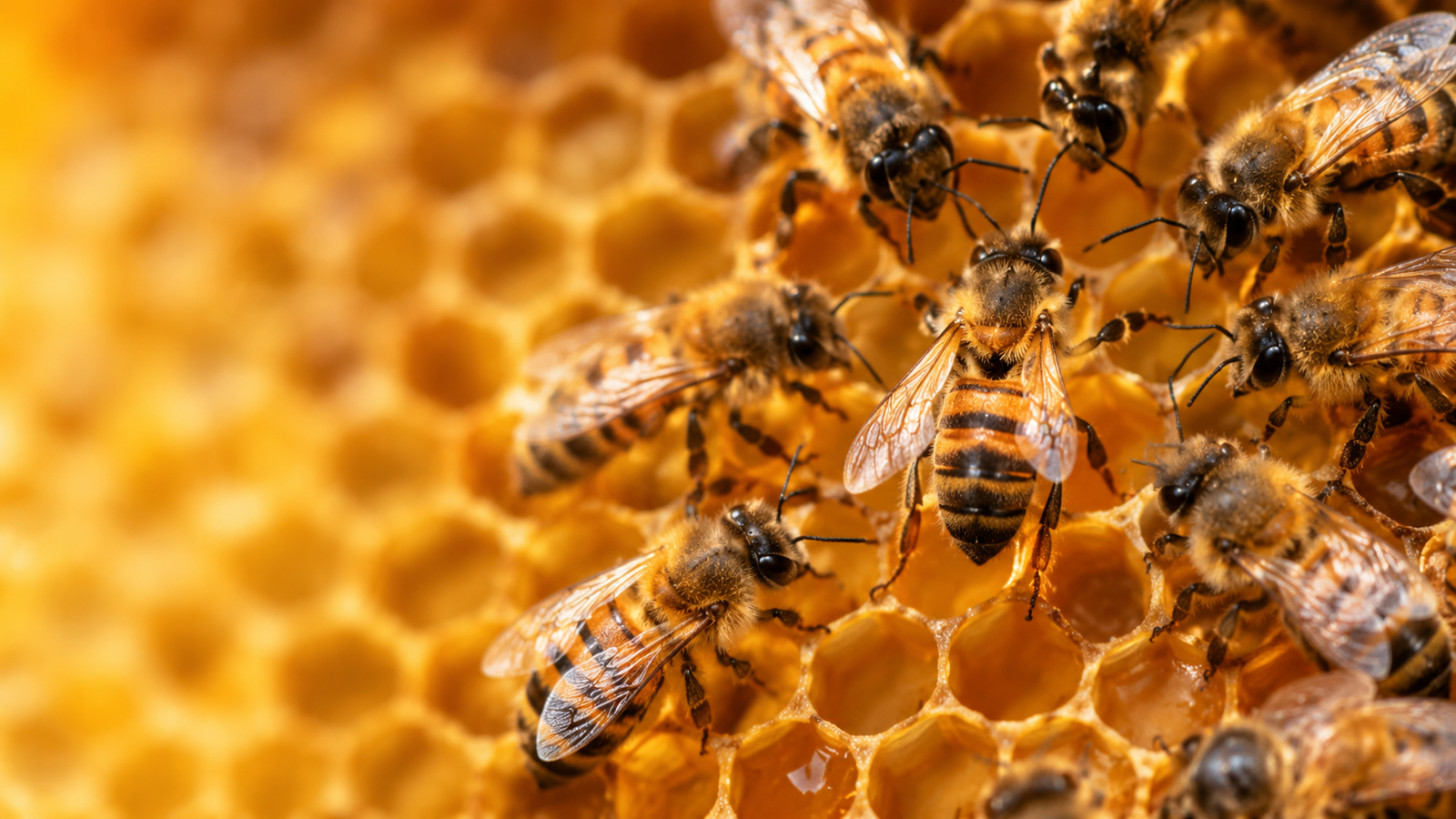
Bees may not communicate with words, but they have a surprisingly sophisticated system for sharing information. They use dances, pheromones, touch, antennae, vibrations, sounds, body movements, and food exchange to coordinate activities within and around the colony.
So, how do bees communicate?
Honey bees are especially famous for the waggle dance, which allows a forager to communicate information about the direction and approximate distance of a food source. Bees also use chemical signals called pheromones to coordinate colony activities, respond to danger, recognize their queen, and influence the behavior of other bees.
Communication is essential because a honey bee colony can contain thousands of individuals that must work together to find food, care for young, defend the nest, regulate temperature, and reproduce.
Quick Answer: How Do Bees Communicate?
Bees communicate using several types of signals, including:
- Waggle dances to communicate the location of distant food sources
- Round dances to indicate nearby food
- Pheromones to influence colony behavior
- Antennae and touch to exchange information
- Sounds and vibrations to signal other bees
- Body movements to communicate behavioral information
- Food exchange to transfer nutrients and chemical information
- Queen pheromones to help organize the colony
- Alarm pheromones to warn other bees about threats
Different bee species use different communication methods. Honey bees have some of the most complex social communication systems because they live in large colonies.
How Do Honey Bees Communicate?
Honey bees communicate through a combination of movement and chemical signals, along with touch, vibration, sound, and food exchange.
Their communication system is not equivalent to human language. Instead, different signals convey specific types of information that help the colony respond to its environment.
For example, a honey bee that discovers a productive patch of flowers can return to the hive and perform a dance that helps other workers locate the resource.
Another bee detecting a threat can release an alarm pheromone that changes the behavior of nearby workers.
The queen produces chemical signals that influence the social organization of the colony.
These different communication systems work together to keep the colony functioning.
1. Bees Communicate Through the Waggle Dance
The waggle dance is probably the most famous example of bee communication.
When a honey bee discovers a valuable food source that is relatively far from the hive, it can return to the colony and perform a distinctive dance on the honeycomb.
The bee moves in a pattern that resembles a figure eight. During the central portion of the dance, known as the waggle run, it moves forward while rapidly vibrating its body.
The dance provides other worker bees with information about the food source.
Two particularly important pieces of information are:
- Direction
- Distance
The dancing bee can therefore recruit other foragers to investigate the resource.
2. How Does the Waggle Dance Communicate Direction?
The direction of the waggle run provides information about the direction of the food source relative to the sun.
Inside the hive, the dancing bee uses the vertical orientation of the honeycomb as a reference.
The angle of the waggle run relative to vertical corresponds to the direction the food source lies relative to the sun.
For example, a particular angle to one side of vertical represents a corresponding angle away from the sun’s position.
Because the sun appears to move across the sky during the day, bees have to account for its changing position when navigating.
This allows a forager’s dance to communicate directional information even though the dance takes place inside the relatively dark hive.
3. How Does the Waggle Dance Communicate Distance?
The duration of the waggle run provides information related to the distance between the hive and the food source.
Generally, a longer waggle run indicates a more distant resource.
The relationship is not a simple measurement like a ruler. Factors such as terrain, wind, and the difficulty of the flight can affect how bees interpret distance.
Nevertheless, the dance gives other workers useful information about how far they may need to travel.
4. What Is the Round Dance?
Honey bees also use a behavior known as the round dance.
This behavior is associated with food sources that are relatively close to the colony.
The bee moves in a circular pattern, changes direction, and repeats the movement.
Unlike the waggle dance, the round dance does not provide the same precise directional information about a distant resource.
Instead, it can signal that a food source is nearby and encourage other workers to search in the surrounding area.
The distinction between round and waggle dances is not an absolute distance rule. The behavior can vary depending on the circumstances and the colony.
5. Bees Communicate Using Pheromones
Dance is only one part of bee communication.
Bees also rely heavily on pheromones.
Pheromones are chemical substances produced by bees that influence the behavior of other members of the same species.
Because bees live together in enclosed colonies, chemical communication is extremely useful.
Different pheromones can trigger or influence different behaviors.
Some chemical signals are associated with the queen, while others are involved in defense, brood care, reproduction, or colony organization.
6. How Does the Queen Communicate With Worker Bees?
The queen does not give instructions to workers through speech.
Instead, she produces chemical signals commonly referred to as queen pheromones.
These signals help communicate the queen’s presence and influence the behavior and social organization of worker bees.
Workers interact with the queen and distribute her chemical signals throughout the colony.
Queen pheromones can influence worker behavior and reproductive processes and help maintain the colony’s social structure.
The queen also produces chemical information associated with reproductive activity, which helps workers respond to the needs of the colony.
7. How Do Bees Communicate Danger?
Bees can communicate danger using alarm pheromones and other behavioral signals.
When a worker detects a threat, it can release chemical signals that alert nearby bees.
A bee that stings a potential threat can also leave alarm-related chemical cues near the sting site.
Other workers may detect these chemicals and become more defensive.
This can cause a rapid collective response, with additional bees moving toward the perceived threat.
That is one reason disturbing a colony can cause multiple bees to become defensive.
8. Bees Communicate Through Touch and Their Antennae
Physical contact is another important part of bee communication.
Bees frequently touch one another with their antennae.
Their antennae contain sensory receptors that allow bees to detect chemical and physical information in their environment.
Antennal contact can help bees interact with nestmates and exchange information at close range.
Touch is especially useful inside the hive, where visibility can be limited.
Bees can also detect vibrations through sensory structures on their bodies, allowing them to respond to movements and signals transmitted through the hive.
9. Bees Communicate by Sharing Food
Honey bees can exchange food directly with one another.
A forager returning to the hive can transfer nectar to another worker through a process called trophallaxis.
This is more than simply feeding another bee.
Food exchange allows bees to transfer nutritional and chemical information and plays an important role in the social organization of the colony.
For example, nectar collected from flowers can be passed between workers as it is processed and eventually stored as honey.
Through these repeated interactions, information and resources move throughout the colony.
10. Bees Communicate Through Sounds and Vibrations
Bees also produce and detect sounds and vibrations.
Honey bees can generate vibrations through movements of their bodies and wings. Vibrations can travel through the honeycomb and be detected by other bees.
Some vibrational signals can influence the behavior of nearby workers.
Bees also produce buzzing sounds during flight and defensive situations.
However, a bee’s buzz should not be treated as a single universal message. The meaning of a sound depends on the circumstances and the other signals being produced.
11. Do Bees Use Body Language?
Yes, in a broad sense.
Bees use movement, posture, wing movements, and other physical behaviors to influence or communicate with other bees.
The waggle dance is the clearest example.
Other movements can occur during defensive behavior, interactions between workers, feeding, and other activities.
Bee communication therefore combines movement, chemistry, touch, and vibration rather than relying on one communication method.
12. How Do Bees Find Flowers?
Communication begins before a bee returns to the hive.
A honey bee first has to locate useful flowers.
Honey bees have sophisticated visual systems that help them identify flowers. They can see colors differently from humans and can detect ultraviolet wavelengths that humans cannot see.
Some flowers have ultraviolet patterns that act as visual guides toward areas containing nectar or pollen.
Once a bee finds a productive food source, it can collect nectar or pollen and return to the colony.
The information gathered during that trip can then be communicated to other workers through behavior such as the waggle dance.
13. How Do Bees Tell Other Bees Where Flowers Are?
A successful forager can communicate information about flowers in several ways.
For a distant food source, the most important mechanism in honey bees is the waggle dance.
The dancer communicates:
- The approximate direction of the food
- The approximate distance
- Information associated with the quality or profitability of the resource
Other bees observe the dance and may then leave the hive to search for the food source.
When several foragers successfully recruit additional workers to the same resource, the colony can rapidly increase the number of bees collecting nectar and pollen there.
This is an efficient way for the colony to exploit temporary food resources.
14. How Do Bees Communicate About Food Quality?
Bees do not simply communicate that food exists.
Their behavior can also provide information related to the value of a food source.
A particularly profitable resource can stimulate stronger recruitment behavior.
The amount of effort a bee puts into its dance can vary according to the quality and circumstances of the resource.
Other factors, including odor and food exchange, can also provide information.
As a result, the colony can adjust its foraging effort according to changing conditions.
15. How Do Bees Communicate During Swarming?
Communication becomes especially important when a honey bee colony prepares to swarm.
Swarming occurs when part of a colony leaves with a queen to establish a new colony.
Worker bees scout potential nesting locations and return with information about possible sites.
Scout bees can communicate information about potential locations through behavior and interactions with other scouts.
Over time, the colony’s scouts converge on a suitable location.
This is an example of collective decision-making rather than one bee simply commanding the rest of the colony.
The final movement of the swarm results from many bees responding to information gathered and communicated by the colony.
16. Do Bees Communicate Inside a Dark Hive?
Yes.
A honey bee colony can communicate effectively even though much of the inside of a hive is dark.
Bees do not depend entirely on vision.
They use:
- Antennal contact
- Chemical signals
- Touch
- Vibrations
- Sounds
- Food exchange
- Dance movements that can be detected through physical and sensory cues
This combination allows bees to exchange information in conditions where visual communication alone would not be sufficient.
17. How Do Worker Bees Communicate With Developing Bees?
Developing bees, called brood, are an important part of colony communication.
Brood produce chemical signals that can influence worker behavior.
These signals can help regulate activities such as feeding and caring for developing bees.
Workers also use direct physical contact and food exchange while caring for brood.
This creates communication between the colony’s developing members and adult workers.
18. Do Drones Communicate With Other Bees?
Drone bees are male honey bees whose primary biological role is reproduction.
They do not perform the same range of colony tasks as worker bees.
Drones interact with workers and the queen and participate in behaviors associated with mating.
Their presence and behavior are also influenced by the colony’s chemical and social environment.
Communication in a honey bee colony therefore involves all three adult forms: queen, workers, and drones, although their roles are different.
19. Do All Bees Communicate the Same Way?
No.
This is an important distinction.
Honey bees are highly social insects that live in colonies, so they have evolved complex communication systems for coordinating thousands of individuals.
Other bees have very different lifestyles.
Bumblebees
Bumblebees live in colonies but generally do not use the honey bee waggle dance to communicate the exact location of a food source.
They can use chemical and behavioral signals and may recruit other workers to productive resources in different ways.
Solitary Bees
Many bee species are solitary.
A solitary bee does not maintain a large permanent colony of workers like a honey bee colony.
Consequently, it does not need the same complex system for coordinating thousands of nestmates.
Solitary bees still communicate through chemical signals, vibrations, sounds, physical interactions, and behaviors associated with reproduction and nesting.
The way a bee communicates is therefore closely connected to its lifestyle.
20. Do Bees Have a Language?
Bee communication is sometimes called a language, particularly when discussing the waggle dance.
The comparison makes sense because the dance conveys information that another bee can use.
However, bee communication is not the same as human language.
Human language can express abstract ideas, describe distant events, create complex narratives, and communicate an enormous range of concepts.
Bee communication is more specialized.
Different bee signals are adapted to particular biological needs, such as:
- Finding food
- Warning about danger
- Maintaining colony organization
- Caring for brood
- Reproduction
- Defending the nest
- Finding a new nesting location
It is therefore more accurate to describe bee communication as a complex communication system rather than a human-like language.
21. Can Bees Recognize Each Other?
Yes, honey bees can distinguish members of their colony from unfamiliar bees.
Chemical odors are particularly important.
Bees living in the same colony share a colony-specific chemical profile, which helps workers identify nestmates.
Antennal contact allows bees to detect chemical information at close range.
This recognition system is important because colonies need to distinguish their own members from potential intruders.
22. How Do Bees Communicate With Humans?
Bees do not intentionally communicate with humans in the same way they communicate with other bees.
However, their behavior provides information that humans can observe.
For example, changes in buzzing, defensive behavior, flight patterns, and activity around the hive can provide clues about what is happening in a colony.
A beekeeper may observe how bees behave during a hive inspection and use those behavioral cues alongside other signs to understand the colony.
However, a loud or intense buzz should not be treated as a precise “sentence.” Bee sounds have to be interpreted in context.
23. Why Is Communication Important to Bees?
Communication is essential to the survival and organization of social bee colonies.
A honey bee colony may contain thousands of individuals performing different jobs.
Workers may be involved in:
- Foraging
- Feeding brood
- Caring for the queen
- Cleaning the hive
- Producing and maintaining comb
- Processing nectar
- Guarding the entrance
- Collecting water
- Collecting resin
- Regulating hive temperature
These activities have to be coordinated.
Communication allows bees to respond to changing food supplies, threats, colony needs, weather conditions, and reproductive events.
In this way, communication helps the colony behave like a coordinated social system.
How Bee Communication Works: A Simple Example
Imagine a honey bee discovers a large patch of nectar-rich flowers.
The process might look like this:
1. The bee finds the flowers.
It uses its senses, including vision and smell, to locate and evaluate the resource.
2. The bee collects nectar or pollen.
It returns to the colony with the food.
3. The bee interacts with other workers.
It may exchange food and chemical information.
4. The bee performs a waggle dance.
The dance communicates information about the direction and distance of the resource.
5. Other workers observe the behavior.
They gather information from the dancer and other interactions.
6. Additional bees leave the hive.
They search for the indicated food source.
7. The colony increases foraging activity.
If the resource remains profitable, more workers may continue visiting it.
This simple example shows why bee communication is so important: information discovered by one bee can influence the behavior of many others.
Frequently Asked Questions About How Bees Communicate
How do bees communicate with each other?
Bees communicate using dances, pheromones, touch, antennae, sounds, vibrations, body movements, and food exchange. Different signals convey different types of information.
What is the waggle dance?
The waggle dance is a communication behavior used by honey bees to provide information about a food source. The direction and duration of the waggle run help communicate where the resource is located.
What does the waggle dance tell bees?
The waggle dance can communicate the direction and approximate distance of a food source relative to the colony.
What is the round dance?
The round dance is a honey bee behavior associated with relatively nearby food sources. It can signal that useful food is available close to the hive without providing the same precise directional information as the waggle dance.
How do bees communicate danger?
Bees can release alarm pheromones when they detect a threat. These chemical signals can cause nearby workers to become more alert and defensive.
Do bees communicate through smell?
Yes. Chemical signals and pheromones are an important part of bee communication. Bees use chemical information for colony organization, defense, reproduction, recognition, and other behaviors.
Do bees communicate through touch?
Yes. Bees frequently use their antennae and physical contact to interact with one another and detect chemical and physical information.
Can bees communicate without dancing?
Yes. Dancing is only one communication method. Bees also use pheromones, touch, vibrations, sounds, body movements, and food exchange.
Do all bees use the waggle dance?
No. The waggle dance is particularly associated with honey bees. Other bee species have different lifestyles and communication systems.
Do bees have a language?
Bees have a sophisticated communication system, but it is not equivalent to human language. Their signals are specialized for tasks such as finding food, defending the colony, reproduction, and maintaining social organization.
How do bees tell other bees where flowers are?
Honey bees can use the waggle dance to communicate the direction and approximate distance of a distant food source. Chemical and food-related information can also contribute to communication about resources.
How does the queen communicate with worker bees?
The queen produces chemical signals known as queen pheromones. These signals influence worker behavior and help maintain the social organization of the colony.
How do bees communicate inside a dark hive?
Bees rely on multiple senses, including chemical signals, touch, antennae, vibrations, sounds, food exchange, and movement. They do not need normal human-like vision to communicate inside the hive.
Final Answer: How Do Bees Communicate?
Bees communicate using a combination of dances, pheromones, touch, antennae, sounds, vibrations, body movements, and food exchange.
Honey bees are particularly famous for the waggle dance, which allows a forager to communicate information about the direction and approximate distance of a food source. They also use chemical signals such as queen and alarm pheromones to organize colony life, respond to danger, and influence the behavior of other bees.
Communication does not stop at dancing. Bees also exchange information through physical contact, food sharing, odors, vibrations, and other behaviors.
Different species communicate differently depending on how they live. Honey bees require sophisticated communication because thousands of individuals work together in a colony, while many solitary bees have much simpler social lives.
Ultimately, bee communication allows individual insects to share information and coordinate activities that help the colony find food, defend itself, care for young, reproduce, and survive.
