

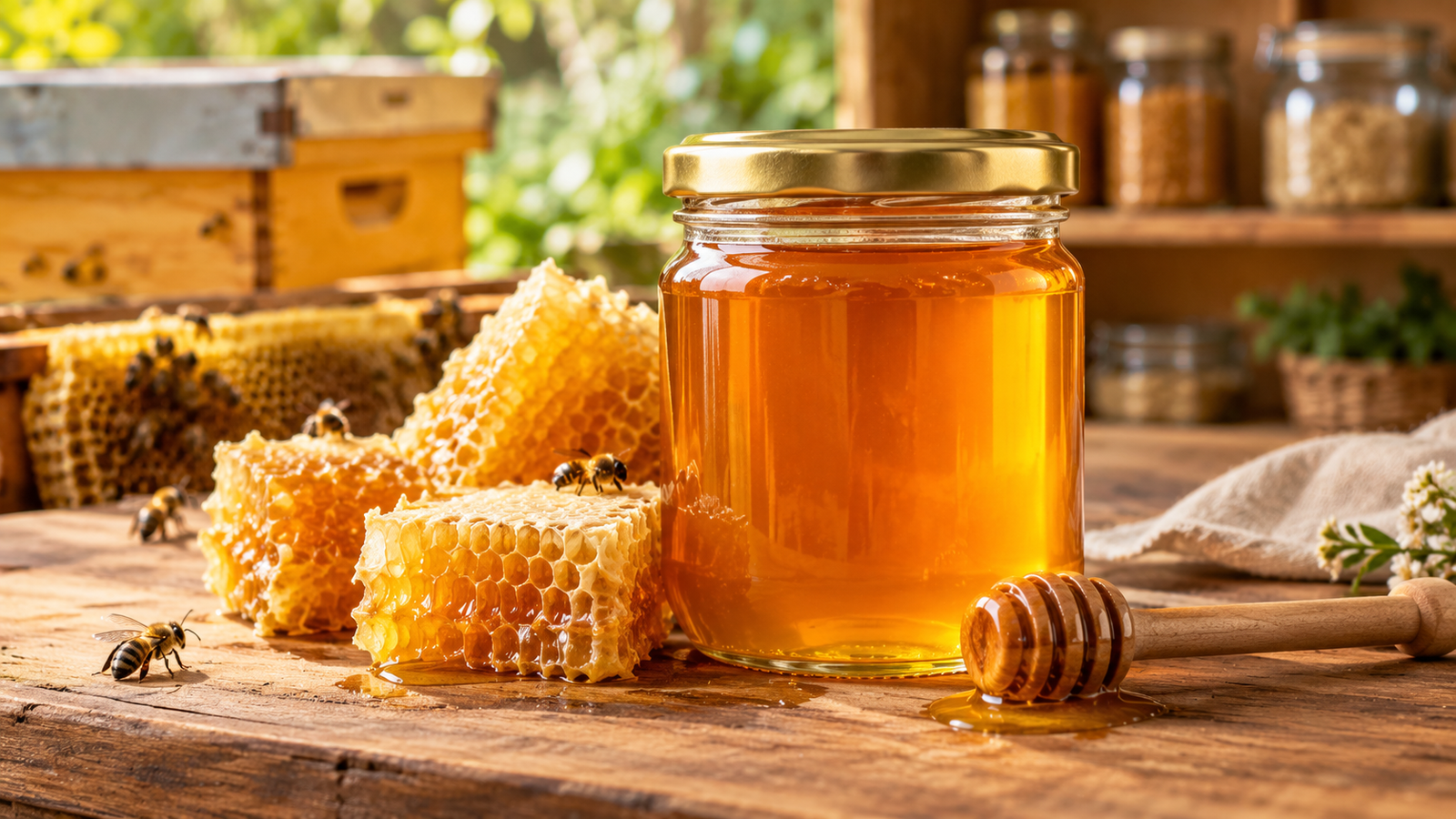
Why bee produce honey? Bees produce honey mainly to store food for their colonies. Honey provides a concentrated source of carbohydrates that honey bees use for energy, daily activities and survival when fresh nectar becomes scarce. Worker bees collect sugary nectar from flowers, add enzymes, remove excess moisture and store the finished honey in wax honeycomb cells for later consumption.
Honey production is therefore a food-storage strategy that helps a colony survive changing seasons, unfavorable weather and periods when flowering plants provide insufficient nectar. Although humans harvest honey for food, honey bees make it primarily to feed themselves and support the needs of their colony.
In this guide, you will discover why bees produce honey, how nectar becomes honey, what bees use it for, why different bee species store food differently and what happens when a colony does not have enough food.
Why Bee Produce Honey?
The main reason bees produce honey is to create a dependable food reserve. Flowers do not provide nectar continuously throughout the year. Their availability changes with rainfall, temperature, flowering cycles and environmental conditions.
Honey bees take advantage of periods when flowers produce abundant nectar. They collect the sugary liquid, process it inside their hive and store it in honeycomb cells. When fresh nectar becomes difficult to find, the colony can consume these stored reserves.
There are several important reasons this food-storage strategy is essential.
1. Bees Produce Honey to Store Food for Later
Honey bees do not consume all the nectar they collect immediately. Instead, they convert much of it into honey, which can be stored and used when the colony needs additional food.
This is particularly important because a honey bee colony contains thousands of individuals with continuous energy requirements. Worker bees must maintain the nest, feed developing young, regulate the hive environment and perform other essential activities.
For example, imagine a colony living in an area where flowering plants are abundant during the rainy season but become scarce during a prolonged dry period. During the flowering season, worker bees can collect substantial amounts of nectar and build up their honey reserves.
When fewer flowers are available, the colony can use this stored honey rather than depending entirely on fresh nectar.
This ability to collect food when it is abundant and preserve it for later gives honey bees an important survival advantage.
2. Bees Produce Honey for Energy
Honey is rich in carbohydrates, particularly glucose and fructose. These simple sugars provide an accessible energy source for honey bees.
Worker bees need energy for activities such as:
- Flying between the hive and flowering plants.
- Collecting nectar and pollen.
- Producing beeswax and constructing honeycomb.
- Cleaning and maintaining the nest.
- Guarding the colony.
- Ventilating the hive.
- Caring for developing bees.
A forager that flies considerable distances to find flowers uses energy throughout the journey. After returning to the hive, the carbohydrates obtained from food help replenish the energy needed for further activity.
Honey is not a complete food, however. Bees also require protein, fats, vitamins, minerals and water. This is why pollen and other nutritional resources are essential to colony health.
3. Bees Store Honey to Survive Winter and Other Food Shortages
In temperate regions, winter can create a serious food shortage for honey bee colonies.
Many flowering plants stop producing nectar, and cold temperatures make it difficult or impossible for bees to forage regularly.
Unlike many insects that become inactive or die during winter, honey bee colonies remain alive inside their nests. Workers gather into a cluster around the queen and generate heat through contractions of their flight muscles.
This process requires considerable energy, which comes largely from consuming stored honey.
Honey reserves are also important outside cold climates.
In tropical and subtropical regions, bees may experience prolonged dry seasons, irregular rainfall or periods when relatively few plants are flowering.
For example, a colony in Ghana may experience changes in nectar availability between wetter flowering periods and drier months. Stored food helps the colony cope with these interruptions, although the severity and timing of shortages depend on local vegetation and rainfall patterns.
Therefore, bees do not make honey exclusively for winter. They make it to survive whenever fresh food becomes insufficient.
4. Honey Supports the Daily Activities of the Colony
A honey bee colony operates as a coordinated community. Different workers perform different tasks, but all depend on adequate nutrition.
Honey supplies carbohydrates that help power these activities.
For example, younger workers may clean cells, feed larvae and attend to the queen. Other workers construct comb, process nectar, ventilate the hive or defend the entrance. Older workers commonly undertake foraging duties.
These activities require energy even when the colony is not collecting large quantities of nectar.
Stored honey helps maintain these essential functions during periods when fresh carbohydrate sources are limited.
A colony with inadequate food reserves may struggle to maintain its population and perform normal activities.
Why Is Honey Better for Long-Term Storage Than Nectar?
One important reason bees convert nectar into honey is that fresh nectar contains considerably more water than mature honey.
Nectar is a watery, sugary liquid produced by flowers. Its sugar concentration varies depending on the plant species, environmental conditions and time of collection.
Fresh nectar may contain approximately 60–80% water, although some sources fall outside this range.
Mature honey commonly contains approximately 17–20% water.
Reducing the moisture content makes the food more concentrated and helps prevent fermentation by many microorganisms.
Honey also has several properties that support its storage:
- High sugar concentration: Creates conditions that limit the growth of many microorganisms.
- Low water availability: Makes it difficult for many bacteria and fungi to grow.
- Acidity: Honey is naturally acidic, which further discourages many microorganisms.
- Protective wax caps: Help keep stored honey enclosed inside the comb.
This does not mean honey is completely immune to spoilage. If it absorbs moisture or is stored under unsuitable conditions, fermentation can occur.
The important difference is that properly ripened honey is much better suited to long-term storage than ordinary fresh nectar.
How Do Bees Make Honey?
Honey production is a coordinated process involving foraging workers and other bees inside the hive.
It is not simply a matter of collecting nectar and leaving it inside a honeycomb. Bees physically and chemically transform the liquid before it becomes mature honey.
Step 1: Worker Bees Collect Nectar From Flowers
Worker honey bees visit flowering plants and use a long, flexible feeding structure called a proboscis to collect nectar.
Nectar is a sugary liquid produced by flowers. It contains water and carbohydrates that bees can use as an energy source.
The collected nectar is temporarily stored in a specialized organ called the crop, commonly known as the honey stomach.
The crop is different from the bee’s main digestive stomach. It allows the bee to transport nectar back to the colony without immediately digesting the entire load.
Some nectar processing begins during collection and transport.
Image placement: Show a worker honey bee collecting nectar from a flower.
Suggested alt text: Worker honey bee collecting sugary nectar from a flower using its proboscis.
Step 2: Bees Begin Changing the Nectar With Enzymes
As nectar travels through the bee’s crop, it comes into contact with enzymes produced by the bee.
One important enzyme is invertase, which breaks down sucrose into simpler sugars, mainly glucose and fructose.
Another enzyme, glucose oxidase, contributes to chemical reactions that produce gluconic acid and hydrogen peroxide under suitable conditions.
These changes help develop the chemical characteristics of honey.
The process is more complicated than simply adding sugar to water. Bee enzymes, nectar composition and moisture removal all contribute to the finished product.
Step 3: Worker Bees Transfer Nectar Inside the Hive
When a forager returns to the colony, it transfers its nectar load to other worker bees.
This transfer can occur through a process called trophallaxis, in which bees exchange liquid food through mouth-to-mouth contact.
Receiver bees may continue processing the nectar before depositing it into honeycomb cells.
This division of labor allows foraging bees to concentrate on collecting resources while other workers participate in processing and storage.
Step 4: Bees Remove Excess Water From Nectar
Fresh nectar contains too much water for efficient long-term storage.
Worker bees spread nectar into honeycomb cells and help increase evaporation by fanning their wings.
The movement of air through the hive helps remove moisture from the exposed nectar.
As water evaporates, the sugar concentration increases and the liquid becomes thicker.
The moisture content of mature honey is commonly around 17–20%, although it varies depending on the nectar source and conditions inside the hive.
This is one of the most important stages of honey production because it helps make the stored food more resistant to fermentation.
Step 5: Bees Seal Mature Honey Inside Honeycomb Cells
Once honey has reached a suitable stage of maturity, worker bees commonly cover the filled cells with thin layers of beeswax.
These coverings are called wax caps.
Capping helps protect the stored food from contamination and excessive exposure to moisture.
The finished honey remains available for the colony to consume when it needs additional energy.
Image placement: Show capped honeycomb cells containing mature honey.
Suggested alt text: Honey bees storing mature honey in sealed wax honeycomb cells.
What Do Bees Use Honey For?
Honey serves several important purposes inside a honey bee colony.
| Purpose | How honey helps |
|---|---|
| Flying | Supplies carbohydrates that fuel flight and foraging. |
| Hive maintenance | Provides energy for cleaning, comb construction and other worker activities. |
| Cold-weather survival | Fuels heat production when bees cluster during cold conditions. |
| Food reserves | Provides nourishment when fresh nectar is unavailable. |
| Brood care | Supplies energy to nurse bees that care for developing larvae. |
| Colony maintenance | Helps support the daily activities of thousands of colony members. |
Honey is especially important because a colony must maintain its activities even when flowers are not producing enough nectar.
Do Bees Make Honey to Feed Their Babies?
Honey helps support the development of young bees, but it is important to understand that honey is not the primary food directly fed to every honey bee larva.
Nurse bees produce glandular secretions commonly called brood food. These secretions provide essential nourishment to developing larvae.
Larval diets change according to age and caste. Queen-destined larvae receive a specialized diet that includes royal jelly throughout their larval development.
Honey and pollen support the adult workers responsible for producing brood food and caring for the young.
Honey therefore contributes to the survival of future generations indirectly by supplying energy to the workers that raise them.
Why Do Bees Need Both Honey and Pollen?
Honey and pollen have different nutritional functions.
Honey is mainly an energy source, while pollen provides much of the protein and other nutrients needed for growth and development.
| Food resource | Main nutritional contribution | Main purpose |
|---|---|---|
| Honey | Carbohydrates, particularly glucose and fructose | Provides energy for daily activities. |
| Pollen | Protein, amino acids, lipids, vitamins and minerals | Supports growth, development and brood rearing. |
| Water | Water | Supports hydration, food processing and temperature regulation. |
For example, worker bees need carbohydrates to power flight, but developing larvae also require protein and other nutrients to grow.
A colony that has plenty of honey but insufficient pollen may still experience nutritional problems.
This is why a healthy bee habitat needs a variety of flowering plants that provide both nectar and pollen.
Why Do Bees Store Honey in Honeycombs?
Honey bees use honeycomb because it provides an organized and efficient structure for storing food.
Worker bees produce beeswax from specialized glands on the underside of their abdomens. They use this wax to construct interconnected hexagonal cells.
These cells serve several functions:
- They provide space for storing honey.
- They allow the colony to organize its food reserves.
- They provide access to stored food when needed.
- They can be sealed with wax after honey matures.
- They also provide cells for raising developing bees.
The hexagonal structure allows bees to build a compact storage system using relatively little wax compared with the amount of material it can contain.
Honeycomb is therefore both a storage structure and an important part of the colony’s organization.
Do All Bees Produce Honey?
No. Not all bee species produce and store honey in the same way.
Honey production and substantial food storage are particularly characteristic of honey bees, but other social bees also store sugary food.
The differences are important because the word “bee” describes a very large group of insects with different nesting behaviors and lifestyles.
1. Honey Bees
Honey bees belong to the genus Apis.
Species such as the Western honey bee (Apis mellifera) are well known for producing and storing substantial quantities of honey.
They build wax honeycombs containing separate cells for brood, pollen and honey.
Their colonies can contain thousands of individuals, and stored honey helps them survive periods when fresh nectar is unavailable.
2. Stingless Bees
Stingless bees belong to the tribe Meliponini.
They are found mainly in tropical and subtropical regions and are particularly interesting because they also produce honey.
Unlike familiar honey bees, many stingless bees store honey in small pots constructed from a wax-and-resin material called cerumen.
These pots are different from the large wax honeycomb cells used by honey bees.
Stingless bee honey can also differ in taste, moisture content and chemical composition depending on the species and environment.
This is especially relevant in tropical regions, where stingless bees are important native pollinators.
3. Bumble Bees
Bumble bees belong to the genus Bombus.
They collect nectar and pollen and maintain food supplies inside their nests.
However, their colonies generally do not produce the large, long-term honey reserves characteristic of honey bee colonies.
Many bumble bee colonies are seasonal. In numerous species, the old colony dies toward the end of the season, while newly produced queens survive and establish colonies the following year.
Their food-storage behavior is therefore different from that of honey bees.
4. Solitary Bees
Most solitary bees do not produce honey for communal long-term storage.
Instead, a female collects pollen and nectar and places these resources inside individual nest cells.
She lays an egg in each provisioned cell, providing food for the developing offspring.
The larva consumes the stored provisions as it grows.
Unlike honey bees, solitary bees generally do not have large colonies with thousands of workers sharing a common honey reserve.
Comparison of Different Bee Groups
| Bee group | Collect nectar? | Produce honey? | Typical food storage |
|---|---|---|---|
| Honey bees (Apis) | Yes | Yes | Wax honeycomb cells. |
| Stingless bees (Meliponini) | Yes | Yes | Small wax-and-resin storage pots. |
| Bumble bees (Bombus) | Yes | Generally no substantial honey production | Small stores of nectar and pollen. |
| Solitary bees | Yes, in many species | Generally no | Nectar and pollen provisions in individual nest cells. |
The main distinction is that honey bees and stingless bees have specialized social food-storage systems, while many other bees use different methods to provide food for themselves or their offspring.
Why Do Bees Sometimes Run Out of Honey?
Although honey bees are excellent food collectors, their colonies do not always have enough honey.
Food shortages can occur when environmental conditions prevent workers from collecting sufficient nectar.
Common causes include:
1. Drought
Prolonged drought can reduce flowering and limit nectar production. Even when plants remain alive, they may produce less nectar under water-stressed conditions.
2. Heavy or prolonged rainfall
Rain can prevent worker bees from flying regularly. It can also affect flowering and nectar availability.
3. Lack of flowering plants
Areas with insufficient flowering vegetation may not provide enough nectar to support a colony.
4. Large colony populations
A large colony contains many individuals consuming stored food. If nectar collection cannot keep up with consumption, honey reserves may decline.
5. Excessive honey harvesting
If beekeepers remove too much honey, colonies may be left without sufficient food for periods when natural resources become scarce.
When food becomes insufficient, bees may reduce brood production, struggle to maintain normal activities and eventually experience starvation.
What Happens When a Honey Bee Colony Has No Honey?
A colony without sufficient carbohydrate reserves faces serious survival challenges.
The effects depend on the colony’s size, remaining food, weather and availability of alternative resources.
Possible consequences include:
- Reduced activity: Worker bees may lack sufficient energy for normal activities.
- Reduced brood production: The colony may have to reduce the resources allocated to raising young.
- Weakened colony condition: Prolonged nutritional stress can affect the colony’s ability to cope with other challenges.
- Starvation: If stored food and fresh nectar are both unavailable for too long, adult bees and eventually the colony can die.
A honey shortage does not automatically mean that every bee will die immediately. Colonies can sometimes use available nectar, other suitable carbohydrate sources or supplementary feed provided by a beekeeper.
However, prolonged food shortages can be devastating.
Do Bees Make Honey for Humans?
No. Honey bees do not make honey specifically for humans.
They produce it primarily to feed their colony and maintain sufficient food reserves.
Humans harvest honey because it is a naturally sweet food that can be used in cooking, baking, drinks and many other products.
Beekeepers manage colonies and may harvest surplus honey, but responsible harvesting requires considering the colony’s nutritional needs.
Before removing honey, beekeepers should assess:
- The amount of honey remaining in the hive.
- The strength and population of the colony.
- The availability of flowering plants.
- The season and expected weather.
- The likelihood of an upcoming nectar shortage.
The amount of honey that can safely be harvested varies by location, climate, colony condition and management system.
In some circumstances, beekeepers must provide suitable supplementary feed to help colonies through periods of food scarcity.
Honey is valuable to people, but it is first and foremost a food reserve produced by bees for their own survival.
How Do Beekeepers Know How Much Honey to Leave for Bees?
There is no single honey-reserve quantity that is suitable for every colony.
A colony in a region with a long, cold winter may require substantially more stored food than a colony in a tropical region with different flowering patterns.
Beekeepers should consider several factors:
- Climate: Cold conditions can increase the amount of stored energy needed.
- Colony strength: Larger colonies generally have more individuals consuming food.
- Local flowering seasons: The timing and duration of nectar availability affect how much food the colony can collect.
- Hive condition: Weak, diseased or poorly managed colonies may struggle to maintain adequate food reserves.
- Expected food shortages: Beekeepers should consider upcoming dry seasons, winter conditions and periods of poor flowering.
A responsible beekeeper does not assume that all honey in a hive is surplus.
The colony’s needs must come before harvesting.
Frequently Asked Questions About Why Bee Produce Honey
1. Why bee produce honey?
Bees produce honey mainly to store food for their colonies. Honey provides energy for flying, hive maintenance, brood care and survival during periods when fresh nectar is unavailable.
2. What is the main reason bees make honey?
The main reason bees make honey is to create a concentrated food reserve that can be stored and consumed later. This helps honey bee colonies survive seasonal changes and food shortages.
3. Why do bees turn nectar into honey?
Bees turn nectar into honey because fresh nectar contains considerable water and is less suitable for long-term storage. They add enzymes and remove excess moisture to create concentrated honey that can be stored in honeycomb cells.
4. Do bees eat their own honey?
Yes. Honey bees consume their own honey to obtain energy for flying, maintaining the hive, caring for the colony and generating heat during cold weather.
5. Do bees make honey every day?
Not necessarily. Bees collect nectar when suitable flowers are available and weather conditions allow them to forage. Honey production changes according to flowering seasons, temperature, rainfall and colony strength.
6. How long can bees store honey?
Properly ripened honey can remain usable for extended periods when protected inside sealed honeycomb cells. However, the colony may consume its reserves quickly when nectar becomes scarce.
7. Can bees survive without honey?
Honey bees need sufficient carbohydrate food, but honey is not the only possible source. Fresh nectar and suitable supplementary feed can provide carbohydrates. However, prolonged food shortages can cause starvation.
8. Is honey the only food bees need?
No. Honey supplies mainly carbohydrates, while pollen provides much of the protein, fats and other nutrients required for growth and brood development. Bees also need water and other essential nutrients.
9. Do all bees make honey?
No. Honey bees and stingless bees produce and store honey. Bumble bees store smaller amounts of food, while most solitary bees provision their individual nest cells with nectar and pollen rather than producing honey.
10. Why do bees store honey in honeycombs?
Honeycombs provide an organized, space-efficient structure for storing food. Their wax cells allow bees to keep honey available for consumption and seal mature reserves for later use.
11. Why do bees make more honey than they immediately need?
When nectar is abundant, honey bees may collect more food than the colony needs immediately. They process and store the surplus to prepare for periods when flowers produce less nectar.
12. Do bees make honey for humans?
No. Bees produce honey for their own nutritional needs. Humans harvest some of the honey because it is a valuable natural food.
13. Why is honey important during winter?
During cold weather, honey bees may remain inside their hive for extended periods. They consume stored honey to obtain the energy needed to generate heat and maintain the colony.
14. What happens if bees run out of honey?
If a colony runs out of honey and cannot find alternative carbohydrate food, it can become weak, reduce brood production and eventually starve.
15. Do stingless bees make honey?
Yes. Stingless bees produce honey and store it in small pots made from wax and plant resin. Their storage structures differ from the honeycombs of familiar honey bees.
Conclusion: Why Bee Produce Honey?
Why bee produce honey? The main reason is food storage. Honey bees collect nectar when flowers are producing it abundantly, transform it through enzymatic processing and moisture reduction, and preserve the finished honey inside their honeycomb cells.
This stored food provides carbohydrates that power flying, hive maintenance, brood care and heat production. It also helps colonies survive winter, dry seasons and other periods when fresh nectar becomes scarce.
Not all bees store food in the same way. Honey bees and stingless bees produce honey, while bumble bees and most solitary bees have different food-storage strategies.
Honey is therefore much more than a sweet substance. It is an important biological adaptation that helps certain social bee species maintain their colonies and survive changing environmental conditions.
Understanding why bees produce honey also highlights the importance of protecting flowering plants, natural habitats and healthy bee populations.
References
- Osterloff, E. What Is Honey and Why Do Bees Make It? Natural History Museum.
https://www.nhm.ac.uk/discover/what-is-honey.html - Wright, G. A., Nicolson, S. W., & Shafir, S. (2018). Nutritional Physiology and Ecology of Honey Bees. Annual Review of Entomology, 63, 327–344.
https://doi.org/10.1146/annurev-ento-020117-043423 - Mississippi State University Extension. How Is Honey Made?
https://extension.msstate.edu/blogs/extension-for-real-life/how-honey-made - University of Missouri Extension. Honey Bees as Pollinators, Their Habitats and Products.
https://extension.missouri.edu/publications/m403 - Ellis, A., Ellis, J. D., O’Malley, M., & Zettel Nalen, C. M. (2010). The Benefits of Pollen to Honey Bees. University of Florida IFAS Extension.
https://doi.org/10.32473/edis-in868-2010 - University of Florida IFAS Extension. Honey Bee Nutrition and Management Resources.
https://entnemdept.ufl.edu/honey-bee/
