

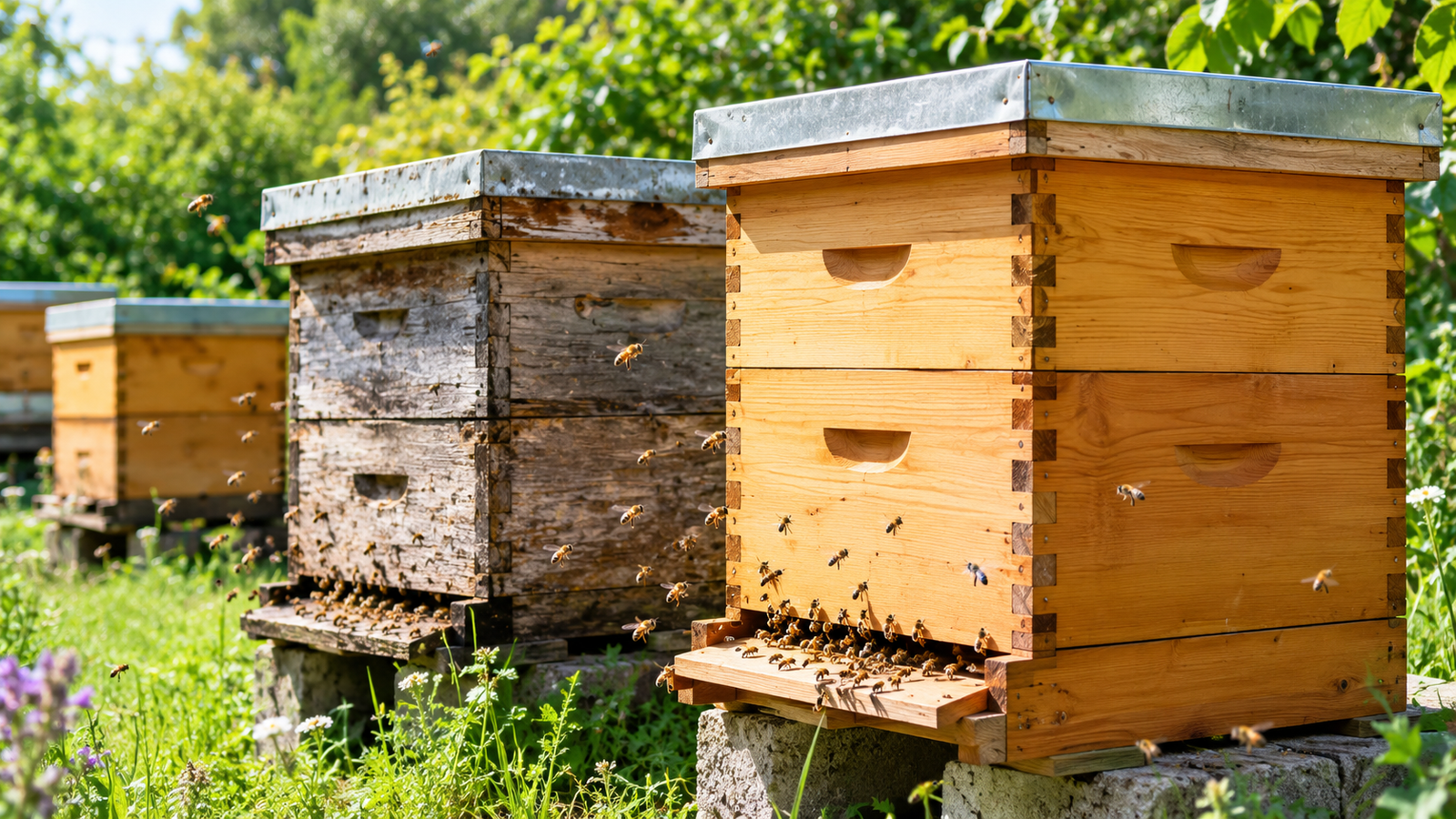
How long do bee hives last? A well-built, properly maintained beehive can remain usable for many years, and some hive structures may last for decades. However, the actual lifespan depends on the materials used, construction quality, weather exposure, pest damage, and how regularly the equipment is maintained.
Wooden beehives can deteriorate through moisture, rot, termites, and repeated exposure to harsh weather. Plastic beehives do not rot like wood, but they can crack, warp, or become brittle after prolonged exposure to sunlight and heat. Natural nesting cavities, such as hollow trees, may remain suitable for bees for many years if the surrounding structure stays sound.
It is also important to distinguish between the lifespan of a physical beehive and the lifespan of the colony living inside it. A honey bee colony can survive for multiple years even though individual worker bees live for much shorter periods. The hive structure may also remain intact after a colony dies or moves away.
Understanding these differences helps beekeepers decide when to repair equipment, replace old comb, or invest in a completely new hive.
Quick Answer: How Long Do Bee Hives Last?
Bee hives can last for many years, and well-maintained structures may remain in service for decades. However, there is no guaranteed lifespan for every hive because materials, climate, construction, and maintenance practices differ.
Here is a general comparison:
| Type of hive or component | Expected durability |
|---|---|
| Wooden beehive box | Many years; potentially decades with proper protection |
| Plastic beehive box | Many years, depending on plastic quality and environmental exposure |
| Natural tree cavity | May remain suitable for decades or longer if the tree stays sound |
| Hive frames | Many years if structurally sound and properly maintained |
| Brood comb | Requires periodic assessment and replacement as it ages |
| Empty beehive | Can remain intact for years if protected from weather and pests |
| Honey bee colony | Can survive for multiple years under suitable conditions |
These are general descriptions, not guaranteed service-life estimates. A wooden hive exposed to persistent moisture may deteriorate much sooner than one kept dry and protected.
The most important point is that a beehive does not have one single lifespan. Its box, frames, comb, and the colony living inside it all have different maintenance and survival requirements.
How Long Does a Honey Bee Colony Live in One Hive?
A healthy honey bee colony can survive for multiple years, provided it has suitable nesting conditions, sufficient food, a productive queen, and effective protection against pests and diseases.
Honey bees are social insects that depend on cooperation between the queen, workers, and drones. Their colony can continue across seasons because new generations replace bees that die.
This is different from the lifespan of an individual bee.
Worker bees perform several jobs throughout their lives. Younger workers generally carry out duties inside the nest, including cleaning cells, feeding developing larvae, and maintaining the colony. Older workers commonly become foragers, collecting nectar, pollen, water, and other resources.
The queen lays eggs that develop into new generations of workers and drones. When an aging or failing queen is replaced, the colony may continue even though its original queen is no longer present.
Can a Bee Colony Live in the Same Hive for 10 Years?
Yes. A honey bee colony may occupy the same hive for 10 years or longer under favorable conditions.
However, this does not mean that the same individual bees remain there for a decade.
The workers are continually replaced by new generations, and the queen may be superseded or replaced during the colony’s lifetime. The colony is therefore better understood as a continuing social community rather than a permanent group of individual bees.
A colony may also swarm, abscond, become queenless, suffer disease, or collapse because of inadequate food or other environmental pressures.
For example, a colony that occupies a wooden hive for several years may eventually swarm and establish a new nest elsewhere. The original hive box could remain structurally sound even after the bees leave.
How Long Do Different Types of Bee Hives Last?
The lifespan of a beehive depends partly on the material used to construct it and the conditions in which it is kept.
Wooden and plastic hives have different maintenance requirements. Natural nesting sites also need to be considered separately because they are part of the surrounding environment.
1. How Long Do Wooden Bee Hives Last?
Wooden beehives can last for many years and, under favorable conditions, may remain usable for decades.
Wood is widely used in beekeeping because it is strong, repairable, and relatively easy to work with. A damaged roof, bottom board, or hive box can often be repaired or replaced without discarding the entire hive.
However, wood is vulnerable to deterioration when it is repeatedly exposed to moisture.
Common causes of wooden hive damage include:
- Rain and moisture: Wet wood swells, and repeated wetting and drying can loosen joints and fasteners.
- Termites: These insects can damage hive stands and wooden components.
- Fungal decay: Prolonged dampness can encourage wood rot and weaken the structure.
- Sunlight: Intense sunlight can weather exterior surfaces and damage protective finishes.
- Temperature changes: Repeated expansion and contraction can contribute to loose joints and cracks.
- Poor construction: Weak joints, unsuitable timber, and badly fitted roofs can shorten the hive’s useful life.
For example, consider two wooden Langstroth hives placed in the same apiary. One sits directly on damp ground with a damaged roof, while the other is raised on a stable stand and protected by a properly fitted cover.
Even if both were purchased at the same time, the first is likely to experience moisture-related deterioration sooner.
This demonstrates why maintenance and placement can be just as important as the original quality of the wood.
The University of Florida’s IFAS Extension explains how repeated swelling and contraction of wet wooden hive components can cause nails to loosen and joints to develop gaps.
To extend the lifespan of wooden hives:
- Choose durable timber and sound construction.
- Use a properly fitted roof.
- Keep the bottom board away from direct ground contact.
- Allow water to drain away from the hive.
- Inspect joints, corners, and exterior finishes.
- Repair damaged sections before deterioration spreads.
- Use suitable protective finishes on exterior surfaces only.
Avoid applying potentially harmful substances inside the hive or where they can contaminate beeswax, honey, or other hive products.
2. How Long Do Plastic Bee Hives Last?
Plastic beehives can also remain useful for many years. Their durability depends on the quality of the material, manufacturing standards, ultraviolet resistance, and exposure to heat and physical damage.
One advantage of plastic is that it does not absorb water and rot in the same way as untreated wood.
However, plastic is not immune to deterioration.
Common problems include:
- Cracking after repeated impact.
- Warping under excessive heat.
- Brittleness after prolonged ultraviolet exposure.
- Damage to connecting joints and fittings.
- Weakening caused by poor-quality materials.
For example, a plastic hive kept outdoors under intense sunlight throughout the year may experience different wear from an identical hive stored under suitable protection when not in use.
A cracked plastic box should not be ignored simply because the material does not rot. Structural damage can allow rainwater inside and make the hive unstable.
When choosing plastic equipment, look for products designed specifically for outdoor beekeeping. Inspect the walls, corners, lids, and connections regularly.
There is no universal number of years that applies to all plastic hives.
3. How Long Does a Natural Beehive in a Tree Last?
A natural nesting cavity inside a hollow tree may remain suitable for bees for decades or longer if the tree and its internal structure remain sound.
Unlike a manufactured hive, a tree cavity is part of a natural structure. Its condition depends on:
- Tree species and age.
- Internal decay.
- Water entering the cavity.
- Insect and fungal activity.
- Storm damage.
- The stability of the surrounding tree.
A hollow tree can continue to provide shelter even after its original honey bee colony disappears.
Another swarm may eventually occupy the same cavity if it offers suitable space, protection, and an accessible entrance.
However, the nesting site can become unsuitable if the tree collapses, the cavity fills with water, or decay seriously weakens the structure.
The physical cavity and the bee colony occupying it should therefore be treated as two separate things.
4. How Long Does a Wild Bee Nest Last?
The lifespan of a wild bee nest depends on the species and its nesting behavior.
Not all bees form permanent colonies.
Honey bees can establish colonies that survive for multiple years. Many bumble bee species, however, have annual colony cycles. Most solitary bees nest individually rather than maintaining a large, continuously occupied colony.
Consider these examples:
| Bee type | Nesting behavior | Typical pattern |
|---|---|---|
| Honey bees | Social colonies | Colonies can survive across multiple years |
| Bumble bees | Social colonies | Most colonies have an annual cycle |
| Mason bees | Individual cavities or tunnels | Seasonal nesting and development |
| Mining bees | Underground individual nests | Often seasonal nesting activity |
A solitary bee may use a nesting tunnel to lay eggs and provide food for its developing offspring. The adult bee may die after its reproductive period, while the next generation develops inside the nest.
Some suitable nesting locations may be reused over successive seasons, but that does not mean the same individual bees occupy them continuously.
This is why the lifespan of a bee nest cannot be estimated without considering the species.
What Factors Affect How Long Bee Hives Last?
Several factors determine how long a beehive remains usable.
Understanding these factors helps beekeepers prevent avoidable damage and reduce equipment replacement costs.
1. Hive Material and Construction Quality
The material used to construct a hive influences how well it withstands outdoor conditions.
Wood provides strength and repairability but can deteriorate when exposed to persistent moisture. Plastic avoids wood rot but may become brittle or deform under unsuitable environmental conditions.
Construction quality also matters.
A properly fitted roof helps prevent water from entering the hive. Strong joints keep boxes stable, while a suitable bottom board supports the entire structure.
Poorly assembled components can develop problems even when the original materials are reasonably durable.
2. Weather and Climate
Weather is one of the major factors affecting hive durability.
Rainfall, humidity, intense sunlight, temperature changes, and strong winds can gradually damage hive equipment.
In tropical regions such as Ghana, beekeepers should pay particular attention to rainfall, drainage, moisture exposure, and termites.
For example, a wooden hive placed in an area where rainwater regularly collects underneath it may deteriorate faster than one raised on a stable stand with good drainage.
However, excessive exposure to direct sunlight can also create problems, particularly for some plastic hive materials and poorly protected wooden surfaces.
The objective is not simply to place a hive in complete shade. It is to provide appropriate weather protection, suitable ventilation, and a location that allows rainwater to drain away.
3. Regular Maintenance
Regular inspection helps identify small problems before they develop into serious structural damage.
A beekeeper should examine:
- Hive walls for cracks and rot.
- Roofs and lids for leaks.
- Joints for separation.
- Bottom boards for moisture damage.
- Stands for instability.
- Frames for broken sections.
- Plastic parts for brittleness and deformation.
For example, replacing a damaged roof before water reaches the wooden hive body may prevent more extensive repairs later.
Maintenance does not necessarily mean replacing equipment frequently. It means keeping individual components in a suitable condition.
4. Pests and Diseases
Pests and diseases can affect both colony survival and the condition of hive materials.
Some important examples include:
Varroa mites: These parasitic mites affect susceptible honey bee species and can transmit harmful viruses. Their impact depends on the bee population and local conditions.
Wax moths: Wax moth larvae can damage unprotected comb, especially in weak colonies or poorly stored equipment.
Small hive beetles: These pests can damage comb and stored hive resources when infestations are not controlled.
Brood diseases: Diseases affecting developing bees can weaken or destroy colonies. Some infectious agents can also remain associated with used hive equipment.
It is important to understand that a damaged colony and a damaged hive structure are not necessarily the same problem.
A colony may collapse because of disease even though the wooden boxes remain physically sound.
If a colony dies unexpectedly, investigate the possible cause before introducing another colony into the equipment. Suspected serious infectious diseases require appropriate local veterinary or beekeeping guidance.
5. Hive Location and Ventilation
The position of a hive can affect both its physical durability and the health of the colony.
A location that collects rainwater or remains excessively damp can accelerate moisture-related damage.
A hive exposed to strong winds, flooding, or frequent physical disturbance may also experience unnecessary wear.
Suitable ventilation helps bees regulate conditions inside their nest, but ventilation arrangements must suit the hive design and local climate.
A well-positioned hive should have:
- A stable and elevated stand.
- Good drainage around the base.
- A properly fitted weatherproof roof.
- A suitable entrance.
- Protection from unnecessary physical disturbance.
- Adequate ventilation for the hive design.
How Do You Know When a Beehive Needs Replacing?
A beehive does not need to be replaced simply because it is old.
Its actual condition is more important than the number of years it has been in use.
Some old hives remain structurally sound, while relatively new ones can become unsafe because of poor construction, moisture damage, or pests.
Look for the following warning signs.
1. Severe Wood Rot
Wood that has become soft, crumbly, or structurally weak may no longer support the weight of the hive safely.
Check the bottom board, corners, joints, and areas where rainwater collects.
Minor surface weathering does not automatically mean the entire hive needs replacement. However, extensive decay may make replacement necessary.
2. Large Structural Cracks
Small cosmetic cracks may be repairable.
Large cracks that compromise the strength of the box or allow significant water entry should be addressed immediately.
If the hive cannot remain stable when stacked, the damaged component should be replaced.
3. Persistent Roof Leaks
The roof protects the colony and equipment from rainfall.
If the cover is damaged, water may enter the hive and create damp conditions.
Repair or replace a leaking roof before the problem affects the hive body, frames, and comb.
4. Loose Joints and Unstable Boxes
Hive boxes should stack securely.
Loose corners, separated joints, and weakened fasteners can make equipment unstable during inspections and transportation.
A small joint problem may be repairable, but a severely weakened box should be retired.
5. Extensive Termite or Insect Damage
Termites and other wood-damaging insects can weaken the structure.
Inspect hive stands and wooden components, particularly in areas where termites are common.
Replace components that have lost their structural strength.
6. Cracked or Warped Plastic
Plastic boxes should be checked for cracks, deformation, and damaged connections.
If a component no longer fits securely or supports the hive properly, replace it.
7. Contaminated or Diseased Equipment
Not all equipment problems are visible.
Old comb and previously occupied equipment may carry pathogens or chemical residues.
If serious brood disease is suspected, do not simply scrape the hive and introduce another colony. Follow the appropriate disease-control and sanitation guidance for your location.
How to Inspect an Old Beehive Before Reusing It
Before introducing a new colony into an old hive, inspect the structure and its previous contents.
This is particularly important when the hive was purchased second-hand or its previous colony died unexpectedly.
Use the following checklist:
| Component | What to inspect | Recommended action |
|---|---|---|
| Hive walls | Rot, cracks, holes, or weak wood | Repair or replace damaged boxes |
| Roof | Leaks, loose fittings, and damaged covering | Repair or replace |
| Bottom board | Rot, water damage, and insect activity | Replace if structurally weak |
| Hive stand | Stability and termite damage | Strengthen or replace |
| Frames | Broken wood and damaged fittings | Replace unsuitable frames |
| Brood comb | Old, dark, damaged, or contaminated wax | Assess for rotation or disposal |
| Plastic parts | Cracks, warping, and brittleness | Replace damaged components |
| Hive interior | Signs of serious brood disease | Seek appropriate disease-control advice |
Example: Should You Replace an Eight-Year-Old Beehive?
Imagine a beekeeper has a wooden hive that has been used for eight years.
During inspection, the beekeeper finds:
- The wooden walls are still firm.
- The roof does not leak.
- The joints remain secure.
- The bottom board is structurally sound.
- Several brood frames contain old, dark comb.
Does the beekeeper need to throw away the entire hive?
Not necessarily.
The outer structure may remain suitable for continued use, while the older brood comb and any damaged frames can be assessed for replacement.
This is an important distinction because the hive box and the comb inside it do not have identical maintenance requirements.
However, if the previous colony died from a suspected serious infectious disease, the equipment must be assessed under appropriate disease-control guidance before reuse.
Do Beehives Need to Be Replaced Every Year?
No. Beehives do not normally need to be replaced every year.
A properly constructed hive can remain useful for many years when maintained correctly.
Most beekeepers replace damaged components as necessary rather than discarding the entire hive annually.
However, brood comb requires separate attention.
How Often Should Old Brood Comb Be Replaced?
Brood comb is the wax structure where a queen lays eggs and developing bees grow.
As workers emerge from their cells, cocoons and other material remain in the wax. Repeated brood cycles can gradually make old comb darker and thicker.
Old comb may also accumulate pathogens, pesticides, and other residues.
For this reason, beekeepers periodically rotate older brood frames out of the colony.
For example, the Canadian Food Inspection Agency’s honey bee producer biosecurity guidance recommends replacing at least 20% of brood frames, ideally one-third annually, as part of its management approach.
Other beekeeping extension resources recommend different schedules, depending on local conditions and management practices.
The important lesson is that there is no single replacement schedule suitable for every apiary.
Beekeepers should:
- Date or mark brood frames when introducing them.
- Inspect comb condition regularly.
- Prioritize damaged, mouldy, or excessively dark comb.
- Replace old brood frames gradually where appropriate.
- Follow local disease-control and food-safety guidance.
A hive box may remain usable for decades while some of its brood comb requires replacement much sooner.
How Can You Make a Beehive Last Longer?
Good maintenance can extend the useful life of hive equipment and reduce unnecessary replacement costs.
The following practices are particularly useful.
1. Protect the Hive From Rain
Use a properly fitted roof and place the hive on a stable stand.
Make sure rainwater drains away from the base instead of collecting around the hive.
Pay particular attention to the bottom board and joints because these areas may remain damp for extended periods.
2. Choose Durable Materials
Use hive boxes, frames, roofs, and stands designed for outdoor beekeeping.
Good-quality timber, suitable construction, and durable plastic materials can help reduce premature equipment failure.
If building your own hive, make sure the components fit the intended hive design. Poorly fitted boxes can create gaps and other problems.
3. Maintain Wooden Surfaces
Inspect exterior finishes regularly.
Repair damaged protective coatings before the wood becomes excessively exposed to rain and sunlight.
Only use suitable protective products on exterior surfaces. Allow treated surfaces to dry and cure fully before bees are introduced, following the product manufacturer’s instructions.
Avoid coatings or chemicals that could contaminate the hive interior or hive products.
4. Monitor for Termites and Other Pests
Inspect the hive stand, wooden walls, and surrounding area for signs of termites and other damaging insects.
Use appropriate pest-management methods that do not expose bees or hive products to harmful substances.
5. Handle Hive Components Carefully
Hive boxes and frames can become heavy when filled with honey, brood, and other stored resources.
Rough handling can damage joints, corners, frames, and plastic fittings.
Use suitable lifting techniques and avoid dropping or dragging hive components unnecessarily.
6. Inspect the Hive Regularly
Do not wait until a hive starts collapsing before inspecting it.
During routine apiary visits, check the roof, stand, bottom board, joints, and other structural components.
Also assess colony strength, brood condition, food resources, and signs of pests or disease.
7. Maintain Colony Health
A durable hive does not automatically mean a healthy colony.
Monitor queen performance, brood development, food availability, and relevant pests and diseases.
Healthy colonies are generally better able to maintain their nest and respond to environmental challenges.
Management should be adapted to the honey bee species, local climate, and regional beekeeping recommendations.
What Happens When a Bee Colony Dies or Leaves Its Hive?
When a colony dies or leaves, the physical hive may remain intact.
However, the condition of the equipment and the reason the bees disappeared determine whether it can be reused.
Can Another Colony Use an Old Hive?
Yes. A suitable empty hive or natural nesting cavity may attract a swarm or another colony.
However, bees do not necessarily return to the same hive after leaving.
Before introducing a new colony, inspect the equipment for structural damage, pests, and signs of disease.
If the previous colony died unexpectedly, investigate the cause before reusing its comb or other components.
What Happens to the Old Comb?
Old comb can remain inside an empty hive, but it may deteriorate or attract pests if left unprotected.
Wax moth larvae, for example, can damage stored comb, particularly when there are no strong colonies to defend it.
Beekeepers should assess comb condition and store suitable frames using appropriate methods.
If serious brood disease is suspected, do not reuse the comb without following the relevant disease-control recommendations.
American foulbrood is an important example because its spores can remain infectious in contaminated comb and equipment for many years.
A physically sound wooden box should not automatically be considered safe simply because it has been cleaned.
Can an Empty Hive Last for Years?
Yes. An empty hive can remain structurally intact for years if its materials and storage conditions are suitable.
A hive stored in a dry, protected location may remain in better condition than one continuously exposed to rain, sunlight, and pests.
However, its comb and other internal components need separate assessment.
The physical structure can therefore outlast the colony that originally occupied it.
Hive Lifespan vs. Individual Bee Lifespan
One of the most common sources of confusion is the difference between how long a beehive lasts and how long the bees inside it live.
A honey bee colony can survive for multiple years even though most individual worker bees live for a much shorter time.
The different members of a honey bee colony have different lifespans.
| Type of honey bee | Typical lifespan |
|---|---|
| Queen | Commonly around 2–3 years of productive life, although some live longer |
| Summer worker | Approximately 5–6 weeks in many managed colonies |
| Winter worker | Several months, depending on climate and colony conditions |
| Drone | Usually several weeks during the reproductive season; mating is fatal |
These figures are general estimates for the western honey bee, Apis mellifera. Actual lifespans vary with genetics, season, workload, environmental conditions, and management.
Why Do Worker Bees Live for Different Lengths of Time?
Summer workers often spend considerable time foraging outside the hive. This exposes them to weather, predators, exhaustion, and other environmental hazards.
Workers that emerge during cooler seasons in temperate climates may live much longer because they spend more time maintaining the winter cluster and are less exposed to foraging hazards.
These seasonal differences help colonies survive periods when flowers and food resources are scarce.
The queen can live for several years, although beekeepers may replace her earlier when her egg-laying performance declines.
The University of Delaware’s Mid-Atlantic Apiculture Research and Extension Consortium and the U.S. Food and Drug Administration provide further explanations of honey bee colony organization and individual bee lifespans.
This is why the lifespan of a colony should never be confused with the lifespan of its individual members.
Frequently Asked Questions About How Long Bee Hives Last
How long do bee hives last in the wild?
Wild honey bee nesting sites can remain suitable for years or decades, depending on the surrounding structure and environmental conditions.
A honey bee colony may survive for multiple years, but it may also swarm, die, or leave the nesting site.
The physical nesting cavity may remain long after the original colony disappears.
How long does a beehive last without bees?
An empty beehive can remain physically intact for years if protected from moisture, sunlight, pests, and physical damage.
However, exposed comb can deteriorate or become infested with wax moths and other pests.
Can bees return to an old hive?
Bees may occupy a previously used hive or natural nesting cavity if it is suitable.
A swarm may establish a colony in an old nesting site, but returning to a specific hive is not guaranteed.
Does a queen bee determine how long a hive lasts?
The queen plays an important role in colony survival because she produces eggs that develop into new generations of bees.
However, colony longevity also depends on worker bees, food availability, pests, diseases, weather, and overall colony health.
The physical hive can remain intact even after the queen dies or the colony disappears.
How long do beehive frames last?
Frames can remain usable for many years if they are structurally sound and properly maintained.
Their lifespan depends on the frame material, handling, pest damage, and condition of the comb.
A wooden frame may still be sound even when the old brood comb attached to it needs replacement.
Damaged, contaminated, or unsuitable frames should be replaced.
Can a beehive last 50 years?
A well-preserved hive structure or natural nesting cavity may remain usable for 50 years or longer under favorable conditions.
However, this is a possibility rather than a standard lifespan for all hive types.
The durability of the materials, weather exposure, construction quality, and maintenance practices all influence how long a hive remains serviceable.
Do bees use the same hive every year?
Honey bee colonies can occupy the same hive across multiple years.
However, they may swarm, abscond, or die. Another colony may also occupy the same nesting location later.
Does an old beehive need to be thrown away?
Not necessarily.
If the structure remains sound, it may still be usable.
Inspect the boxes, roof, bottom board, frames, and comb. Address structural damage, pests, and possible disease risks before introducing another colony.
How long does old brood comb last?
There is no universal expiration date for brood comb.
Its condition changes as bees repeatedly use the cells for raising brood. Cocoons, debris, and possible contaminants can accumulate over time.
Beekeepers should inspect brood frames regularly and rotate older comb according to suitable local management and disease-control recommendations.
Does rain shorten the lifespan of a wooden beehive?
Yes, persistent moisture can shorten the useful life of wooden hive equipment.
Repeated wetting and drying can cause wood to swell and contract, loosen joints, and encourage decay.
A well-fitted roof, raised stand, good drainage, and suitable exterior protection help reduce moisture-related damage.
Conclusion: How Long Do Bee Hives Last?
So, how long do bee hives last?
A well-built, properly maintained beehive can remain useful for many years, and some wooden or plastic hive structures and natural nesting cavities may last for decades or longer.
However, the actual lifespan depends on the material, construction quality, climate, moisture exposure, pests, and maintenance.
Wooden hives need protection from rot, termites, and repeated wetting. Plastic hives need protection from cracking, warping, and prolonged exposure to damaging environmental conditions.
It is equally important to remember that hive boxes, frames, brood comb, and bee colonies do not have the same lifespan. A hive box may remain structurally sound while older brood comb needs to be replaced.
By choosing durable materials, inspecting equipment regularly, protecting hives from moisture, and maintaining healthy colonies, beekeepers can extend the useful life of their equipment and avoid unnecessary replacement costs.
The best approach is to assess the actual condition of each hive component rather than replacing an entire beehive simply because it has been in use for several years.
Further Reading and Scientific References
- University of Florida IFAS Extension – Preserving Woodenware in Beekeeping Operations
- University of Delaware – The Colony and Its Organization
- U.S. Food and Drug Administration – Helping Agriculture’s Helpful Honey Bees
- Canadian Food Inspection Agency – Honey Bee Producer Guide to the National Bee Farm-Level Biosecurity Standard
- Ghana Veterinary Services Directorate – Ghana Bee Health Manual
- Oregon State University Extension – Beekeeping Equipment Expenses: Woodenware and Other Components
- University of Arkansas Cooperative Extension – About Honey Bees
