

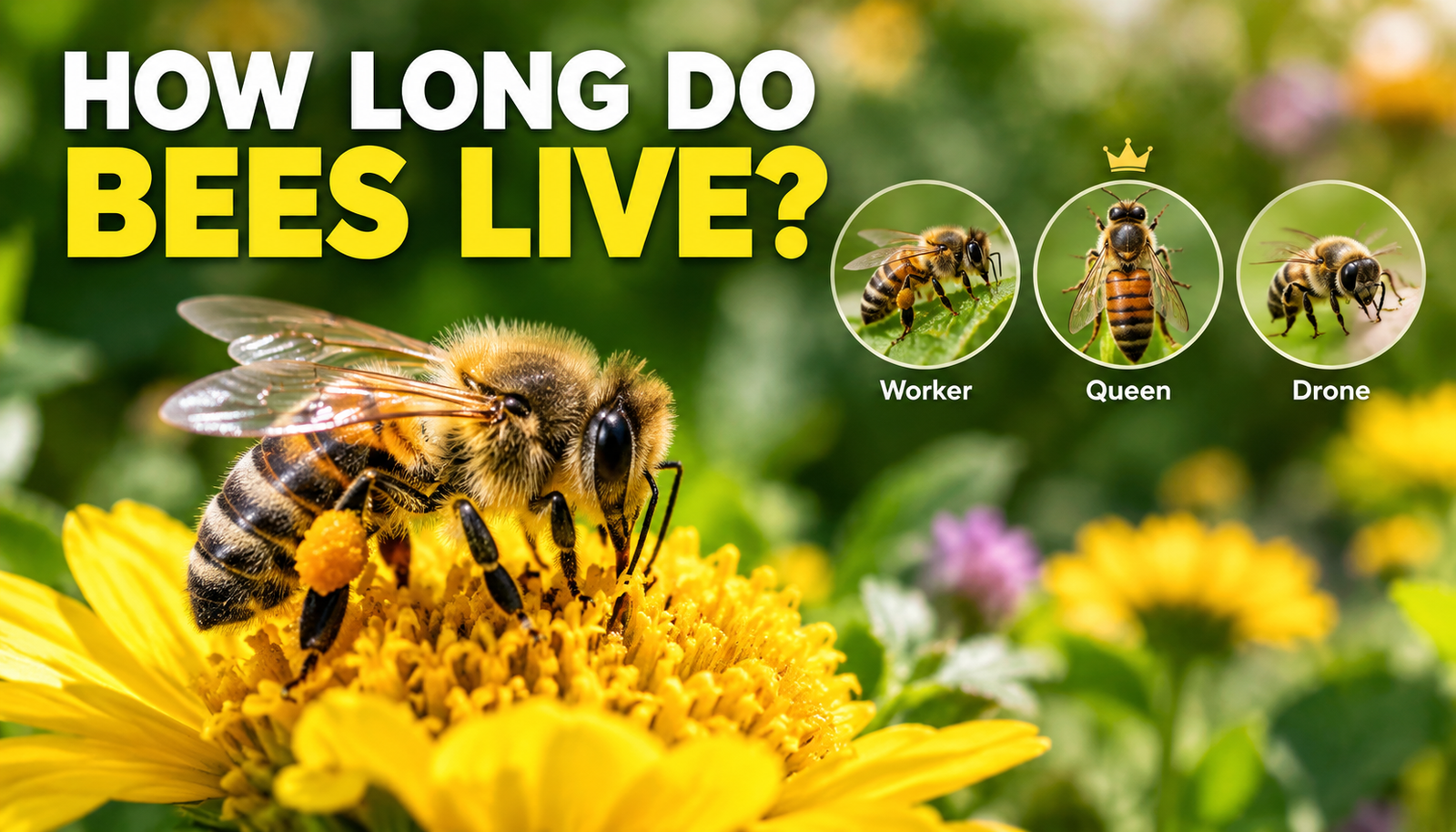
How long bee live? Bees can live from a few weeks to several years, depending on their species, role, season, and environmental conditions. For example, a worker honey bee typically lives about 5–7 weeks during the active season, while a queen honey bee can live for 2–5 years. Bumblebees and solitary bees have different life cycles, so their lifespans vary.
There is no single lifespan that applies to every bee. A bee’s life expectancy depends on whether it is a queen, worker, or drone, as well as factors such as food availability, weather, disease, parasites, and exposure to predators.
In this guide, you’ll discover how long different types of bees live, how their life cycles work, why some bees live longer than others, and what affects their survival.
How Long Bee Live?
The answer to how long bee live? depends primarily on the type of bee and its biological role.
Some bees survive for only a few weeks as adults, while others can live for months or years. Honey bees provide a particularly clear example because queens, workers, and drones have different lifespans.
Here is a quick overview of typical bee lifespans.
| Type of bee | Typical adult lifespan |
|---|---|
| Worker honey bee | About 5–7 weeks during the active season |
| Winter worker honey bee | Several months |
| Queen honey bee | Commonly 2–3 years; sometimes up to 5 years |
| Drone honey bee | Several weeks to a few months, depending on circumstances |
| Bumblebee worker | Usually several weeks |
| Bumblebee queen | Several months, including winter dormancy in many species |
| Solitary bee | Often several weeks as an adult, depending on species |
These figures are approximate. Lifespans differ between species and individual bees, and the time spent as an egg, larva, and pupa is not included in the adult lifespan figures.
Why do bees have different lifespans?
Three main factors explain much of the difference.
- Species: Honey bees, bumblebees, and solitary bees have different biological life cycles.
- Role: A queen honey bee has a reproductive role that differs considerably from the work performed by workers and drones.
- Season: Active-season worker honey bees generally live for weeks, while winter workers can survive for months.
Understanding these differences makes it easier to answer the question of how long an individual bee can live.
How Long Do Honey Bees Live?
Honey bees live in organized colonies containing three main types of adult bees: queens, workers, and drones.
Each type performs a different function, and each has a different expected lifespan.
How Long Do Worker Bees Live?
A worker honey bee typically lives about 5–7 weeks during the active season, particularly when the colony is busy raising young and collecting food.
Worker bees are female and perform most of the tasks needed to keep the colony functioning.
Their responsibilities include:
- Cleaning honeycomb cells
- Feeding and caring for developing larvae
- Attending to the queen
- Producing and processing food
- Building and repairing honeycomb
- Guarding the hive entrance
- Regulating the temperature inside the hive
- Collecting nectar, pollen, and water
- Removing waste and dead bees
Young workers usually begin with tasks inside the hive. As they grow older, many transition to foraging outside the colony.
Foraging requires repeated flights and exposes bees to changing weather, predators, pesticides, and other environmental hazards. This physically demanding work contributes to the relatively short lifespan of many active-season workers.
However, not every worker dies after five or seven weeks. Seasonal conditions and the bee’s physiological state can make a substantial difference.
How Long Do Winter Bees Live?
Winter worker honey bees can live for several months, much longer than many workers raised during the active season.
Their survival is essential because a colony must remain alive when flowers are scarce and cold weather limits foraging.
Winter bees help maintain the colony’s cluster, regulate warmth, and sustain the queen until conditions improve. They are physiologically different from many short-lived summer workers and typically have greater energy reserves and enhanced physiological capacity for surviving the winter.
When spring arrives and food becomes available, the colony can raise new generations of workers.
This seasonal difference explains why the lifespan of a worker honey bee cannot be described using a single number.
How Long Does a Queen Bee Live?
A queen honey bee commonly lives for 2–3 years, although some queens can survive for up to five years under favorable conditions.
The queen’s primary role is reproduction. She lays eggs that develop into workers, drones, and potential replacement queens.
She also produces pheromones that contribute to the social organization of the colony.
Unlike worker bees, a queen does not normally spend her days collecting nectar and pollen. Her reproductive role and different physiology contribute to her much longer potential lifespan.
Why does a queen bee live longer than workers?
Queens and workers develop from female larvae, but their development differs because of the nutrition and conditions provided during larval growth.
A queen develops in a specialized queen cell and receives a developmental diet that supports reproductive maturity. These differences produce a bee with fully developed reproductive organs and other characteristics associated with the queen caste.
Workers, by contrast, carry out demanding tasks that include foraging, nursing, and maintaining the nest.
Queen longevity is not guaranteed, however. Disease, parasites, injury, poor colony conditions, and natural changes in queen performance can affect how long a queen remains alive and productive.
How Long Do Drone Bees Live?
Drone bees are male honey bees. Their primary biological function is to mate with queens.
A drone may live for several weeks to a few months, depending on the season and colony conditions.
If a drone successfully mates with a queen during flight, it dies shortly afterward because of the injury associated with the mating process.
Drones that do not mate may survive longer, but they depend on the colony for food and shelter. As the season changes and resources become limited, worker bees may remove or exclude drones from the colony.
As a result, a drone’s lifespan depends partly on whether it mates and partly on the seasonal needs of its colony.
How Long Do Bumblebees Live?
Bumblebees have a different life cycle from honey bees. Most bumblebee colonies are seasonal rather than permanent, and their survival strategy centers on new queens.
A colony usually begins when a queen emerges from winter dormancy, establishes a nest, and raises the first generation of workers.
As the colony grows, it produces more workers and eventually males and new queens.
How long do bumblebee workers live?
Bumblebee workers generally live for several weeks during the active season.
They collect nectar and pollen, feed developing bees, maintain the nest, and help defend the colony.
Their lifespan depends on the species, workload, weather, food availability, and other environmental conditions.
How long does a bumblebee queen live?
A bumblebee queen may live for several months, although the exact lifespan varies by species and life-cycle stage.
In many species, newly produced queens mate and then enter a period of winter dormancy. They survive until the following season, when they can establish new colonies.
The old queen and most workers and males from the previous colony typically die as the colony cycle ends.
Unlike a honey bee queen, which may remain in the same colony for several years, a bumblebee queen generally establishes a new colony during her reproductive season.
How Long Do Solitary Bees Live?
Most bee species are solitary rather than social. Unlike honey bees, solitary bees do not usually live in large colonies with a queen and specialized worker caste.
A solitary female typically constructs or occupies a nest, collects food for her offspring, lays eggs, and leaves the next generation to develop.
Examples include mason bees, leafcutter bees, and many mining bees.
Many solitary bees live for several weeks as adults. However, their complete life cycle may last considerably longer because eggs, larvae, or pupae can remain protected inside nests for months.
For example, some solitary bees emerge as adults during spring or summer, reproduce, and then die after their short adult period. Their offspring may remain in the nest until the following year.
Therefore, when considering how long solitary bees live, it is important to distinguish between the adult lifespan and the time required to complete the entire life cycle.
The Bee Life Cycle: From Egg to Adult
Bees undergo complete metamorphosis, meaning they pass through four distinct developmental stages:
- Egg
- Larva
- Pupa
- Adult
The duration of each stage varies by species. Honey bees provide a useful example of how this process works.
1. Egg
A honey bee’s life begins when an egg is laid in a honeycomb cell.
The egg is small and elongated. Under typical conditions, the egg stage lasts approximately three days before the larva hatches.
2. Larva
After hatching, the bee becomes a larva.
The larva looks very different from an adult bee. It is soft-bodied, lacks functional wings, and depends on worker bees for food and care in a honey bee colony.
During this stage, the larva grows rapidly. Its nutrition and developmental conditions help determine whether a female larva becomes a queen or a worker.
3. Pupa
Once larval development is complete, the bee enters the pupal stage.
During this period, its body develops adult structures, including wings, legs, antennae, and compound eyes.
The pupa remains inside its cell while metamorphosis takes place.
4. Adult Bee
The fully developed bee eventually emerges from its cell.
It then begins the activities associated with its species and role. A newly emerged worker honey bee initially performs tasks inside the hive before many workers transition to foraging as they age.
How long does it take honey bees to develop?
The approximate time from egg to adult emergence differs by caste.
| Honey bee type | Development time |
|---|---|
| Queen | About 16 days |
| Worker | About 21 days |
| Drone | About 24 days |
These are typical developmental periods under suitable conditions. Temperature, colony conditions, and other factors can influence development.
Development time should not be confused with adult lifespan. A worker takes about three weeks to develop, then may live for several additional weeks or months, depending on the season.
What Factors Affect How Long Bees Live?
A bee’s lifespan is influenced by its biology and the conditions in which it lives.
1. Species
Different bee species have distinct life cycles and survival strategies.
Honey bees maintain colonies that can persist for years, while many bumblebee colonies follow an annual cycle. Solitary bees have a wide range of nesting and overwintering strategies.
2. Biological role
In social bee species, the queen, workers, and drones have different responsibilities and biological characteristics.
These differences influence their typical lifespans. For example, a queen honey bee may live for years, while an active-season worker may live for only several weeks.
3. Season and temperature
Seasonal conditions affect bee activity, food availability, and survival.
Active-season workers may spend considerable energy foraging. Winter workers generally have adaptations that help them survive for months.
Extreme heat, cold, storms, and prolonged rain can also affect individual bees and their colonies.
4. Food availability
Bees depend on adequate nutrition for survival.
Nectar supplies carbohydrates, while pollen provides protein, fats, vitamins, minerals, and other nutrients.
A shortage of flowering plants can make it harder for bees to find food. Poor nutrition may weaken individual bees and affect the ability of colonies to raise healthy offspring.
5. Disease
Bees can be affected by viruses, bacteria, fungi, and other pathogens.
Some infections shorten the lives of individual bees, while others can weaken entire colonies.
Healthy colonies, suitable nutrition, and effective disease management can help support bee survival.
6. Parasites
Parasites can have a substantial effect on bee health.
Varroa mites are particularly important for honey bees because they parasitize developing and adult bees and can transmit harmful viruses.
Heavy parasite burdens and associated infections can reduce survival and contribute to colony decline.
7. Pesticide exposure
Some pesticides can harm bees through direct exposure or contaminated food sources.
The effects depend on the chemical, dose, duration of exposure, and bee species. Depending on the circumstances, exposure can cause death or interfere with behavior and other important functions.
Reducing unnecessary pesticide exposure and following pollinator-protection guidance can help protect bees.
8. Predators
Bees face threats from birds, spiders, insects, and other animals.
Predators can kill individual bees, although the impact varies by species, location, and environmental conditions.
9. Habitat and nesting conditions
Suitable nesting sites and access to flowering plants are important for bee survival.
Honey bees need appropriate colony conditions, while solitary bees often depend on particular soil types, cavities, hollow stems, or other nesting locations.
Habitat loss and limited food resources can make it harder for bees to reproduce successfully and survive throughout their life cycles.
Do Bees Die After They Sting?
Whether a bee dies after stinging depends on the species and the circumstances.
A worker honey bee can die after stinging a person or another mammal because its barbed stinger can become embedded in the skin. When the bee pulls away, the stinging apparatus may tear from its body, causing fatal injury.
However, not every bee dies after stinging.
Many other bee species can sting more than once because their stingers are less likely to become embedded in a mammal’s skin. Male bees cannot sting because they do not possess stingers.
A bee’s lifespan can therefore be shortened by stinging, but this is not a universal outcome for all bees.
Do Bees Die Naturally?
Yes. Like other living organisms, bees eventually die.
A bee may reach the end of its natural lifespan or die earlier because of environmental hazards, disease, parasites, or other causes.
Common causes of bee mortality include:
- Natural aging
- Disease and infection
- Parasites
- Predators
- Starvation or poor nutrition
- Extreme weather
- Pesticide exposure
- Physical injury
In a healthy honey bee colony, new adults continually emerge as older bees die. This turnover allows the colony to continue functioning even though individual workers may have relatively short lives.
How Many Bees Are in a Honey Bee Colony?
A honey bee colony can contain tens of thousands of bees, although the exact population varies throughout the year.
During periods of abundant food and active reproduction, the colony may grow substantially. During winter or periods of limited resources, its population may decline.
The colony’s survival depends on the combined efforts of its members. The queen lays eggs, workers care for the developing young and maintain the hive, and drones contribute to reproduction.
This means a honey bee colony can persist for years even though many individual workers live for only weeks or months.
What Happens When a Queen Bee Dies?
When a honey bee colony loses its queen, the workers may be able to raise a replacement if suitable young female larvae are available.
They select appropriate larvae and feed them in a way that supports queen development. A successfully developed queen must then mature and mate before she can begin laying fertilized eggs.
If the colony cannot successfully replace its queen, it may struggle to produce enough new workers. Over time, the population can decline.
A queen’s death does not necessarily mean the immediate death of the entire colony, but successful replacement is important for long-term survival.
Why Do Worker Bees Live Such Short Lives?
The relatively short lifespan of active-season worker honey bees is associated with their demanding lifestyle and the conditions they experience.
Young workers carry out tasks inside the hive. Many later become foragers, repeatedly flying outside to collect nectar, pollen, and water.
Foragers face changing temperatures, wind, rain, predators, pesticides, and the physical demands of repeated flights.
These hazards contribute to the mortality of active-season workers. However, the relationship between workload and lifespan is complex, and not every worker follows the same pattern.
Winter workers have different physiological characteristics and typically avoid much of the demanding foraging associated with the active season. This helps them survive for several months.
What Is the Average Lifespan of a Bee?
There is no single average lifespan that accurately describes all bee species.
The answer depends on whether you mean a honey bee worker, queen, drone, bumblebee, or solitary bee.
Here is a simple summary:
- Worker honey bee: about 5–7 weeks during the active season.
- Winter honey bee worker: several months.
- Queen honey bee: commonly 2–3 years, sometimes up to five years.
- Drone honey bee: several weeks to a few months, depending on mating and seasonal conditions.
- Bumblebee worker: generally several weeks.
- Bumblebee queen: several months, depending on the species and life cycle.
- Solitary bee: varies widely by species, with many adults living for several weeks.
These are general estimates rather than fixed limits. Individual bees may live for shorter or longer periods.
The most important distinctions are species, biological role, season, and whether you are measuring adult lifespan or the entire life cycle.
Frequently Asked Questions About How Long Bee Live?
How long bee live on average?
There is no universal average for all bees. Many adult worker bees live for several weeks, while winter worker honey bees may live for several months and queen honey bees can live for several years.
How long do honey bees live?
Worker honey bees typically live about 5–7 weeks during the active season. Winter workers may survive for several months, and queen honey bees commonly live for 2–3 years.
How long does a queen bee live?
A queen honey bee commonly lives for 2–3 years, although some queens can survive for up to five years under favorable conditions.
How long does a worker bee live?
An active-season worker honey bee generally lives about 5–7 weeks. Winter workers can survive for several months because of their different physiology and seasonal role.
How long does a drone bee live?
A drone honey bee may live for several weeks to a few months. A drone that successfully mates with a queen dies shortly afterward.
How long do bumblebees live?
Bumblebee workers generally live for several weeks. New queens can survive through winter dormancy and establish colonies in the following season.
How long do solitary bees live?
Many solitary bees live for several weeks as adults, but their complete life cycles may last months or longer because immature bees develop inside their nests.
Do bees live longer in winter?
Some honey bees do. Winter workers can live for several months, considerably longer than many active-season workers. This helps the colony survive until food becomes available again.
Do bees die after stinging?
Worker honey bees often die after stinging a mammal because their barbed stingers can become embedded in the skin. Many other bee species can sting more than once.
Do all bees have the same lifespan?
No. Bee lifespan varies by species, caste, season, nutrition, environmental conditions, and other factors.
Can a bee live for several years?
Yes. Queen honey bees can live for several years, commonly around two to three years and sometimes up to five. Most worker bees have much shorter adult lifespans.
What is the shortest-lived type of bee?
There is no single type that is always the shortest-lived. Lifespan varies among species and individuals, and some adult bees live for only a few weeks. The exact lifespan depends on their biology and environmental conditions.
Final Answer: How Long Bee Live?
So, how long bee live? The answer depends on the species, role, season, and environmental conditions.
A worker honey bee usually lives about 5–7 weeks during the active season, while a winter worker can survive for several months. A queen honey bee commonly lives for 2–3 years and may sometimes reach five years. Drone honey bees generally live for several weeks to a few months, while bumblebees and solitary bees follow their own life cycles.
Bee lifespan is influenced by nutrition, weather, disease, parasites, predators, pesticide exposure, and habitat quality.
Understanding how long different bees live helps explain how they survive and reproduce. Individual bees may live for weeks or months, but their different roles and reproductive strategies allow bee populations and honey bee colonies to continue across generations.
