

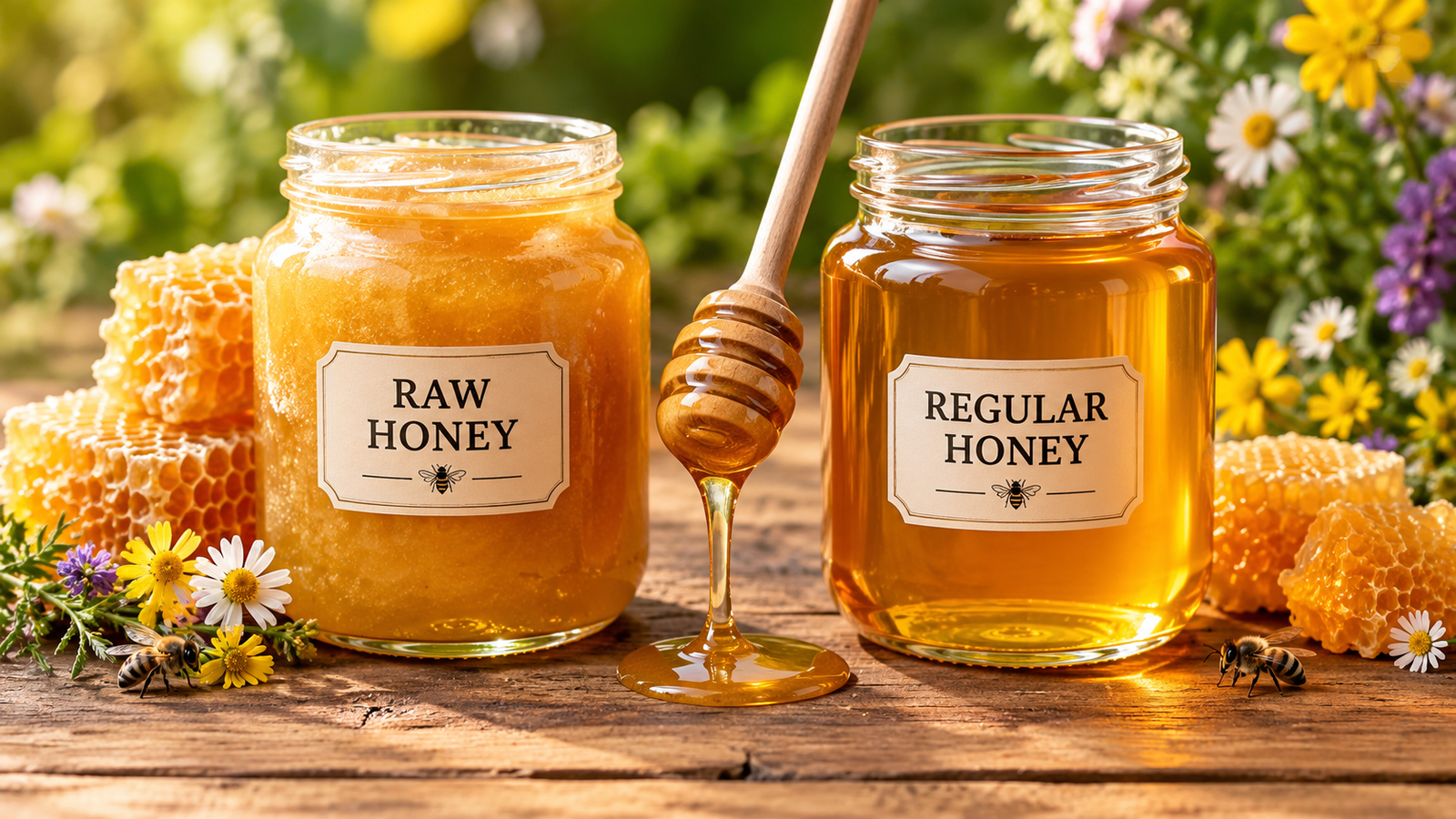
Raw honey vs regular honey is a common comparison for people who want to know whether the honey they buy is minimally processed, more nutritious, or healthier.
Both raw honey and regular honey come from honey bees and contain naturally occurring sugars, but they can differ significantly in how they are processed after harvesting. Raw honey is generally strained with minimal processing, while regular commercial honey may be heated, finely filtered, blended, and processed to create a clearer and more consistent product.
These processing differences can affect honey’s appearance, texture, flavor, pollen content, microorganisms, and some of its naturally occurring compounds.
So, which is better: raw honey or regular honey?
For people who prefer minimally processed foods, raw honey may be more appealing. It can retain more pollen and other naturally occurring components. Regular honey, however, can offer a smoother, clearer, more consistent product and may be preferable for people who want a more processed and standardized honey.
Neither should be considered a low-sugar food. Both are concentrated sources of naturally occurring sugars and should be consumed in moderation.
Raw Honey vs Regular Honey: Quick Comparison
| Feature | Raw Honey | Regular Honey |
|---|---|---|
| Processing | Generally minimally processed | Usually more extensively processed |
| Heating | May not be deliberately heat-treated | May be heated during processing |
| Filtration | Usually strained or lightly filtered | May undergo fine filtration |
| Appearance | Can be cloudy, thick, or opaque | Usually clear and smooth |
| Pollen | More likely to retain pollen | May contain less pollen after filtration |
| Microorganisms | More likely to contain naturally occurring microbes | Heating can reduce microbial content |
| Antioxidants | May retain more of some heat-sensitive compounds | Some compounds may be reduced by processing |
| Flavor | Can have stronger or more varied flavors | Often milder and more consistent |
| Texture | Can vary considerably | Usually smooth and uniform |
| Crystallization | Can crystallize naturally | Can also crystallize |
| Sugar | High in naturally occurring sugars | High in naturally occurring sugars |
| Safety | Not suitable for infants under 12 months | Also not suitable for infants under 12 months |
| Best for | People seeking minimally processed honey | People seeking consistency and convenience |
What Is Raw Honey?
Raw honey is honey that has undergone relatively little processing after it is removed from the honeycomb.
After bees fill honeycomb cells with honey and the honey is ready for harvesting, beekeepers can remove the wax cappings and extract the honey.
Raw honey is generally strained to remove larger pieces of:
- Beeswax
- Bee parts
- Debris
- Other visible material
Unlike highly processed commercial honey, raw honey is generally not subjected to extensive filtration or processing designed to make it completely clear.
As a result, raw honey can contain small amounts of naturally occurring pollen and other components from the hive.
Raw honey can also vary considerably in appearance. It may be clear, cloudy, thick, opaque, or contain tiny particles.
Is all raw honey processed the same way?
No.
The term raw honey is not a perfectly standardized description of processing everywhere, so different producers may use the term differently.
If processing is important to you, check the producer’s description to find out whether the honey has been strained, filtered, heated, or otherwise processed.
What Is Regular Honey?
Regular honey is honey that has undergone additional processing before it reaches consumers.
Commercial honey may be:
- Extracted from the honeycomb
- Strained
- Heated
- Finely filtered
- Blended
- Packaged for sale
Heating can make honey less viscous, which makes it easier to pump, filter, blend, and bottle.
Fine filtration can remove very small particles, including much of the pollen naturally present in honey.
The result is usually a honey that is:
- Clearer
- Smoother
- More uniform
- Easier to process
- More consistent from one jar to another
Regular honey is still honey. Processing does not fundamentally change the fact that it originated as nectar collected and transformed by bees.
What Is the Main Difference Between Raw Honey and Regular Honey?
The biggest difference between raw honey vs regular honey is processing.
Raw honey generally undergoes less processing after harvesting, while regular honey may be heated and filtered more extensively.
This difference can affect several characteristics.
1. Processing and filtration
Raw honey is generally strained to remove larger pieces of debris.
Regular commercial honey may undergo finer filtration to produce a clear, smooth appearance.
2. Heating
Raw honey is generally associated with minimal or no deliberate heat treatment.
Regular honey may be heated during processing.
Heating can make honey easier to handle and filter, but some heat-sensitive compounds may be affected by processing.
3. Pollen content
Raw honey is more likely to retain naturally occurring pollen because it generally undergoes less intensive filtration.
Highly filtered honey may contain substantially less pollen.
4. Microorganisms
Because raw honey is generally not pasteurized, it can contain more naturally occurring microorganisms than heat-treated honey.
This is one reason raw honey is not automatically the better choice for every person.
5. Appearance and texture
Raw honey may be cloudy, thick, or contain tiny natural particles.
Regular honey is usually clearer and smoother.
Does Raw Honey Have More Antioxidants?
Honey naturally contains antioxidant compounds, including polyphenols.
The amount varies significantly depending on the floral source of the honey.
Processing can also affect some of these compounds. Heat processing may reduce certain heat-sensitive antioxidants.
This means raw honey may retain more of some naturally occurring antioxidant compounds than heavily heat-processed honey.
However, it would be inaccurate to assume that every raw honey automatically contains more antioxidants than every regular honey.
The antioxidant content of honey depends on factors including:
- Floral source
- Geographic origin
- Processing
- Storage
- Honey variety
So, raw honey can have an advantage in this area, but the difference is not identical for every jar.
Does Raw Honey Contain More Pollen?
Generally, raw honey is more likely to contain naturally occurring pollen than highly filtered regular honey.
Bees collect pollen from flowers and bring it back to the hive. Some pollen can end up in honey during production and extraction.
When honey is finely filtered, some of this pollen can be removed.
However, pollen content varies considerably among different honeys.
It depends on:
- The plants visited by the bees
- Geographic location
- Beekeeping practices
- Extraction methods
- Filtration
Therefore, you should not assume that all raw honey contains the same amount of pollen.
Can Raw Honey Help With Seasonal Allergies?
You may have heard that eating local raw honey can help the body become accustomed to pollen and reduce seasonal allergies.
However, there is not enough evidence to consider raw honey a proven treatment for seasonal allergies.
The pollen responsible for many seasonal allergies is often windborne, while bees primarily collect pollen from flowers.
In addition, pollen-containing honey can cause allergic reactions in some people.
If you have significant pollen allergies or a history of severe allergic reactions, speak with a healthcare professional before consuming raw honey or other bee products.
Does Raw Honey Contain More Microorganisms?
It can.
Raw honey has generally undergone less heat processing, so it may retain more naturally occurring microorganisms than heat-treated honey.
Some microorganisms associated with honey may be harmless or potentially beneficial, while others can pose risks in particular circumstances.
This is one reason that “raw” should not automatically be treated as synonymous with “safer” or “healthier.”
For most healthy adults, honey is generally safe when consumed appropriately. However, there are important exceptions, particularly infants and some people with specific health risks.
Is Raw Honey Healthier Than Regular Honey?
This depends on what you mean by “healthier.”
Raw honey may retain more naturally occurring pollen and some compounds that can be reduced by heat processing.
However, both raw and regular honey are primarily sources of sugar.
Honey can contain small amounts of:
- Minerals
- Vitamins
- Amino acids
- Enzymes
- Polyphenols
- Other naturally occurring compounds
But honey should not be considered a major source of essential nutrients.
The difference between raw and regular honey is therefore more about processing and the retention of minor natural components than a dramatic difference in basic nutrition.
Raw Honey vs Regular Honey: Sugar and Calories
Both raw and regular honey contain significant amounts of sugar.
Processing does not turn honey into a low-sugar food.
Raw honey is not automatically:
- Sugar-free
- Low-calorie
- Low-carbohydrate
- Suitable for unlimited consumption
If you are monitoring your sugar or calorie intake, portion size matters regardless of whether you choose raw or regular honey.
The exact nutritional values can vary among products, so check the nutrition label when comparing specific jars.
Does Raw Honey Taste Better?
Taste is subjective, but raw honey can have a more distinctive flavor.
Honey’s flavor is strongly influenced by the flowers from which bees collect nectar.
Different floral sources can produce honey with:
- Floral flavors
- Fruity notes
- Herbal characteristics
- Caramel-like flavors
- Earthy notes
- Different levels of sweetness
Because raw honey is generally less processed, it may preserve more of these natural characteristics.
Regular honey is often processed and sometimes blended to produce a more consistent taste.
If you enjoy trying different honey varieties, raw honey may provide a wider range of flavors and textures.
Why Does Raw Honey Crystallize?
Crystallization is a natural process and does not mean that honey has gone bad.
Honey contains different types of sugar, including glucose and fructose.
When glucose separates from the water in honey, it can form crystals.
Some honey crystallizes rapidly, while other varieties can remain liquid for much longer.
The rate of crystallization depends on:
- Floral source
- Sugar composition
- Water content
- Storage temperature
- Tiny particles present in the honey
Raw honey can crystallize readily because it may retain more natural particles that provide places where crystals can form.
Regular honey can also crystallize.
Is Crystallized Honey Safe to Eat?
Yes.
Crystallized honey is generally safe to eat.
Crystallization changes the texture of honey but does not automatically mean that the honey has spoiled.
Crystallized honey may become:
- Grainy
- Thick
- Semi-solid
- Spreadable
If you prefer liquid honey, you can gently warm the container to soften the crystals.
Avoid excessive heating if you want to preserve as much of honey’s naturally occurring heat-sensitive compounds as possible.
Raw Honey vs Regular Honey for Cooking
Both types can be used for cooking and baking.
Regular honey may be convenient when you want:
- A smooth consistency
- Predictable texture
- Consistent flavor
- Easy mixing
Raw honey may be preferable when you want:
- A distinctive flavor
- A minimally processed ingredient
- More natural variation
However, if you are heating honey extensively during cooking, some of the compounds associated with minimally processed honey may be affected by the heat.
Therefore, choosing raw honey specifically for its minimally processed characteristics is less important when the honey will be exposed to high temperatures.
Raw Honey vs Regular Honey in Tea
Both raw and regular honey can be used to sweeten tea.
If you want to preserve more of honey’s natural characteristics, you may choose to add it after the tea has cooled somewhat rather than exposing it to very high temperatures.
For ordinary sweetening, however, either type can work well.
Is Raw Honey Safer Than Regular Honey?
No. Raw honey should not automatically be considered safer than regular honey.
In fact, because raw honey undergoes less processing, it can retain more microorganisms and pollen.
This may be relevant for people with certain allergies or health conditions.
Most importantly, children under 12 months old should never be given honey of any type.
That includes:
- Raw honey
- Regular honey
- Organic honey
- Local honey
- Pasteurized honey
Honey can contain spores of Clostridium botulinum, which can cause infant botulism.
The spores can be present in both raw and regular honey.
What about adults?
Botulism from honey is very rare in healthy adults and older children.
However, people with certain medical conditions or weakened immune systems may need to take additional precautions. If you have a condition that affects your immune system, ask your healthcare professional whether raw honey is appropriate for you.
Can Raw Honey Cause Allergic Reactions?
Yes.
Honey allergies are uncommon, but honey can contain pollen and other bee-related substances that may trigger reactions in susceptible individuals.
People with severe pollen allergies or a history of anaphylaxis should be particularly cautious with raw honey.
Possible allergic symptoms can include:
- Itching
- Hives
- Swelling
- Breathing difficulty
- Other symptoms of a serious allergic reaction
Severe breathing difficulty, swelling of the throat, or other signs of anaphylaxis require immediate emergency medical attention.
Raw Honey vs Organic Honey: Are They the Same?
No.
Raw and organic describe different characteristics of honey.
“Raw” generally refers to how honey has been processed.
“Organic” refers to how the honey and beekeeping operation meet applicable organic production standards.
Therefore, honey can be:
- Raw but not certified organic
- Organic but processed
- Both raw and organic
- Neither raw nor organic
If you specifically want minimally processed organic honey, look for a product that meets the relevant organic certification requirements and is also described as raw.
Is Regular Honey Always Made With Added Sugar?
No.
Regular honey does not automatically mean honey with added sugar.
Commercial honey can be processed honey that still consists entirely of honey.
However, honey adulteration can occur, with cheaper sweeteners sometimes being added fraudulently.
This is why buying honey from a reputable producer or supplier is important.
When buying packaged honey, check the ingredient list. If you want pure honey, look for a product that lists honey as the only ingredient.
How to Choose the Best Honey
Whether you choose raw or regular honey, the quality of the product matters.
Consider these factors:
1. Buy from a reputable producer
A trustworthy producer is more likely to provide accurate information about the honey’s origin and processing.
2. Check the label
Look at:
- Ingredients
- Country or region of origin
- Processing information
- Organic certification, if applicable
3. Consider the floral source
Honey from different plants can have dramatically different flavors.
If flavor matters to you, trying different floral varieties can be more useful than simply choosing between raw and regular honey.
4. Don’t judge honey only by appearance
Clear honey is not automatically better.
Cloudiness, crystallization, or slight variation in color does not necessarily indicate poor quality.
5. Store honey properly
Keep honey:
- Tightly sealed
- In a dry location
- Away from direct sunlight
- At a stable room temperature
Avoid introducing water into the jar because excess moisture can increase the risk of fermentation.
Raw Honey vs Regular Honey: Which Is Better?
There is no universal winner.
Raw honey may be better for you if you:
- Prefer minimally processed foods
- Want honey with more natural variation
- Prefer distinctive floral flavors
- Want honey that is more likely to retain pollen
- Prefer less processed honey
Regular honey may be better for you if you:
- Prefer a clear appearance
- Want a smooth texture
- Prefer consistent flavor
- Want a highly filtered product
- Prefer a widely available commercial product
Neither option should be considered automatically superior for everyone.
Raw Honey vs Regular Honey: Pros and Cons
Raw Honey Pros
- Generally less processed
- More likely to retain pollen
- May retain more of some heat-sensitive compounds
- Can have distinctive flavors
- Natural variation in color and texture
- Can be enjoyed in both liquid and crystallized forms
Raw Honey Cons
- Can contain more pollen
- May contain more naturally occurring microorganisms
- Can vary considerably from batch to batch
- May be unsuitable for some people with allergies or specific health conditions
- Can be more expensive
Regular Honey Pros
- Clear and smooth appearance
- Consistent texture
- Consistent flavor
- Often easier to find
- Fine filtration can remove particles
- Convenient for cooking and everyday use
Regular Honey Cons
- More processing can reduce some naturally occurring compounds
- Fine filtration can remove pollen
- Heating can affect some heat-sensitive components
- Some products may be adulterated, making reputable sourcing important
Frequently Asked Questions About Raw Honey vs Regular Honey
Is raw honey better than regular honey?
Raw honey may retain more pollen and some naturally occurring compounds because it generally undergoes less processing. However, both are primarily sugar-rich foods, so raw honey is not automatically healthier in every respect.
What is the difference between raw honey and regular honey?
The main difference is processing. Raw honey is generally minimally processed and strained, while regular honey may be heated, finely filtered, blended, and processed to produce a clearer and more consistent product.
Does raw honey have more nutrients?
Raw honey may retain more of some naturally occurring compounds affected by processing, but neither raw nor regular honey is a major source of essential nutrients.
Does raw honey contain more antioxidants?
It may retain more of certain heat-sensitive antioxidant compounds, but antioxidant levels vary widely according to floral source and processing. Therefore, not every raw honey will have more antioxidants than every regular honey.
Does raw honey contain pollen?
Raw honey is more likely to contain naturally occurring pollen because it generally undergoes less intensive filtration.
Can raw honey help allergies?
There is not enough evidence to consider raw honey a proven treatment for seasonal allergies. In fact, pollen-containing honey can trigger allergic reactions in some people.
Does regular honey contain added sugar?
Not necessarily. Regular honey can be pure honey that has simply undergone additional processing. Always check the ingredient label if purity is important to you.
Does raw honey crystallize?
Yes. Raw honey can crystallize naturally, and crystallization does not mean that the honey has spoiled.
Is crystallized honey safe?
Yes. Crystallization is a natural change in texture and does not by itself mean that honey is unsafe or spoiled.
Is raw honey safe for babies?
No. Children under 12 months old should never consume honey of any kind, including raw honey.
Is organic honey the same as raw honey?
No. Organic refers to production and certification standards, while raw generally refers to processing. Honey can be organic, raw, both, or neither.
Can I cook with raw honey?
Yes. Raw honey can be used in cooking and baking, although high temperatures can affect some of its naturally occurring compounds.
Which honey tastes better?
Taste is subjective. Raw honey can have more distinctive and varied flavors, but the floral source of the honey is a major factor in determining taste.
Final Verdict: Raw Honey vs Regular Honey
The most important difference between raw honey vs regular honey is how the honey is processed.
Raw honey generally undergoes less processing and is more likely to retain pollen, natural particles, and some compounds that can be affected by heat or fine filtration. It may also offer greater variation in flavor, texture, color, and crystallization.
Regular honey typically undergoes more processing, which can produce a clearer, smoother, more consistent product. This can make it convenient for everyday use, cooking, and people who prefer a uniform honey.
However, raw does not automatically mean healthier, safer, or lower in sugar. Both raw and regular honey are concentrated sources of sugar and should be consumed in moderation.
For most shoppers, the best choice comes down to processing preference, flavor, quality, and individual health needs.
If you prefer minimally processed foods and natural variation, choose a reputable raw honey. If you prefer a clear, smooth, consistent product, regular honey may be the better fit.
Whichever type you choose, buy from a trustworthy source, check the label, store the honey properly, and never give honey to a child under 12 months old.
