

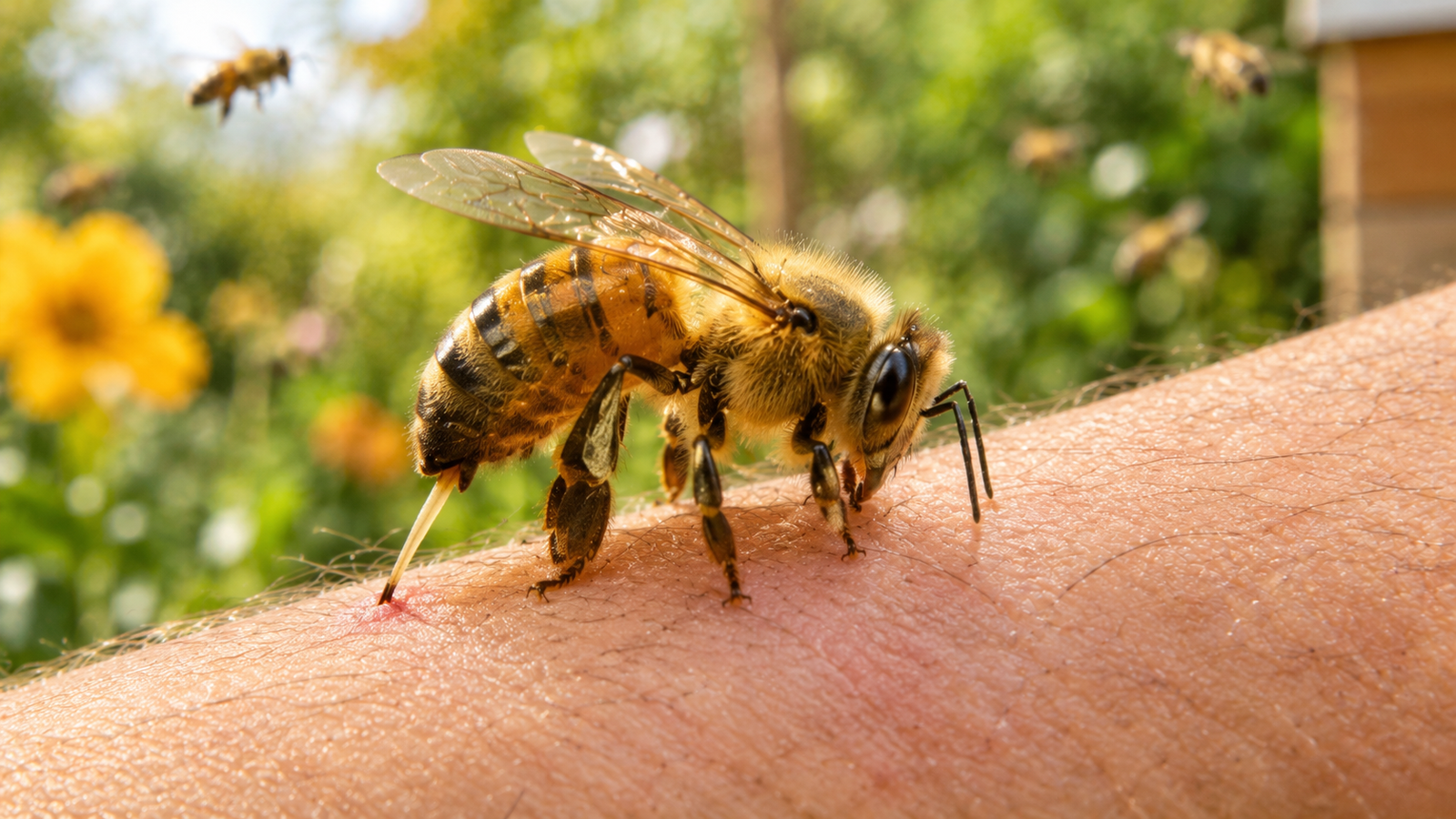
What bee dies after it stings you? The worker honey bee is the bee most commonly known to die after stinging a human. This happens because its barbed stinger can become lodged in human skin. When the bee tries to fly away, the stinger and attached venom-delivery apparatus may tear away from its abdomen, causing severe injuries that are usually fatal.
However, not every bee dies after stinging. Bumble bees, carpenter bees, and many other bees can usually withdraw their stingers and survive. Male bees cannot sting at all, while queen honey bees have stingers that they primarily use when fighting rival queens.
Understanding which bee dies after stinging, why it happens, and how different bees defend themselves can help you better understand bee behavior.
What Bee Dies After It Stings You?
The worker honey bee (Apis mellifera) is the bee most likely to die after stinging a human.
Worker honey bees are female bees responsible for collecting nectar and pollen, producing beeswax, caring for young bees, and defending their colonies. Although honey bees generally avoid unnecessary conflict, worker bees may sting when they or their colony are threatened.
A worker honey bee has a barbed stinger designed to penetrate and remain anchored in the skin of certain animals. When it stings a human, the backward-facing barbs can prevent the stinger from being withdrawn easily.
If the bee pulls away while the stinger is firmly lodged in the skin, the stinger and associated venom-delivery structures may tear from its abdomen. This severe injury usually kills the bee.
This is why the worker honey bee is famous for dying after stinging a person.
However, the outcome depends on the circumstances. A worker honey bee may survive if it can withdraw its stinger without sustaining fatal damage, such as in some encounters with other insects.
Why Does a Honey Bee Die After Stinging You?
A worker honey bee usually dies after stinging a human because its barbed stinger becomes trapped in the skin, and pulling away can cause the stinger apparatus to separate from the bee’s body.
Here is how the process works.
1. The honey bee inserts its stinger
When a worker honey bee perceives a threat, it may use its sharp stinger to defend itself or its colony. The stinger penetrates the skin and delivers venom through a hollow structure.
Honey bee venom causes pain and can trigger redness, swelling, itching, and other reactions. In people who are allergic, a sting can cause a potentially life-threatening allergic reaction.
2. The barbed stinger becomes lodged in the skin
The worker honey bee’s stinger has backward-facing barbs. These barbs help anchor it in the skin, particularly the relatively elastic skin of humans and other mammals.
Unlike a smooth needle, a barbed stinger may be difficult for the bee to pull out once it has penetrated deeply.
3. The bee attempts to fly away
After delivering the sting, the bee may try to escape. If the stinger remains firmly lodged in the skin, the bee cannot easily detach itself.
As the bee pulls away, tension builds between its body and the embedded stinger.
4. The stinger apparatus tears away from the bee
The force can cause the stinger and associated venom-delivery apparatus to separate from the bee’s abdomen. This can involve the venom sac, muscles, glands, and other abdominal tissues.
The resulting injury is severe and usually fatal to the worker honey bee.
This is not a conscious act of self-sacrifice. The bee responds defensively to a perceived threat, and the fatal injury results from the structure of its stinger and the circumstances of the sting.
5. The detached stinger can continue delivering venom
Even after the bee has separated from the stinger, the detached apparatus can continue pumping venom briefly through its muscular mechanism.
That is why you should remove an embedded stinger promptly rather than waiting for the pain to subside.
What Makes a Honey Bee’s Stinger Different?
The main reason worker honey bees may die after stinging humans is the structure of their stingers.
A worker honey bee’s stinger has several specialized features:
- Backward-facing barbs: These help anchor the stinger in human skin.
- Lancets: Two slender, toothed structures work together to penetrate the skin.
- A venom-delivery system: The hollow stinger connects to structures that deliver venom.
- Associated muscles and tissues: These help operate the stinging mechanism and can be torn away when the stinger becomes trapped.
The barbs are especially important. Once the stinger is firmly embedded in human skin, the bee may be unable to withdraw it without suffering severe injury.
Other bees have stingers that are generally easier to withdraw, allowing them to sting and survive.
Do All Honey Bees Die After Stinging?
No. Not every honey bee dies after stinging.
Worker honey bees are most likely to die when their barbed stingers become lodged in the skin of humans or other mammals. However, they may survive in circumstances where the stinger can be withdrawn without fatal injury.
For example, when a worker honey bee attacks another insect, its stinger may penetrate the insect’s body without becoming trapped in the same way it would in human skin.
| Situation | Likely outcome for the worker honey bee |
|---|---|
| Stings a human and the stinger becomes lodged | Usually dies after pulling away |
| Stings another mammal and the stinger becomes lodged | May die from the resulting injury |
| Stings another insect | May withdraw its stinger and survive |
| Stings without trapping or severely damaging its stinger apparatus | May survive |
The important factor is whether the stinger becomes trapped and causes the bee to lose vital tissues when it pulls away.
Which Bees Can Sting You Without Dying?
Several other bees can sting humans and usually survive because their stingers can generally be withdrawn without causing the fatal injury commonly associated with worker honey bees.
1. Bumble bees
Bumble bees are large, fuzzy bees often recognized by their black and yellow markings. Female bumble bees, including queens and workers, can sting when threatened.
Unlike worker honey bees, bumble bees generally have stingers that can be withdrawn from human skin. A female bumble bee can therefore sting more than once without necessarily dying.
Male bumble bees cannot sting because they lack functional stingers.
Bumble bees are usually not aggressive toward people when left undisturbed. Stings are more likely when they are handled, trapped, or threatened.
2. Carpenter bees
Carpenter bees are often confused with bumble bees because they can be similar in size. Many carpenter bees have a shiny, relatively hairless abdomen, while bumble bees tend to have a fuzzy abdomen.
Female carpenter bees can sting, but they are generally reluctant to do so unless threatened or handled. Their stingers are not strongly barbed like those of worker honey bees, so a female carpenter bee can usually withdraw her stinger and survive.
Male carpenter bees cannot sting, although they may hover near people or behave defensively while protecting their territory.
3. Sweat bees
Sweat bees are generally small bees that may be attracted to human perspiration. Most species are not aggressive, although females can sting when handled or threatened.
Their stingers generally allow them to sting and survive.
4. Mining bees
Mining bees are solitary bees that commonly nest in the ground. Females can sting, but they are usually docile and rarely sting unless handled or threatened.
They can generally withdraw their stingers without suffering the same fatal injury commonly experienced by worker honey bees in human skin.
5. Mason bees
Mason bees are solitary bees that often nest in small cavities. Females can sting, but they are usually gentle and unlikely to sting unless trapped or handled.
They generally survive after stinging because their stingers can be withdrawn.
Remember: Being able to sting more than once does not mean these bees will repeatedly attack people. Most bees prefer to avoid confrontation and sting primarily when they feel threatened.
Do Male Bees Die After Stinging You?
Male bees cannot sting humans because they do not have functional stingers.
A bee’s stinger evolved from an egg-laying structure called an ovipositor. As a result, stingers are found in female bees, not males.
Male honey bees are called drones. Their main reproductive role is to mate with a queen, and they do not have stingers for colony defense.
The same general distinction applies to familiar bees such as bumble bees and carpenter bees: females may sting, while males cannot.
Therefore, if a honey bee stings you, it is a female bee, usually a worker honey bee.
Do Queen Honey Bees Die After Stinging?
Queen honey bees have stingers, but they use them differently from worker honey bees.
A queen’s stinger is primarily used during conflicts with rival queens, particularly when competing for reproductive control of a colony. Queens may sting other queens during these encounters.
Queen honey bees generally do not experience the same fatal outcome as worker honey bees when they sting a rival queen. Their stingers are less strongly barbed than those of workers and are better suited to queen-to-queen combat.
Queens rarely sting humans. Their primary role is reproduction, while worker bees carry out most colony defense.
It is therefore important to distinguish between a worker honey bee, which is most likely to die after stinging a human, and a queen honey bee, which has a different role and use for her stinger.
Do Honey Bees Know They Will Die After Stinging You?
There is no scientific evidence that honey bees understand that stinging a human may cause their death.
When a worker honey bee perceives a threat, it responds through evolved defensive behavior. It does not need to understand the long-term consequences of its actions to sting.
Although a worker’s death may occur during colony defense, this does not mean the bee consciously decides to sacrifice itself.
Honey bees can also release alarm pheromones during defensive encounters. These chemical signals can alert nearby workers and encourage them to respond to a perceived threat.
This helps explain why disturbing a honey bee colony can sometimes lead to multiple stings.
Why Do Honey Bees Die After Stinging Humans but Not Always After Stinging Insects?
The difference is largely related to the target’s body structure and the way the stinger becomes embedded.
Human skin is relatively elastic and can hold a worker honey bee’s barbed stinger firmly in place. When the bee tries to fly away, the stinger may remain lodged in the skin.
Many insects have a harder outer covering called an exoskeleton. Depending on the insect and the location of the sting, the bee may be able to withdraw its stinger without losing the associated tissues.
However, this is not a universal rule. A honey bee’s survival depends on the specific circumstances of the encounter, including whether its stinger becomes trapped.
The main point is that the worker honey bee’s barbed stinger is more likely to become lodged in human skin than in many other targets.
What Happens to a Honey Bee After It Stings You?
When a worker honey bee’s stinger becomes lodged in human skin, the bee may fly away without its stinger apparatus or fall near the sting site. The detached apparatus can continue delivering venom briefly.
Because the bee has lost vital tissues, it generally cannot survive for long after this injury.
The bee’s death does not mean that the sting has become harmless. The venom already delivered can continue to cause pain and swelling, and the severity of the reaction depends on the amount of venom delivered and the person’s sensitivity.
For most people, a single honey bee sting causes localized pain, redness, itching, and swelling. These symptoms usually improve over hours to a few days, although larger local reactions can last longer.
People who are allergic to bee venom can develop serious reactions even after a single sting.
What Should You Do If a Honey Bee Stings You?
If a honey bee stings you, taking prompt action can help reduce discomfort and the risk of complications.
1. Move away from the bee
If you are near a hive or a group of defensive bees, move away calmly and get to a safer location. Avoid swatting at bees, which may provoke further defensive behavior.
2. Remove the stinger promptly
Look for a small stinger or dark speck embedded in the skin. Remove it as quickly as possible by scraping it out or pulling it out with your fingers or tweezers.
Do not delay removal while trying to find the perfect method. The priority is to remove the stinger promptly because the detached venom apparatus may continue delivering venom.
3. Wash the sting site
Clean the affected area with soap and water to help reduce the risk of infection.
4. Apply a cold compress
Apply a cold pack wrapped in a cloth for short periods to help reduce pain and swelling. Avoid placing ice directly on the skin.
5. Monitor your symptoms
Watch for worsening swelling, widespread hives, dizziness, vomiting, or breathing difficulties.
Seek emergency medical help immediately if you develop difficulty breathing, swelling of the tongue or throat, faintness, collapse, or other signs of a severe allergic reaction. If you have a prescribed epinephrine auto-injector, use it as directed and seek emergency care.
Multiple stings can also cause serious venom toxicity, even in people who are not allergic. Seek urgent medical advice after numerous stings, particularly if you develop weakness, vomiting, severe pain, or other concerning symptoms.
Frequently Asked Questions About Bees That Die After Stinging
What bee dies after it stings you?
The worker honey bee is the bee most commonly known to die after stinging a human. Its barbed stinger can become lodged in the skin, and pulling away can tear the stinger apparatus and associated tissues from its abdomen.
Why does a honey bee die after stinging a human?
A worker honey bee’s barbed stinger can become trapped in human skin. When the bee pulls away, the stinger and associated venom-delivery apparatus may tear from its abdomen, causing fatal injury.
Do all honey bees die after stinging?
No. Worker honey bees usually die when their stingers become lodged in human or other mammalian skin, but they may survive if they can withdraw their stingers without severe injury.
Do bumble bees die after stinging you?
Bumble bees generally survive after stinging because their stingers can usually be withdrawn from human skin. Female bumble bees may sting more than once if threatened.
Do wasps die after stinging you?
Most wasps can withdraw their stingers and sting repeatedly without dying. Their stingers generally do not become lodged in human skin in the same way as those of worker honey bees.
Do male honey bees sting?
No. Male honey bees, called drones, do not have functional stingers. Worker honey bees and queens are female and possess stingers.
Can a dead honey bee still sting you?
A dead honey bee cannot deliberately sting you. However, its detached stinger can still injure you if handled, and an embedded stinger may continue delivering venom briefly.
Avoid touching a detached stinger with bare hands.
Does the honey bee queen die after stinging?
Not usually. Queen honey bees primarily use their stingers during fights with rival queens, and their stingers are less strongly barbed than those of workers. They generally do not suffer the same fatal injury when stinging a rival queen.
Can a honey bee survive after losing its stinger?
A worker honey bee that loses its stinger apparatus along with associated abdominal tissues generally cannot survive for long because the injury is severe and damages vital structures.
Do honey bees sting people on purpose?
Honey bees generally sting defensively rather than seeking out people to attack. They may sting when threatened, crushed, trapped, or defending their colony.
Conclusion
The worker honey bee is the bee most likely to die after it stings you. Its barbed stinger can become lodged in human skin, and when the bee pulls away, the stinger and associated venom-delivery apparatus may tear from its abdomen. This injury is usually fatal.
However, not all bees die after stinging. Bumble bees, carpenter bees, mining bees, and many other species can generally withdraw their stingers and survive. Male bees cannot sting, while queen honey bees primarily use their stingers during conflicts with rival queens.
The key difference is the structure of the stinger and whether it becomes trapped. Understanding this difference helps explain why worker honey bees can die after defending themselves, while many other bees can sting and survive.
If you are stung by a honey bee, remove any embedded stinger promptly, treat the affected area, and seek emergency help if you experience signs of a severe allergic reaction.
