

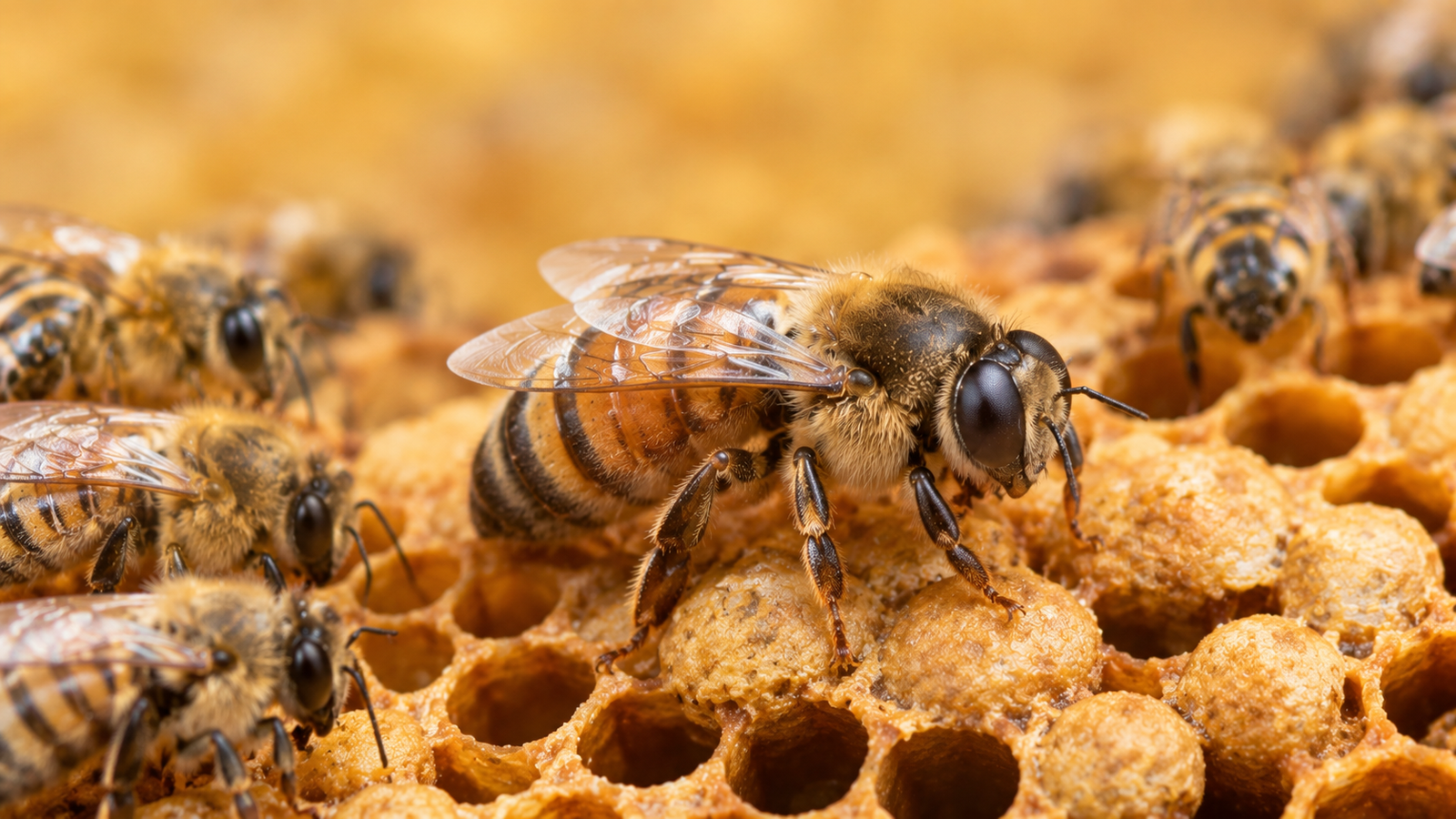
What is a drone bee? A drone bee is a male honey bee whose primary role is to mate with a queen. Unlike female worker bees, drones do not normally collect nectar or pollen, build honeycomb, feed larvae, or defend the colony. Instead, their main biological purpose is reproduction and passing their genes to the next generation.
Drones are easy to recognize because they are usually larger and broader than worker bees and have exceptionally large eyes. They are produced from unfertilized eggs and spend much of their adult lives inside the colony or flying to areas where queens and drones gather for mating.
Although drones do not perform most of the daily work of a honey bee colony, they are essential because successful mating provides queens with the sperm needed to produce future generations of female bees.
What Is a Drone Bee?
A drone bee is a male honey bee that develops from an unfertilized egg laid by a queen.
The three main types of honey bees in a colony are:
- Queen: A reproductive female that lays eggs.
- Worker: A non-reproductive female that performs most colony tasks.
- Drone: A male whose primary role is to reproduce by mating with queens.
A drone’s role is therefore very different from that of a worker. Worker bees keep the colony functioning by collecting food, caring for brood, producing wax, regulating temperature, cleaning the hive, and defending the entrance. Drones are primarily involved in reproduction.
What Does a Drone Bee Do?
The main job of a drone bee is to mate with a virgin queen.
When a young queen reaches reproductive maturity, she leaves the colony on one or more mating flights. Drones also leave their colonies and travel to areas where many drones gather.
These locations are called drone congregation areas.
When a virgin queen enters one of these areas, drones compete to reach her and mate with her. The successful drones transfer sperm to the queen, which she stores inside her body for later use.
A queen can mate with multiple drones during her mating flights. This gives the colony sperm from different males and increases genetic diversity among the queen’s offspring.
Why Are Drone Bees Important?
Drones are important because they provide the sperm needed for honey bee reproduction.
Without drones, virgin queens would not be able to become fully reproductive queens capable of producing fertilized female offspring.
Drones also contribute to genetic diversity.
A queen typically mates with multiple drones, and the sperm from these males can be stored and used to fertilize eggs over time. As a result, workers in the same colony can have different fathers even though they share the same mother.
Greater genetic diversity can contribute to differences in traits such as behavior, disease resistance, productivity, and environmental adaptation.
So, although drones do not perform most of the visible work in the hive, their reproductive contribution is essential to the long-term success of honey bee colonies.
What Does a Drone Bee Look Like?
Drone bees are generally easy to distinguish from worker bees.
A typical drone has:
- A larger, broader body
- A thick, somewhat rounded abdomen
- A large, rounded head
- Very large compound eyes
- Large wings
- No pollen baskets
- No functional worker-type stinger
The large eyes are one of the drone’s most recognizable features. Their large compound eyes help them detect queens during mating flights.
Drones can also appear somewhat blunt or bulky compared with the slimmer bodies of worker bees.
How Is a Drone Bee Different From a Worker Bee?
The most important difference is that a drone is male, while a worker is female.
| Feature | Drone Bee | Worker Bee |
|---|---|---|
| Sex | Male | Female |
| Develops from | Unfertilized egg | Fertilized egg |
| Main role | Reproduction | Colony maintenance |
| Body size | Larger | Smaller |
| Eyes | Very large | Smaller |
| Collects nectar | No | Yes |
| Collects pollen | No | Yes |
| Produces wax | No | Yes |
| Feeds larvae | No | Yes |
| Makes honey | No | Yes |
| Defends colony | No | Yes |
| Functional stinger | No | Yes |
This division of labor allows the colony to efficiently manage reproduction, food collection, brood care, defense, and other essential activities.
How Are Drone Bees Born?
Drone bees develop from unfertilized eggs.
This is one of the most interesting features of honey bee reproduction.
When the queen lays an egg, she can control whether sperm is released to fertilize that egg. Fertilized eggs develop into females—either workers or queens. Unfertilized eggs develop into males, which are drones.
This reproductive system is known as haplodiploidy.
In simple terms:
- Fertilized egg → female honey bee
- Unfertilized egg → male drone
Because a drone develops from an unfertilized egg, he receives his genetic material from his mother only.
Does a Drone Bee Have a Father?
No. A drone bee does not have a biological father.
Because the drone develops from an unfertilized egg, no male contributed sperm to create him.
However, a drone does have a grandfather.
His mother, the queen, developed from a fertilized egg. Therefore, she had a father. That male is the drone’s maternal grandfather.
This unusual inheritance pattern is a direct consequence of the honey bee’s haplodiploid reproductive system.
How Long Does a Drone Bee Take to Develop?
A drone generally takes about 24 days to develop from egg to adult.
The basic development stages are:
- Egg
- Larva
- Pupa
- Adult drone
Compared with other honey bees:
- Queen: about 16 days
- Worker: about 21 days
- Drone: about 24 days
The exact timing can vary somewhat with colony conditions and temperature.
After completing development, the adult drone emerges from its cell and gradually becomes sexually mature.
What Are Drone Cells?
Drone cells are the larger brood cells used to raise male honey bees.
They are noticeably larger than worker brood cells because drones have larger bodies.
Drone cells are often found in groups, particularly along the lower portions or edges of brood comb, although their location can vary.
After the drone larva develops, the cell is capped. Drone brood caps are typically more raised and rounded than the flatter caps covering worker brood.
This distinctive appearance can help beekeepers identify drone brood when inspecting a colony.
Why Do Drone Cells Matter to Beekeepers?
Drone brood is important to beekeepers for more than simply identifying male bees.
Drone brood can be particularly attractive to Varroa mites, which reproduce within capped honey bee brood. Drone brood develops for longer than worker brood, providing mites with a longer reproductive opportunity.
For this reason, beekeepers may pay particular attention to drone brood when monitoring colony health and managing Varroa.
Drone brood can therefore be both:
- An essential part of natural colony reproduction
- An important consideration in honey bee health management
Beekeepers should use appropriate, evidence-based Varroa monitoring and control practices rather than assuming that drone brood alone will solve a mite problem.
Do Drone Bees Make Honey?
No. Drone bees do not normally make honey.
Honey production is primarily performed by worker bees. Workers collect nectar, process it, reduce its moisture content, and store it in honeycomb.
Drones depend on worker bees for food.
Their lack of contribution to nectar collection is one reason colonies may reduce their drone population when food becomes scarce.
Do Drone Bees Collect Pollen?
No. Drones do not collect pollen.
Worker bees have specialized structures on their hind legs called pollen baskets, or corbiculae, which help them transport pollen back to the colony.
Drones do not have these structures and do not perform pollen-collection duties.
Can a Drone Bee Sting?
No, a drone bee cannot sting like a worker bee.
The honey bee stinger is a modified egg-laying structure, so it is found in female bees.
Because drones are male, they do not have a functional worker-type stinger.
This means a drone cannot defend the hive by stinging predators or people.
Where Do Drone Bees Mate With Queens?
Drones typically leave the hive and fly to drone congregation areas, where large numbers of drones gather.
These areas can contain drones from multiple colonies.
A virgin queen flies into these areas during her mating flights, allowing her to encounter males from colonies other than her own.
This behavior is important because mating with drones from different colonies increases the genetic diversity represented in the queen’s stored sperm.
How Many Drones Mate With a Queen?
A queen typically mates with multiple drones, rather than a single male.
Research has shown that queens commonly mate with numerous drones during one or more mating flights. The exact number can vary between queens and populations.
Although many drones may gather in a congregation area, only a relatively small number successfully mate with a particular queen.
This competition is primarily about which drones can reach the queen during flight rather than physical fighting between males.
What Happens When a Drone Mates With a Queen?
For a drone that successfully mates, reproduction comes at a high cost.
During mating, the drone transfers sperm to the queen. The mating process causes severe physical injury to the drone, and the drone normally dies shortly afterward.
The queen, however, retains the sperm and can use it to fertilize eggs later.
Therefore, a successful mating allows a drone to contribute his genes to the next generation even though he does not survive the mating event.
How Does Drone Mating Help Genetic Diversity?
Genetic diversity is one of the most important reasons drones are necessary.
A queen mates with multiple drones, and their sperm can remain stored inside her reproductive system.
When the queen later lays fertilized eggs, sperm from different males can fertilize different eggs.
This means a colony can contain groups of worker bees that share the same mother but have different fathers.
Genetic diversity can be valuable because colonies with different genetic backgrounds may vary in characteristics such as:
- Disease resistance
- Foraging behavior
- Temperament
- Productivity
- Environmental adaptation
- Colony survival
Drones therefore contribute much more than simply producing individual offspring. They help distribute genetic variation throughout honey bee populations.
Do Drones Help Cool the Hive?
Drones are not responsible for colony temperature regulation in the same way that worker bees are.
However, bees of different types can contribute to hive ventilation under certain conditions. Drones may also participate in wing fanning when temperatures rise.
Worker bees remain the primary specialists in regulating the hive environment.
When Do Honey Bee Colonies Produce Drones?
Colonies commonly produce more drones during the warmer and more resource-rich parts of the year.
Drone numbers often increase during spring and summer, when:
- Food becomes more available
- Colonies expand
- Swarming activity increases
- Virgin queens need to mate
- Reproduction becomes more favorable
The exact timing varies according to climate, colony condition, food availability, and local seasonal patterns.
Seeing drones in a colony during the appropriate season is therefore generally normal.
Do Drones Mean a Colony Is Preparing to Swarm?
Not necessarily, but the presence of drones can be an important seasonal clue.
Drones are particularly common when colonies are preparing for reproductive activity.
During spring and early summer in many regions, increasing drone production can occur around the same time that colonies become more likely to swarm.
However, the presence of drones alone does not mean that a colony will swarm.
Beekeepers should also look for other signs of swarm preparation, such as queen cells, congestion, and a strong, rapidly growing colony.
How Long Does a Drone Bee Live?
A drone can live for several weeks or, under favorable conditions, potentially a few months.
Its lifespan depends on factors such as:
- Season
- Food availability
- Colony condition
- Temperature
- Predation
- Whether it successfully mates
A drone that successfully mates dies shortly afterward.
Drones that do not mate may survive longer, but they can be expelled from the colony when resources become limited.
Why Are Drones Kicked Out of the Hive?
As colder weather arrives and flowers become less abundant, maintaining drones becomes an additional cost for the colony.
Drones consume food but do not contribute to foraging or most colony-maintenance tasks.
When resources become scarce, worker bees may begin evicting drones from the hive.
The workers may prevent drones from re-entering the colony, causing them to die from starvation or exposure.
This behavior is especially common before or during winter in climates where colonies must conserve food.
Do Drones Survive Winter?
In many temperate honey bee colonies, drones do not normally remain in the hive throughout winter.
As autumn approaches, colonies typically reduce or eliminate their drone population.
This is an energy-saving strategy. The colony can conserve stored food for the workers and queen that will be needed to survive the winter.
In warmer climates where colonies can continue foraging and reproducing throughout the year, drone populations may behave differently.
Are Drone Bees Good or Bad for a Hive?
Drone bees are neither simply good nor bad.
They are a normal and essential component of a honey bee colony.
Drones consume colony resources, but they also perform an irreplaceable reproductive function.
A colony needs drones because virgin queens need males with which to mate. At the same time, colonies regulate drone numbers according to seasonal conditions and available resources.
The apparent “cost” of producing drones is therefore part of the colony’s overall reproductive strategy.
Can Worker Bees Lay Drone Eggs?
Yes. In certain circumstances, worker bees can lay unfertilized eggs that develop into drones.
These workers are called laying workers.
Because worker bees are female but normally cannot mate, the eggs they lay are unfertilized. As a result, those eggs develop into drones rather than workers or queens.
A colony with a laying worker problem can therefore contain large amounts of drone brood, often with brood placed irregularly in worker-sized cells.
This is different from a healthy queen laying drone eggs in appropriately sized drone cells.
Why Do Drone Bees Have Large Eyes?
Drones have exceptionally large compound eyes because vision is important during mating flights.
A drone needs to detect and pursue a queen while flying in an area containing many other bees.
Their large eyes provide a broad visual field and are one of the clearest physical adaptations associated with their reproductive role.
What Is the Life Cycle of a Drone Bee?
The drone life cycle can be summarized as:
Unfertilized egg → larva → pupa → adult drone → mating or eviction → death
Stage 1: Egg
The queen lays an unfertilized egg in a drone cell.
Stage 2: Larva
The egg hatches and the larva is fed by worker bees.
Stage 3: Pupa
The larva develops inside its capped cell and undergoes metamorphosis.
Stage 4: Adult
After roughly 24 days from egg to adult, the drone emerges.
Stage 5: Sexual maturity
The young drone develops and eventually begins making mating flights.
Stage 6: Reproduction or eviction
A drone may successfully mate with a queen, or it may continue flying until the colony eventually removes it when conditions become unfavorable.
Stage 7: Death
A successful mating results in the drone’s death. Drones that are evicted may die from starvation or exposure.
Why Are Drone Bees Important to Beekeepers?
Understanding drones can help beekeepers interpret what is happening inside a colony.
Drones can provide useful information about:
- Seasonal colony development
- Reproductive activity
- Brood patterns
- Potential swarm preparation
- Varroa mite pressure
- Queen and colony health
Drone brood can also be examined during hive inspections to assess brood production and identify unusual patterns.
However, drones should not automatically be treated as unwanted bees. Removing drones indiscriminately can interfere with natural colony reproduction.
Frequently Asked Questions About Drone Bees
What is a drone bee?
A drone bee is a male honey bee that develops from an unfertilized egg. Its primary purpose is to mate with a virgin queen and contribute genetic material to the next generation.
Is a drone bee male or female?
A drone is male. Queens and worker bees are female.
What is the main purpose of a drone bee?
The main purpose of a drone is reproduction. Drones leave the colony to find and mate with virgin queens.
Do drone bees make honey?
No. Drones do not normally collect nectar or make honey. These jobs are performed primarily by worker bees.
Do drone bees collect pollen?
No. Drones do not collect pollen and do not have the specialized pollen baskets found on worker bees.
Can drone bees sting?
No. Male honey bees do not have the functional stinger found in female worker bees.
How are drone bees born?
Drones develop from unfertilized eggs laid by the queen.
How long does a drone bee take to develop?
A drone generally takes about 24 days to develop from egg to adult.
How can you identify a drone bee?
Drones are generally larger and broader than workers and have very large compound eyes. They also have large wings and lack the pollen baskets and functional stinger of worker bees.
How many drones mate with a queen?
A queen normally mates with multiple drones during her mating flights. The exact number varies, but a queen can mate with numerous males.
Where do drone bees mate?
Drones gather in drone congregation areas, where they may encounter virgin queens during their mating flights.
Do drone bees die after mating?
Yes. A drone that successfully mates with a queen normally dies shortly afterward because the mating process causes fatal physical injury.
Why are drone bees kicked out of the hive?
When food becomes scarce, particularly before winter in temperate climates, worker bees may evict drones to conserve the colony’s food resources.
Do drone bees have fathers?
No. A drone develops from an unfertilized egg, so he has no biological father. However, he does have a grandfather through his mother.
Why are drone cells larger?
Drone bees are larger than workers, so they require larger brood cells. Drone cells are also usually capped with more raised, rounded coverings.
Are drone bees important?
Yes. Drones are essential for honey bee reproduction because they provide sperm for queens. Their mating activity also contributes to genetic diversity within honey bee populations.
Final Answer: What Is a Drone Bee?
So, what is a drone bee?
A drone bee is a male honey bee that develops from an unfertilized egg and specializes in reproduction. Its primary role is to leave the colony, find a virgin queen, and mate with her.
Drones are larger than worker bees, have exceptionally large eyes, do not collect nectar or pollen, and do not have a functional stinger. They develop in larger drone cells and take about 24 days to reach adulthood.
Their importance goes far beyond mating. Because queens mate with multiple drones, drones help introduce genetic diversity into honey bee colonies. Their offspring can inherit different combinations of paternal genes, which can influence important colony traits.
Drones may appear to contribute little to everyday hive activities, but they perform an essential reproductive function. Once mating opportunities decline and resources become scarce, colonies may remove drones to conserve food.
In short, the drone bee is the male reproductive member of the honey bee colony, and its primary contribution is helping produce the next generation of bees.
