
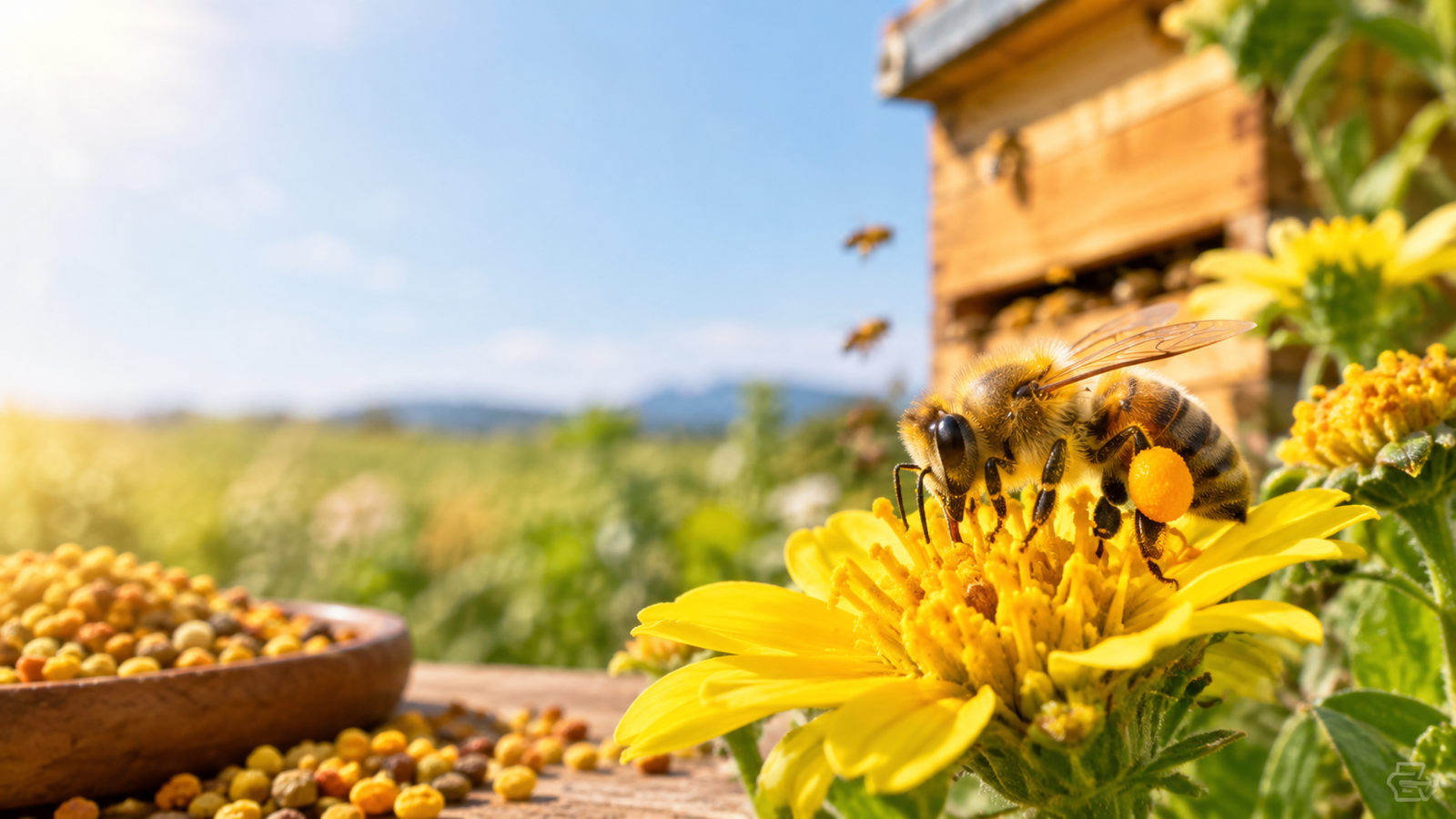
Bee pollen is flower pollen collected by honey bees and packed into small pellets with the help of nectar and bee secretions. Bees carry these pollen pellets back to their hive, where pollen provides an important source of protein, amino acids, lipids, vitamins, minerals, and other nutrients for the colony.
Bee pollen is also consumed by people as a food or dietary supplement. It is commonly sold as small granules, powder, capsules, or tablets.
But what exactly is bee pollen? How do bees collect it? What does it contain? Why do bees need it, and is bee pollen safe for humans?
This guide explains what bee pollen is, how it is made, what it contains, how bees use it, how people consume it, its potential benefits, possible risks, and how it differs from honey, bee bread, royal jelly, and propolis.
What Is Bee Pollen?
Bee pollen is pollen collected by honey bees from flowering plants and formed into small pellets that the bees carry back to their hive.
Pollen itself is produced by plants as part of their reproductive process. When honey bees visit flowers, pollen grains stick to their bodies. The bees groom the pollen from their bodies and gather it into compact pellets on their hind legs.
The bees use small amounts of nectar and bee secretions to help bind the pollen together. The resulting pellets are commonly called bee pollen.
So, in simple terms:
Flower pollen + bee collection and packing = bee pollen.
Bee pollen should not be confused with pollen taken directly from flowers. The pollen in bee pollen has been collected and processed by honey bees.
How Do Bees Collect Bee Pollen?
Honey bees collect pollen while visiting flowers to forage for food.
The process generally works as follows:
- A honey bee visits a flower.
- Pollen grains stick to the bee’s body.
- The bee uses its legs to groom the pollen from its body.
- The pollen is mixed with small amounts of nectar or other substances to help it stick together.
- The bee packs the pollen into pellets.
- The pellets are placed on specialized structures on the bee’s hind legs called pollen baskets, or corbiculae.
- The bee carries the pollen back to the hive.
A single bee may visit many flowers during its foraging activities. As a result, collected bee pollen can contain pollen from several different plant species.
What Does Bee Pollen Look Like?
Bee pollen usually appears as small, irregular granules or pellets.
Its color can vary considerably depending on the plants from which the bees collected the pollen. Bee pollen may be:
- Yellow
- Orange
- Red
- Brown
- Green
- Purple
- A mixture of several colors
The flavor can also vary. Depending on its botanical source, bee pollen may taste floral, mildly sweet, earthy, bitter, or slightly nutty.
Its color, taste, and nutritional composition can therefore differ from one batch to another.
What Is Bee Pollen Made Of?
Bee pollen has a complex composition, but there is no single nutritional profile that applies to all bee pollen.
Its composition can vary according to:
- The plant species visited by the bees
- Geographic location
- Season
- Weather
- Soil conditions
- Bee species
- Harvesting methods
- Processing and storage
Bee pollen can contain varying amounts of:
- Protein
- Amino acids
- Carbohydrates
- Lipids and fatty acids
- Water
- Vitamins
- Minerals
- Enzymes
- Antioxidant compounds
- Other plant-derived bioactive compounds
The uploaded medical source similarly notes that bee pollen contains proteins, carbohydrates, lipids, vitamins, minerals, enzymes, and antioxidants, while emphasizing that its composition depends on the plant sources and season.
This variation is important because two bee pollen products can have noticeably different nutritional compositions.
How Much Protein Does Bee Pollen Contain?
Bee pollen can be a relatively protein-rich bee product, but the exact amount varies substantially according to its botanical source.
For example, the source reviewed for this article reports major differences between pollen collected from different plants, illustrating why a single protein percentage should not be presented as applying to all bee pollen.
Therefore, if you want to know the nutritional content of a particular commercial product, the product’s nutrition label or laboratory analysis is more useful than a general figure.
Why Do Bees Need Pollen?
Pollen is one of the most important nutritional resources in a honey bee colony.
Nectar primarily provides carbohydrates, while pollen supplies protein and other nutrients.
Worker bees use pollen as part of the food resources needed to support developing larvae and young bees. Adequate pollen availability is therefore important for colony growth and development.
Bees collect pollen throughout the foraging season and may store it inside honeycomb cells.
This is one of the key differences between bee pollen and honey: bees primarily collect pollen for its nutrients, while nectar is the raw material from which honey is produced.
What Is Bee Bread?
Bee bread is closely related to bee pollen, but the two terms do not mean exactly the same thing.
Bee pollen generally refers to the pollen pellets collected by bees and brought back to the hive.
Bee bread is pollen that bees have stored inside honeycomb cells and processed through fermentation and other hive processes.
A simplified way to understand the difference is:
- Bee pollen: freshly collected pollen pellets
- Bee bread: stored and fermented pollen inside the hive
Bee bread therefore represents a later stage of pollen processing within the colony.
What Are the Potential Benefits of Bee Pollen?
Bee pollen is consumed by humans because of its nutritional content and the variety of plant compounds it contains.
Research has investigated bee pollen for several potential biological effects, including antioxidant, anti-inflammatory, and antimicrobial activity.
However, it is important to distinguish laboratory or animal findings from proven health effects in humans.
The medical source reviewed for this article discusses antioxidant, anti-inflammatory, antimicrobial, cardiovascular, liver, wound-healing, and other potential effects, but also acknowledges that much of the evidence comes from laboratory and animal research and that more human research is needed.
Bee Pollen and Antioxidants
Some types of bee pollen contain antioxidant compounds, including various flavonoids, carotenoids, and other plant-derived compounds.
Antioxidants can help protect cells from oxidative damage.
However, finding antioxidant activity in a laboratory does not automatically prove that eating bee pollen will prevent a particular disease in humans.
Bee Pollen and Inflammation
Research has also examined compounds in bee pollen for possible anti-inflammatory effects.
Laboratory and animal studies have reported biological effects involving inflammatory pathways. However, these findings should not be interpreted as proof that bee pollen can replace established medical treatments for inflammatory conditions.
Bee Pollen and Other Health Claims
Bee pollen is sometimes marketed for:
- Immune support
- Cardiovascular health
- Liver health
- Wound healing
- Menopausal symptoms
- Allergy relief
- General nutrition
Some of these areas have been investigated in laboratory, animal, or human studies, but the strength of evidence varies.
For this reason, bee pollen should be regarded primarily as a food or supplement, rather than a proven treatment or cure for a medical condition.
How Do People Eat Bee Pollen?
People commonly consume bee pollen in several forms, including:
- Whole granules
- Powder
- Capsules
- Tablets
Granules or powder may be added to foods such as:
- Yogurt
- Oatmeal
- Cereal
- Smoothies
- Fruit
- Salads
There is no universally established therapeutic dose of bee pollen for treating disease because products vary in composition and research has not established a standard medical dosage.
If you are using a commercial bee pollen supplement, follow the manufacturer’s instructions.
Is Bee Pollen Safe?
Bee pollen can be consumed as a food by many people, but it is not risk-free.
The most important safety concern is an allergic reaction.
Because bee pollen can contain pollen from different plants, people with pollen allergies may react to it.
Possible allergic symptoms include:
- Itching
- Hives
- Skin reactions
- Swelling
- Sneezing
- Runny nose
- Stomach or digestive symptoms
- Difficulty breathing
In severe cases, an allergic reaction can cause anaphylaxis, which is a medical emergency.
The medical source reviewed for this article also warns that people allergic to pollen should avoid bee pollen because reactions can include itching, swelling, difficulty breathing, and anaphylaxis.
If someone develops severe difficulty breathing, swelling of the throat or tongue, fainting, or other signs of a serious allergic reaction after consuming bee pollen, emergency medical attention is necessary.
Who Should Be Careful With Bee Pollen?
Extra caution may be appropriate for people who:
- Have pollen allergies
- Have known allergies to bee products
- Have experienced serious allergic reactions
- Take prescription medications
- Are pregnant
- Are breastfeeding
- Want to use bee pollen to manage a medical condition
The reviewed source specifically mentions potential interaction with blood-thinning medication such as warfarin and advises caution during pregnancy and breastfeeding because of insufficient safety evidence.
If you take medication or have a medical condition, talk with a healthcare professional before using bee pollen as a supplement.
Can Bee Pollen Cause Allergies?
Yes.
Bee pollen can trigger allergic reactions, particularly in people who are sensitive to pollen.
A common misconception is that because bees collect pollen, bee pollen must be safe for people with pollen allergies. That is not necessarily true.
Bee pollen can contain pollen from different plants, and the exact allergen profile can vary between products.
Therefore, people with known pollen allergies should be particularly cautious.
What Is the Difference Between Bee Pollen and Honey?
Bee pollen and honey are both produced or collected by honey bees, but they come from different sources and serve different roles.
| Bee Pollen | Honey |
|---|---|
| Primarily flower pollen collected by bees | Primarily produced from flower nectar |
| Provides protein and other nutrients to the colony | Primarily provides carbohydrates |
| Usually appears as granules or pellets | Usually a thick liquid or crystallized food |
| Collected from flowers | Made from nectar collected from flowers |
| Commonly sold as granules, powder, or supplements | Commonly used as a food and sweetener |
The simplest distinction is:
Bee pollen comes primarily from flower pollen, while honey comes primarily from flower nectar.
What Is the Difference Between Bee Pollen and Royal Jelly?
Royal jelly and bee pollen are different bee products.
Bee pollen originates primarily from pollen collected from flowers.
Royal jelly is a secretion produced by worker bees and used to feed developing larvae and queen bees.
Therefore, although both are associated with honey bee colonies, they have different origins, compositions, and biological roles.
What Is the Difference Between Bee Pollen and Propolis?
Propolis is another completely different hive product.
Bees collect plant resins and combine them with bee-derived substances to produce propolis. They use it primarily as a protective and construction material inside the hive.
In simple terms:
- Bee pollen: collected flower pollen
- Honey: processed flower nectar
- Royal jelly: secretion produced by worker bees
- Propolis: plant resins modified by bees
- Beeswax: wax produced by bees
These products should not be treated as interchangeable.
Is Bee Pollen the Same as Flower Pollen?
No.
Flower pollen is produced directly by plants.
Bee pollen is flower pollen that has been collected and packed by honey bees, usually into pellets using small amounts of nectar and bee secretions.
The terms are therefore related, but they describe different forms of the material.
Does Bee Pollen Come From One Plant?
Not necessarily.
Honey bees may visit many different flowering plants while collecting pollen.
Consequently, a batch of bee pollen can contain pollen from multiple plant species.
The botanical composition can influence:
- Color
- Taste
- Nutritional composition
- Protein content
- Amount and type of plant compounds
This is another reason why bee pollen from different regions or seasons can differ considerably.
How Do Beekeepers Collect Bee Pollen?
Beekeepers can collect bee pollen using a device called a pollen trap.
The trap is installed near the entrance of a hive. As returning bees pass through the device, some of the pollen pellets attached to their hind legs are removed and fall into a collection container.
The collected pollen can then be cleaned, dried, refrigerated, or otherwise processed depending on the product and intended use.
Beekeepers must manage collection carefully because pollen is also an important food resource for the colony.
Does Bee Pollen Expire?
Yes.
Bee pollen can deteriorate over time, particularly when exposed to:
- Moisture
- Heat
- Oxygen
- Light
- Contamination
The exact shelf life depends on how the product was harvested, processed, packaged, and stored.
For commercially packaged bee pollen, follow the manufacturer’s storage instructions and use the product before its stated expiration or best-before date.
How Should Bee Pollen Be Stored?
Storage instructions vary by product.
In general, bee pollen should be protected from excessive heat and moisture and kept in a properly sealed container.
If a product label recommends refrigeration or another specific storage method, follow those instructions.
Is Bee Pollen Good for You?
Bee pollen can provide protein, amino acids, fats, carbohydrates, vitamins, minerals, antioxidants, and other plant compounds.
However, the nutritional composition varies substantially between products, and the evidence for specific health benefits in humans is not strong enough to treat bee pollen as a cure or universal health remedy.
It is best considered a food or dietary supplement that can contribute nutrients to the diet.
A balanced diet should remain the foundation of nutrition.
Frequently Asked Questions About Bee Pollen
What exactly is bee pollen?
Bee pollen is flower pollen collected by honey bees and packed into small pellets with the help of nectar and bee secretions. Bees bring these pellets back to the hive as an important nutritional resource.
Is bee pollen made by bees?
Not exactly. Plants produce pollen. Bees collect, moisten, and pack the pollen into pellets, producing what people commonly call bee pollen.
What is bee pollen used for by bees?
Bees use pollen primarily as a source of protein, amino acids, lipids, vitamins, minerals, and other nutrients needed by the colony.
What is bee pollen used for by humans?
Humans commonly consume bee pollen as a food or dietary supplement because it contains various nutrients and plant compounds.
Is bee pollen the same as honey?
No. Bee pollen comes primarily from flower pollen, while honey is produced mainly from flower nectar.
Is bee pollen the same as bee bread?
No. Bee pollen generally refers to collected pollen pellets, while bee bread is pollen that bees have stored and fermented inside the hive.
Does bee pollen contain protein?
Yes. Bee pollen can contain substantial amounts of protein and amino acids, but the amount varies according to its botanical source.
What color is bee pollen?
Bee pollen can be yellow, orange, red, brown, green, purple, or a mixture of colors depending on the flowers from which the bees collected the pollen.
Can humans eat bee pollen?
Yes. Bee pollen is commonly consumed as granules, powder, capsules, and tablets. However, people with pollen allergies should be cautious because allergic reactions can occur.
Can bee pollen cause an allergic reaction?
Yes. Bee pollen can cause allergic reactions, including potentially severe reactions, particularly in people who are sensitive to pollen.
Can bee pollen cure allergies?
There is not enough reliable evidence to conclude that bee pollen can cure allergies. In fact, consuming bee pollen can trigger allergic reactions in susceptible people.
Can children eat bee pollen?
Because allergic reactions are possible and safety depends on the individual child and product, parents should consult a pediatric healthcare professional before giving bee pollen to a child.
Is bee pollen vegan?
There is no universal answer because vegan definitions differ. Since bee pollen is collected by bees and is a hive-associated product, many vegans choose not to consume it.
Final Answer: What Is Bee Pollen?
Bee pollen is flower pollen collected by honey bees and formed into small pellets using pollen, nectar, and bee secretions. Bees carry these pellets back to their hive, where pollen provides important nutrients for the colony.
For humans, bee pollen is commonly sold as granules, powder, capsules, or tablets. It contains varying amounts of protein, amino acids, carbohydrates, lipids, vitamins, minerals, enzymes, antioxidants, and other plant compounds. Its exact nutritional composition depends heavily on the plants from which the bees collected the pollen.
Bee pollen is different from honey, bee bread, royal jelly, propolis, and beeswax, even though all are associated with honey bees.
Research has investigated bee pollen for antioxidant, anti-inflammatory, antimicrobial, nutritional, and other potential effects. However, much of the evidence comes from laboratory and animal research, so specific health claims should be interpreted cautiously.
Most importantly, bee pollen can cause allergic reactions, particularly in people who are sensitive to pollen. Anyone with pollen allergies, taking medication, pregnant, breastfeeding, or considering bee pollen for a health condition should seek appropriate professional advice before using it.
In short, bee pollen is not pollen made by bees—it is plant pollen collected and packed by bees, and it serves as an important nutritional resource inside the hive.
