

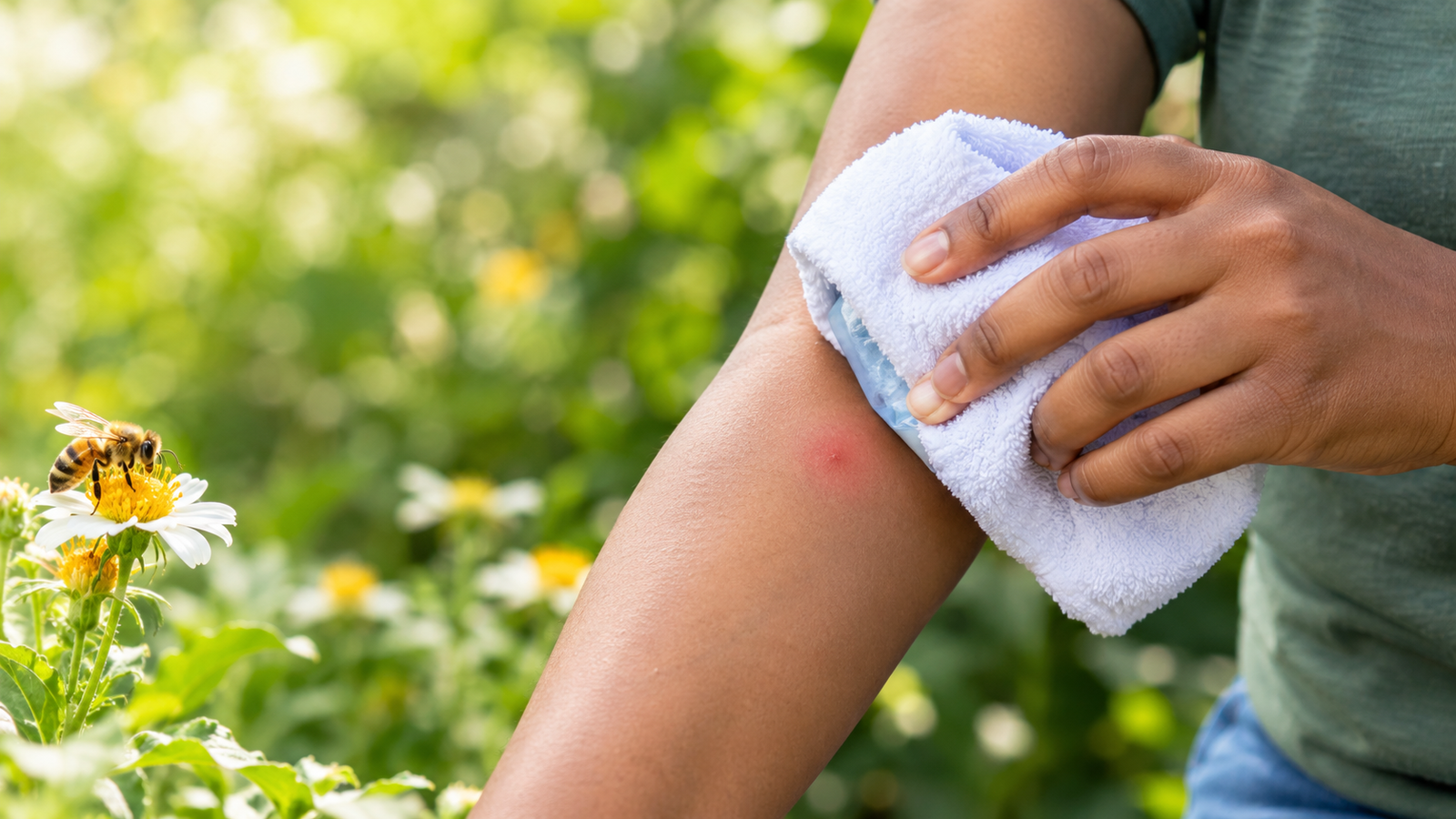
When bee sting what to do? If a bee stings you, move away from the bee, remove the stinger quickly if it remains in your skin, wash the affected area with soap and water, and apply a cold compress for 10–20 minutes. These steps help reduce pain, swelling, and irritation.
Most bee stings cause a temporary local reaction that can be treated at home. However, some stings trigger severe allergic reactions, while receiving numerous stings can cause venom-related illness even in someone who is not allergic.
The most important thing is knowing the difference between an ordinary bee sting reaction and symptoms that require medical attention. Difficulty breathing, swelling of the tongue or throat, dizziness, or collapse can indicate anaphylaxis, a life-threatening emergency.
This guide explains what to do immediately after a bee sting, how to treat pain and swelling at home, why different bees leave different types of stings, and when to seek medical help.
What to Do Immediately After a Bee Sting
If a bee stings you, take the following steps as soon as possible.
1. Move Away From the Bee
First, calmly move away from the bee and the area where the sting occurred.
If you are near a hive, nest, or group of defensive bees, move to a safe enclosed location if possible. Avoid swatting at bees or attempting to disturb their nest.
This step is important because some bees release alarm pheromones when they sting. These chemical signals can attract other defensive honey bees toward the area.
For example, if someone is stung while working near a honey bee hive, remaining beside the hive to examine the wound could expose them to additional stings. Moving away first is safer.
2. Remove the Stinger as Quickly as Possible
Check the sting site for a small, dark, needle-like structure. A honey bee worker commonly leaves its barbed stinger embedded in human skin when it flies away.
Remove a visible stinger promptly.
You can use:
- Your fingernail to scrape it sideways.
- The edge of a clean plastic card.
- Your fingers or tweezers to grasp and remove it if that is the quickest available method.
The important thing is not to waste time deciding which removal technique is perfect.
A honey bee’s retained stinger is connected to a venom apparatus that can continue delivering venom briefly after the bee has separated from it. Removing it quickly limits further venom delivery.
Why does this happen?
The worker honey bee has a barbed stinger. When it penetrates the relatively elastic skin of a human, the barbs can hold it in place. As the bee pulls away, the stinger and associated venom apparatus can become detached from its body.
This is different from many other bees, which can usually withdraw their stingers.
3. Wash the Sting Area With Soap and Water
After removing the stinger, gently wash the affected skin with soap and clean water.
This removes dirt and surface contaminants and helps reduce the risk of a secondary skin infection.
Avoid vigorously rubbing the wound or scratching it, even if it begins to itch.
If you have been stung on your hand, remove rings and other tight jewelry before swelling makes them difficult to remove.
4. Apply a Cold Compress
Place a cold pack or ice wrapped in a clean towel over the affected area for approximately 10–20 minutes.
Cold helps relieve pain and temporarily reduces local swelling.
Do not place ice directly against your skin because prolonged direct contact can cause cold injury.
You can repeat the application after allowing the skin to warm up.
If the sting is on your arm, hand, leg, or foot, elevate the affected limb when practical.
Practical example: If a bee stings your finger while gardening, remove the stinger, wash the finger, remove any rings, and apply a wrapped cold pack. Removing the ring early is particularly important because swelling may make it difficult to take off later.
5. Monitor Your Symptoms
After completing first aid, observe the affected area and pay attention to how you feel.
Common local symptoms include:
- Pain or a burning sensation.
- Redness around the sting.
- Mild swelling.
- Itching.
- Tenderness.
These symptoms do not automatically mean you are allergic to bee venom.
However, difficulty breathing, swelling of the tongue or throat, faintness, or other symptoms of a severe systemic allergic reaction require emergency treatment.
Do not wait for every possible symptom to appear before getting help.
How to Treat a Bee Sting at Home
Most bee stings that produce only mild symptoms around the affected skin can be managed at home.
Treatment focuses on relieving pain, reducing swelling, controlling itching, and keeping the skin clean.
How to Relieve Bee Sting Pain
Bee venom contains biologically active substances that cause pain and inflammation.
The initial pain may feel sharp, burning, or stinging. It often becomes less intense as the immediate reaction settles.
To relieve discomfort:
- Apply a cold compress for 10–20 minutes.
- Keep the affected limb elevated if possible.
- Consider paracetamol (acetaminophen) for pain.
- Consider ibuprofen if it is safe for you to take.
Always follow the medicine’s instructions and use an appropriate dose.
Ibuprofen may not be suitable for everyone, including some people with stomach ulcers, kidney problems, or certain other medical conditions. Ask a pharmacist or healthcare professional if you are unsure.
How to Reduce Bee Sting Swelling
Swelling occurs because venom triggers an inflammatory response in the surrounding tissue.
The body’s immune system and other inflammatory processes cause fluid and immune cells to accumulate around the affected area.
A small sting on the hand, for example, may produce swelling around the finger even after the stinger has been removed.
To manage swelling:
- Apply a wrapped cold compress.
- Elevate the affected arm or leg.
- Avoid scratching or pressing the swollen area.
- Remove tight jewelry or clothing.
- Monitor whether the swelling remains localized or spreads.
Swelling may become more noticeable during the first 24–48 hours, particularly after a large local reaction. It can take several days, and sometimes a week or longer, to settle.
Important difference: Swelling around the sting site is different from swelling of the tongue or throat. Tongue or throat swelling, especially after a sting, is an emergency because it can obstruct breathing.
How to Stop Bee Sting Itching
Itching can develop as the skin responds to venom.
You may notice that the sting becomes less painful but increasingly itchy several hours later.
To relieve itching:
- Avoid scratching the affected area.
- Ask a pharmacist about an appropriate oral antihistamine.
- Consider a suitable over-the-counter hydrocortisone cream for localized itching.
- Keep the affected skin clean.
Use creams according to their instructions and avoid applying them to broken skin unless a healthcare professional advises you to.
Antihistamines can relieve itching, but they do not treat anaphylaxis.
How to Care for Redness Around a Bee Sting
Some redness around a bee sting is a normal part of the inflammatory response.
The skin may look pink or red, feel warm, and become slightly swollen.
However, worsening pain, increasing warmth, spreading redness, pus, or fever may indicate an infection or another complication.
Not every red or swollen sting is infected. The timing and progression of symptoms matter.
If these warning signs develop, seek medical advice rather than assuming that the reaction is normal.
What Happens Inside Your Body After a Bee Sting?
Understanding what happens after a bee sting helps explain why the skin becomes painful, swollen, and itchy.
When a honey bee stings a person, its stinger penetrates the skin and delivers venom into the surrounding tissue.
Honey bee venom contains several biologically active substances, including:
- Melittin: A major venom peptide that damages cell membranes and contributes to pain and inflammation.
- Phospholipase A2: An enzyme that contributes to tissue effects and can act as an important allergen.
- Hyaluronidase: An enzyme that helps venom components spread through surrounding tissue.
- Other venom peptides and enzymes: These contribute to the biological effects of the sting.
The body responds to these substances through inflammatory and immune processes.
This produces several familiar symptoms.
| What happens | What you may notice |
|---|---|
| Venom stimulates pain-sensing nerves | Immediate burning or sharp pain |
| Local inflammation develops | Redness and warmth |
| Fluid accumulates in surrounding tissue | Swelling |
| Inflammatory and immune chemicals affect the skin | Itching and irritation |
| An allergic immune response develops | Hives or potentially systemic symptoms |
A normal local reaction is usually limited to the area surrounding the sting.
An allergic reaction is different because the immune system responds in a way that can affect other parts of the body.
Normal Bee Sting Reaction vs. Large Local Reaction vs. Anaphylaxis
Not every bee sting produces the same response.
Understanding the differences can help you decide whether home treatment is appropriate or emergency care is necessary.
| Reaction | Common symptoms | What to do |
|---|---|---|
| Normal local reaction | Pain, redness, itching, and limited swelling | Home first aid and monitoring |
| Large local reaction | Extensive swelling around the sting, sometimes involving a large part of a limb | Cold compress and medical advice if severe |
| Systemic allergic reaction | Symptoms beyond the sting site, such as widespread hives or other allergic symptoms | Prompt medical assessment |
| Anaphylaxis | Breathing difficulty, throat swelling, collapse, or other severe systemic symptoms | Emergency services and immediate epinephrine if available |
1. Normal Local Reaction
This is the most common type of reaction.
The affected area may become painful, red, itchy, and swollen.
For example, someone stung on the back of the hand may notice a small swollen area surrounding the sting.
These symptoms generally improve with appropriate first aid.
2. Large Local Reaction
A large local reaction causes more extensive swelling than an ordinary sting.
For example, a person stung on one finger may experience swelling that extends across much of the hand.
The swelling can increase during the first 24–48 hours and may take several days or longer to resolve.
Although uncomfortable, a large local reaction does not automatically mean the person is experiencing anaphylaxis.
However, significant swelling, severe pain, or difficulty moving the affected limb should be medically assessed.
3. Systemic Allergic Reaction
A systemic allergic reaction affects areas beyond the immediate sting site.
Symptoms may include:
- Widespread hives.
- Itching over several parts of the body.
- Swelling of the lips or face.
- Abdominal symptoms.
- Respiratory or circulatory symptoms.
A systemic reaction requires medical assessment. If severe symptoms develop, treat it as an emergency.
4. Anaphylaxis
Anaphylaxis is a severe, potentially life-threatening allergic reaction.
It can develop rapidly after a bee sting.
Warning signs include:
- Difficulty breathing.
- Wheezing or persistent coughing.
- Swelling of the tongue or throat.
- Difficulty swallowing.
- A feeling that the throat is closing.
- Sudden dizziness or fainting.
- Collapse or severe weakness.
- A rapid or weak pulse.
- Widespread hives accompanied by other serious symptoms.
Anaphylaxis does not always involve every symptom on this list. Do not wait for all symptoms to appear.
What to Do If a Bee Sting Causes an Allergic Reaction
If you suspect anaphylaxis, act immediately.
Step 1: Use an Epinephrine Auto-Injector
If the person has a prescribed epinephrine (adrenaline) auto-injector, use it promptly according to the device instructions and their emergency action plan.
Epinephrine is the first-line emergency medicine for anaphylaxis.
It helps counter the dangerous effects of the reaction, including airway swelling and circulatory problems.
Step 2: Call Emergency Medical Services
Arrange emergency medical assistance immediately.
Do not assume that the person is safe simply because symptoms begin to improve after epinephrine.
Step 3: Position the Person Safely
Have the person lie flat with their legs raised if tolerated.
If breathing is difficult, they may need to sit with their legs extended. A pregnant person should generally be positioned on their left side.
Do not allow someone with suspected anaphylaxis to stand or walk suddenly, even if they say they feel better.
Step 4: Follow the Emergency Action Plan
If symptoms do not improve and a second prescribed auto-injector is available, use it according to the person’s emergency plan and device instructions. Many emergency guidelines advise a second dose after approximately five minutes if symptoms persist.
Step 5: Obtain Hospital Assessment
Anyone who experiences suspected anaphylaxis needs emergency medical assessment, even if symptoms improve after epinephrine.
Symptoms can return after initial improvement.
Important: Antihistamines may relieve itching and some skin symptoms, but they cannot replace epinephrine in anaphylaxis. Never delay emergency treatment while trying an antihistamine, cream, or home remedy.
People who have previously experienced a severe reaction to an insect sting should discuss allergy evaluation, venom immunotherapy where appropriate, and an emergency treatment plan with an allergy specialist.
What to Do If a Bee Stings a Child
A bee sting can be particularly upsetting for a child, especially when it occurs for the first time.
The first-aid steps are similar to those for adults:
- Move the child away from the bee.
- Check whether a stinger remains in the skin.
- Remove any visible stinger promptly.
- Wash the area with soap and water.
- Apply a cold compress wrapped in a clean towel.
- Watch for signs of an allergic reaction.
Children may have difficulty explaining whether they feel dizzy, nauseated, or have trouble breathing.
Pay attention to unusual behavior, weakness, persistent crying, breathing changes, or swelling around the face and mouth.
Example: If a child is stung on the hand while playing outdoors, remove any rings or tight items, clean the area, and apply a wrapped cold pack.
If the child develops breathing difficulties, tongue or throat swelling, faintness, or collapse, seek emergency medical assistance immediately and use a prescribed epinephrine auto-injector if available.
A sting inside the mouth or throat requires immediate emergency assessment because swelling can interfere with breathing.
For pain or itching medicines, use age-appropriate products and doses recommended by a healthcare professional or pharmacist.
What to Do If a Bee Stings Your Hand, Foot, Face, or Eye
The location of a sting can affect how urgently it needs medical attention.
Bee Sting on the Hand or Finger
Remove rings, watches, and other restrictive items before swelling increases.
Wash the area, apply a cold compress, and elevate the hand.
Swelling may make finger movement uncomfortable. Seek medical advice if it becomes severe or interferes with normal movement.
Bee Sting on the Foot or Ankle
Remove tight footwear and clean the affected area.
Apply a wrapped cold compress and elevate the foot.
Avoid walking unnecessarily if the swelling or pain is substantial.
Bee Sting on the Face
Facial stings can produce noticeable swelling, particularly around the eyes and lips.
Monitor the person carefully.
A sting on the cheek or forehead does not automatically indicate anaphylaxis. However, swelling of the tongue or throat, breathing difficulty, or faintness requires emergency treatment.
Bee Sting Near or in the Eye
A sting on the eyelid or close to the eye should receive prompt medical assessment.
If the eyeball itself may have been stung, seek emergency eye care.
Do not rub, press, or attempt to remove a stinger or foreign object from the eyeball yourself.
Eye injuries require professional evaluation because the eye is delicate and can be damaged by inappropriate handling.
Bee Sting Inside the Mouth or Throat
A sting inside the mouth or throat is particularly concerning.
Even localized swelling can interfere with the airway.
Seek emergency medical care immediately. Do not wait for breathing difficulties to develop.
What If You Receive Multiple Bee Stings?
Receiving several bee stings is different from receiving one ordinary sting.
Each sting can deliver additional venom into the body.
A large venom exposure can cause toxic effects, even in someone who has never experienced an allergic reaction.
Possible warning signs include:
- Severe or widespread pain.
- Nausea or vomiting.
- Weakness.
- Headache.
- Dizziness.
- Dark urine or reduced urine output.
- Unusual muscle pain or other signs of illness.
Seek urgent medical assessment after numerous stings. Do not wait for symptoms of an allergy to appear.
Children and smaller individuals may be particularly vulnerable to a substantial venom exposure.
There is no single number of stings that is safe for everyone. The person’s body size, overall health, amount of venom received, and individual sensitivity all matter.
What Not to Do After a Bee Sting
Some popular remedies and common reactions can make a sting more uncomfortable or delay appropriate treatment.
| Avoid doing this | Why it matters |
|---|---|
| Delaying stinger removal | A retained honey bee stinger may continue delivering venom briefly |
| Scratching the sting | Can damage the skin and increase irritation |
| Applying ice directly to the skin | Can cause cold injury |
| Using toothpaste as treatment | It is not an established treatment for bee venom |
| Applying vinegar to neutralize venom | It is not an established bee sting treatment and may irritate the skin |
| Relying on baking soda | There is no reliable evidence that it neutralizes bee venom |
| Ignoring breathing difficulties | These can indicate a life-threatening allergic reaction |
| Using antihistamines instead of epinephrine for anaphylaxis | Antihistamines do not treat the life-threatening features of anaphylaxis |
| Leaving rings on a swelling finger | Increasing swelling can make jewelry difficult to remove |
The safest approach is to use established first-aid measures and seek medical help when warning signs appear.
How Long Does a Bee Sting Take to Heal?
The recovery time depends on the person’s reaction to the venom, the location of the sting, and whether complications develop.
A mild bee sting often begins improving within a few hours.
However, pain, itching, redness, and swelling may continue for several days.
A large local reaction can become more noticeable during the first 24–48 hours and may take a week or longer to settle.
The following table gives a general guide.
| Time after sting | What may happen |
|---|---|
| First few minutes | Sharp pain, burning, redness, and initial swelling |
| First few hours | Local pain, itching, and inflammation continue |
| 24–48 hours | Swelling may become more pronounced, especially with a large local reaction |
| Days 3–5 | Mild reactions often begin settling |
| One week or longer | Some large local reactions may still be resolving |
These are approximate patterns, not a guaranteed recovery schedule.
Seek medical advice if the symptoms worsen rather than improve, swelling becomes unusually extensive, pain becomes severe, or signs of infection appear.
When Should You See a Doctor After a Bee Sting?
Not every bee sting requires a hospital visit.
If the reaction is limited to mild pain, redness, itching, and localized swelling, home treatment is usually sufficient.
However, seek medical advice if:
- Swelling becomes severe or affects a large area.
- Pain continues to worsen.
- Redness spreads or the skin becomes increasingly warm.
- Pus develops around the sting.
- You develop a fever.
- You have received numerous stings.
- The sting is inside the mouth or throat.
- The eye may have been stung.
- You develop widespread hives or other symptoms beyond the sting site.
- You have previously experienced a serious allergic reaction to an insect sting.
Seek emergency medical help immediately if you experience difficulty breathing, swelling of the tongue or throat, collapse, faintness, or suspected anaphylaxis.
If you have a known severe bee venom allergy, speak with an allergy specialist about testing, prescribed epinephrine, and venom immunotherapy where appropriate.
How to Prevent Another Bee Sting
Bees generally sting when they feel threatened or when they are defending their colony.
Although it is not always possible to avoid bees, a few precautions can reduce the risk.
1. Keep Your Distance From Hives and Nests
Do not approach, disturb, or attempt to handle a honey bee hive or swarm without appropriate protective equipment and experience.
If a colony is close to your home, contact a qualified beekeeper or pest professional for appropriate assistance.
2. Avoid Swatting at Bees
Swatting can make an encounter more dangerous.
If a bee approaches, remain calm and move away without attempting to strike it.
3. Cover Sweet Foods and Drinks
Sweet drinks, ripe fruit, and food scraps can attract some stinging insects.
Keep outdoor food covered and clean up spills promptly.
4. Wear Appropriate Footwear
Wear shoes when walking through grass, especially where flowering plants or ground-nesting bees may be present.
5. Be Careful Around Flowering Plants
Bees visit flowers to collect nectar and pollen.
Avoid disturbing bees while they are feeding.
6. Follow Your Allergy Prevention Plan
If you have previously experienced a severe sting reaction, follow your healthcare professional’s recommendations.
Carry prescribed epinephrine and make sure people close to you know how to recognize an emergency and assist with your treatment plan.
Remember that bees are important pollinators. The aim is to avoid unnecessary contact rather than destroy bees or disturb their colonies.
Frequently Asked Questions About What to Do After a Bee Sting
1. When bee sting what to do first?
Move away from the bee, remove any visible stinger promptly, wash the affected area with soap and water, and apply a cold compress for 10–20 minutes.
Monitor your symptoms. If you develop breathing difficulties, tongue or throat swelling, faintness, or collapse, seek emergency medical help immediately.
2. Should I remove a bee stinger immediately?
Yes. A visible honey bee stinger should be removed as quickly as possible because its attached venom apparatus can continue delivering venom briefly after the sting.
You can scrape it out with a fingernail or clean card, or pull it out with another available method. Do not waste time choosing a particular technique.
3. Is it normal for a bee sting to swell?
Yes. Localized swelling is a common reaction to bee venom.
The swelling may increase over the first 24–48 hours, especially after a large local reaction.
However, swelling of the tongue or throat, particularly when accompanied by breathing difficulty or faintness, is an emergency.
4. Can I treat a bee sting at home?
Yes, if the symptoms are mild and remain limited to the sting site.
Remove the stinger, wash the area, apply a cold compress, and consider appropriate over-the-counter pain or itching treatments.
Do not rely on home treatment if severe allergic symptoms develop.
5. What is the fastest way to reduce bee sting swelling?
Apply a cold pack wrapped in a clean towel for 10–20 minutes at a time.
Elevating the affected arm or leg may also help.
Avoid scratching or applying ice directly to the skin.
6. How do I know if I am allergic to a bee sting?
Possible warning signs include widespread hives, swelling away from the sting site, breathing difficulty, dizziness, or faintness.
A severe allergic reaction can develop even if an earlier sting caused only mild symptoms.
A healthcare professional or allergy specialist can assess your history and determine whether allergy testing is appropriate.
7. Should I go to the hospital after a bee sting?
A mild sting that produces only localized symptoms can usually be treated at home.
However, breathing difficulty, tongue or throat swelling, faintness, or suspected anaphylaxis requires immediate emergency treatment.
Stings inside the mouth or throat, eye injuries, numerous stings, and severe or worsening symptoms also require prompt medical assessment.
8. Is toothpaste or vinegar good for a bee sting?
No. Toothpaste and vinegar are not established treatments for bee venom.
They do not replace proper stinger removal, cleaning, or cold compresses. Some substances may also irritate the skin.
9. Can a bee sting become infected?
Yes, although redness and swelling immediately after a sting are usually part of the normal inflammatory response.
Increasing warmth, worsening pain, spreading redness, pus, or fever may indicate an infection.
Seek medical advice if these symptoms develop.
10. Why does a bee sting itch more after the pain goes away?
The initial pain comes partly from venom stimulating pain-sensing nerves.
As that pain settles, inflammatory and immune responses can continue affecting the skin, producing itching and swelling.
An appropriate antihistamine may help relieve itching, but it should never replace emergency treatment for anaphylaxis.
11. Do all bees leave their stingers in the skin?
No.
Honey bee workers commonly leave their barbed stingers behind when they sting humans.
Bumblebees and many other bee species can usually withdraw their stingers. Wasps are different insects and generally can sting repeatedly without leaving their stingers behind.
12. Can you die from a bee sting?
Yes, although fatal outcomes are uncommon.
A single sting can cause a fatal allergic reaction in a person who experiences anaphylaxis.
Numerous stings can also cause serious venom toxicity, even without an allergy.
This is why recognizing emergency symptoms and obtaining prompt treatment are so important.
Final Thoughts: When Bee Sting What to Do?
When bee sting what to do? The safest response is to move away from the bee, remove any visible stinger promptly, wash the affected area with soap and water, and apply a cold compress for 10–20 minutes.
Most mild bee stings improve with simple first aid and appropriate home treatment. Pain, redness, itching, and localized swelling are common and do not automatically indicate an allergic reaction.
However, knowing when a sting becomes dangerous is equally important. Difficulty breathing, swelling of the tongue or throat, faintness, and collapse can indicate anaphylaxis, which requires immediate emergency treatment and epinephrine when available.
Remember that numerous stings can also cause serious venom-related illness, even in people without a known allergy.
By understanding the difference between an ordinary sting reaction, a large local reaction, and a severe allergic reaction, you can respond more confidently and know when professional medical help is necessary.
Medical and Scientific References
The following sources support the medical and scientific information discussed in this article.
- Mayo Clinic – Insect Bites and Stings: First Aid.
- NHS – Insect Bites and Stings.
- American Heart Association – 2024 First Aid Guidelines: Bee and Wasp Stings.
- American Academy of Allergy, Asthma & Immunology – Stinging Insect Allergy.
- University of California Statewide Integrated Pest Management Program – Bee and Wasp Stings.
- Lee et al. – Methods of Honey Bee Stinger Removal: A Systematic Review of the Literature.
- American Academy of Dermatology – How to Treat a Bee Sting.
Medical disclaimer: This article provides general educational information and is not a substitute for professional medical diagnosis or treatment. Suspected anaphylaxis, breathing difficulty, or swelling of the tongue or throat requires immediate emergency medical assistance.
