

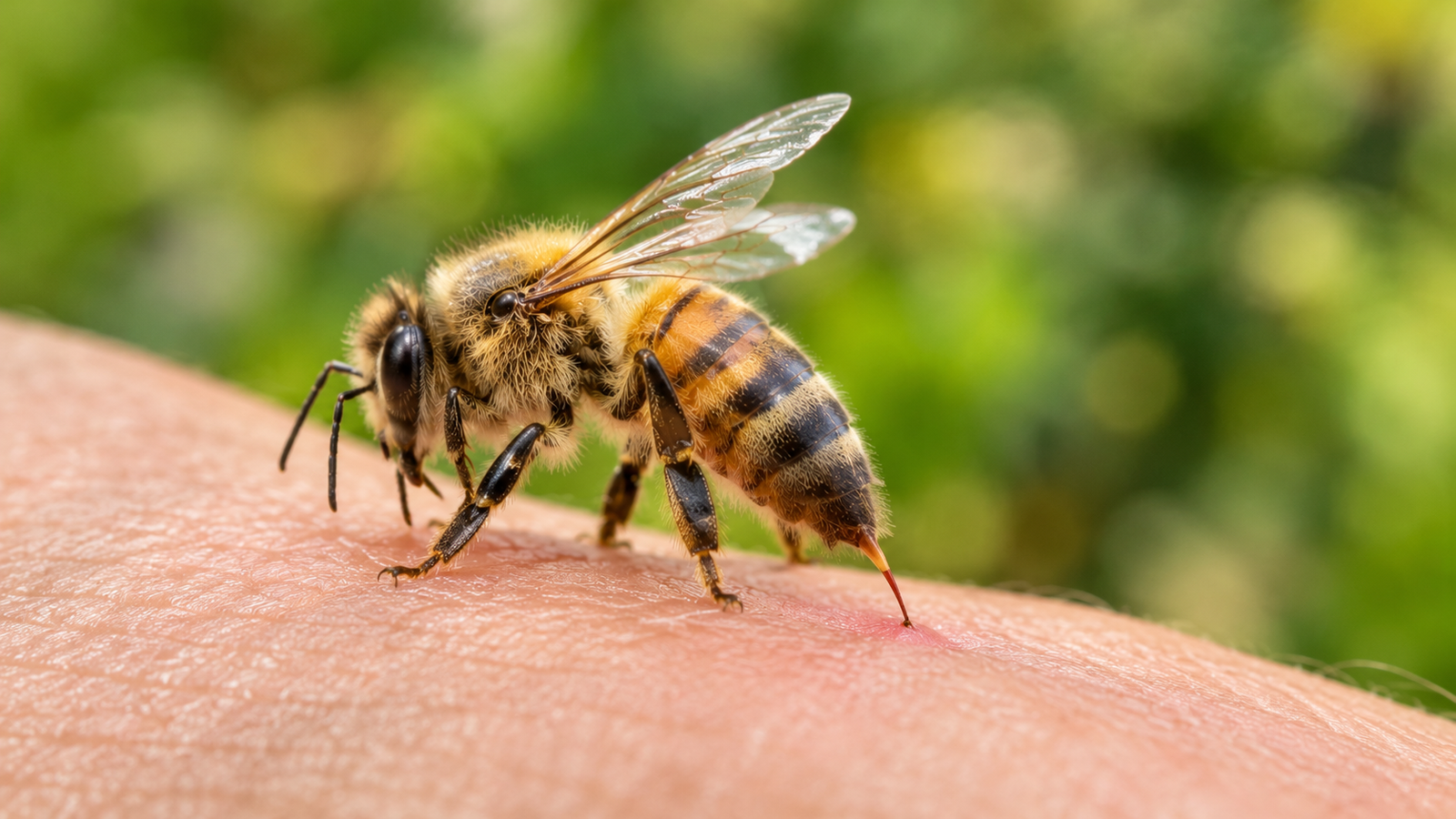
The worker honey bee is the bee most commonly known to die after stinging a human. This happens because its stinger has tiny backward-facing barbs that can become lodged in human skin. When the bee tries to fly away, the stinger and attached tissues can tear away from its abdomen, causing injuries that usually lead to its death.
However, not all bees die after stinging. Bumblebees, carpenter bees and many other bee species can generally withdraw their stingers without suffering the same fatal injury. Even within a honey bee colony, workers, queens and drones have different stinging abilities.
Understanding why this happens requires looking at the structure of a bee’s stinger, the differences between bee species and what happens when a bee attacks a human rather than another insect.
Which Bee Dies After Stinging a Human?
The worker honey bee (Apis mellifera) is the bee most commonly associated with dying after stinging a human.
Worker honey bees are female members of a colony responsible for activities such as collecting nectar and pollen, feeding young bees, maintaining the hive and protecting the colony from threats.
When a worker honey bee stings a person, its barbed stinger can become anchored in the skin. If the bee pulls away, the stinger and its attached venom-delivery structures may remain behind, tearing away part of the bee’s abdomen.
The resulting injury is usually fatal.
This is why a honey bee may be seen flying away from a person without its stinger after delivering a defensive sting. The bee does not die simply because it released venom. It dies because the attempt to withdraw its embedded stinger causes severe physical damage.
Important distinction: The familiar explanation applies particularly to worker honey bees stinging humans and other mammals. A worker may sometimes sting another insect and withdraw its stinger without suffering the same injury.
Why Do Worker Honey Bees Die After Stinging?
The reason worker honey bees die after certain stings is found in the design of their stingers.
Unlike a simple needle, a worker honey bee’s stinger has backward-facing barbs that help it remain embedded in the target.
When the stinger penetrates human skin, these barbs can catch in the tissue. As the bee attempts to fly away, the stinger may remain anchored while the bee’s body moves in the opposite direction.
This creates a severe mechanical injury.
1. The stinger penetrates the skin
A worker honey bee uses its stinger to inject venom into a perceived threat.
The stinger is located at the end of the abdomen and is normally kept inside the bee’s body until needed.
When the bee stings a human, the pointed stinging apparatus penetrates the skin and delivers venom.
2. The backward-facing barbs become lodged
The worker honey bee’s stinger contains tiny backward-facing barbs.
These structures help anchor the stinger in relatively thick, elastic skin, such as human skin.
Unlike a smooth needle that can be withdrawn easily, a barbed stinger can resist removal.
3. The bee pulls away
After delivering the sting, the bee may attempt to fly away.
However, if the stinger remains firmly embedded, the bee cannot simply pull it out.
The pulling force can separate the stinging apparatus from the bee’s abdomen.
4. The bee suffers a fatal abdominal injury
The detached apparatus can include the stinger, venom sac, muscles and associated tissues.
Losing these structures creates severe abdominal damage.
The worker honey bee generally cannot survive this injury and dies afterward.
5. The detached stinger continues delivering venom
An important detail is that the stinger does not necessarily stop working when it separates from the bee.
Muscular components of the detached apparatus can continue contracting and delivering venom for a short time.
This is why removing an embedded honey bee stinger promptly is important.
The Centers for Disease Control and Prevention’s Public Health Image Library provides a scanning electron microscope image showing the structure of the honey bee stinger.
What Makes a Honey Bee Stinger Different?
A honey bee stinger is not simply a sharp needle. It is a specialized defensive structure with several interconnected parts.
Its main components include:
- Stylet: The central supporting structure of the stinging apparatus.
- Lancets: Two movable structures that work with the central shaft during penetration.
- Barbs: Small backward-facing projections that can anchor the stinger in tissue.
- Venom-delivery system: Structures that allow venom to pass through the stinger.
- Associated muscles and venom sac: Components that help deliver venom and can remain attached when the stinger is pulled away.
The stinger is evolutionarily derived from the ovipositor, the egg-laying structure of female insects. In bees, it has become a defensive organ.
This explains why male bees do not possess functional stingers: they do not have the egg-laying anatomy from which the female stinger developed.
The CDC’s scanning electron microscope image of Apis mellifera shows the paired barbed lancets and central stinger structures.
Do All Honey Bees Die After Stinging?
No. Not all honey bees have the same stinging anatomy or defensive role.
A honey bee colony contains three main castes: workers, queens and drones. Their bodies and reproductive functions differ, which also affects their ability to sting.
Worker honey bees
Worker honey bees are female bees responsible for most colony activities.
They have barbed stingers and defend the colony against threats.
When a worker stings a human and the stinger becomes lodged, the resulting abdominal injury is usually fatal.
Workers are therefore the honey bees most commonly associated with dying after stinging people.
Queen honey bees
The queen is the reproductive female of the colony.
Unlike the worker’s stinger, the queen’s stinger is generally less barbed and is adapted for fighting rival queens.
A queen can sting more than once without normally suffering the same fatal injury experienced by a worker honey bee after stinging a human.
Queens do not normally spend their time defending the colony against people. Their primary biological role is reproduction.
Drone honey bees
Drones are male honey bees.
Their primary reproductive function is to mate with virgin queens.
Drones do not have functional stingers and cannot sting people.
This is an important distinction because a bee that looks like a honey bee is not necessarily capable of stinging.
Honey bee caste comparison
| Honey bee caste | Sex | Has a functional stinger? | Can sting? | Typical outcome |
|---|---|---|---|---|
| Worker | Female | Yes, barbed | Yes | Usually dies if the stinger becomes lodged in human skin |
| Queen | Female | Yes, less barbed | Yes | Can generally sting without the same fatal injury |
| Drone | Male | No | No | Cannot sting |
Do Bumblebees Die After Stinging?
No. Bumblebees generally do not die after stinging a human.
Bumblebees belong to the genus Bombus. They are recognizable by their relatively large, rounded, hairy bodies and often distinctive bands of yellow, black or other colors.
Like worker honey bees, female bumblebees have stingers that they use for defense.
However, their stingers do not normally become permanently lodged in human skin in the same way as a worker honey bee’s barbed stinger.
A female bumblebee can usually withdraw her stinger and sting again if she remains threatened.
Male bumblebees cannot sting because they lack a functional stinger.
Example: If someone accidentally handles a female bumblebee and the insect feels threatened, it may sting to defend itself. Unlike a worker honey bee, it can generally fly away with its stinging apparatus intact.
Do Carpenter Bees Die After Stinging?
No. Female carpenter bees generally survive after stinging.
Carpenter bees belong to the genus Xylocopa. They are relatively large bees that often resemble bumblebees, although many species have a shiny, relatively hairless abdomen.
Female carpenter bees have functional stingers and may use them when threatened or handled.
Their stingers generally do not become lodged in human skin in the same fatal way as those of worker honey bees.
Male carpenter bees cannot sting because they do not possess functional stingers.
An important identification difference is that male carpenter bees may hover close to people or behave defensively, but they cannot deliver a venomous sting.
Can Other Bee Species Die After Stinging?
Most bees do not experience the same fatal outcome as worker honey bees when they sting humans.
Bee species have different stinger structures and defensive strategies.
Some can sting repeatedly, some have reduced or ineffective stinging structures, and others have lost the ability to sting entirely.
Solitary bees
Solitary bees include mason bees, leafcutter bees and many other species.
Unlike honey bees, most solitary bees do not live in large colonies with thousands of workers defending a shared nest.
Many female solitary bees possess functional stingers, although their size and ability to penetrate human skin vary considerably.
They generally do not die after stinging because their stingers are not adapted to become permanently lodged in human skin in the same way as a worker honey bee’s stinger.
Male solitary bees cannot sting.
Stingless bees
Stingless bees belong to the tribe Meliponini.
They are found mainly in tropical and subtropical regions and include many species that live in social colonies.
Despite their name, stingless bees are not completely defenseless.
They have lost the ability to deliver a conventional functional sting, but some species defend their nests by biting, using their mandibles or engaging in other defensive behaviors.
Some stingless bees also produce honey.
A surprising fact about bee species
The idea that bees generally die after stinging is misleading.
A 2024 article published by the University of Wollongong, written by researchers from the University of Wollongong, Western Sydney University and the University of Sydney, reports that only eight out of almost 21,000 bee species die when they sting.
That is approximately 0.04% of bee species.
This makes the fatal stinging behavior associated with certain honey bees an unusual feature rather than a general rule among bees.
The important distinction is that the figure describes bee species, not the percentage of individual bees that die after stinging.
Why Do Honey Bees Sometimes Survive Stinging Other Insects?
One of the most interesting details about honey bee stings is that the outcome can depend on what the bee stings.
Human skin is relatively thick and elastic compared with the outer coverings of many insects.
When a worker honey bee stings a human, the backward-facing barbs can become anchored in the skin. Pulling away may then tear the stinger and associated abdominal tissues from the bee.
However, when a worker honey bee attacks another insect, the stinger may penetrate without becoming permanently lodged.
The bee may therefore be able to withdraw it and survive.
Practical example:
Imagine a worker honey bee defending its colony against a small insect approaching the hive.
The bee may use its stinger to attack the intruder. If the stinger does not become firmly trapped, the worker can withdraw it and return to its defensive activities.
Now imagine the same worker stinging a person’s arm.
The stinger may become anchored in the skin. When the bee flies away, the stinging apparatus can tear from its abdomen.
The two encounters can have very different outcomes even though the same type of bee delivers the sting.
This distinction helps explain why the statement that every worker honey bee dies after every sting is too broad.
Why Do Some Bees Have Barbed Stingers While Others Do Not?
The shape of a bee’s stinger is connected to its evolutionary history and defensive strategy.
A stinger is a modified egg-laying structure that evolved into a weapon for defense.
Different bee groups have developed different stinging adaptations.
For example:
- Worker honey bees have barbed stingers that can remain embedded in the skin of mammals.
- Bumblebees can generally withdraw their stingers after attacking.
- Female carpenter bees have functional stingers but do not normally lose them after stinging.
- Many solitary bees have functional stingers that are not associated with the same fatal injury.
- Stingless bees have lost the ability to deliver a conventional sting.
These differences demonstrate that there is no single stinging mechanism shared by every bee species.
What Happens to a Honey Bee After It Stings a Human?
After a worker honey bee leaves its stinger embedded in human skin, the detached apparatus may continue delivering venom.
The bee itself suffers a serious abdominal injury because the stinger and associated tissues have been torn away.
Without these structures, the worker cannot recover from the damage and usually dies.
The detached stinger may continue pumping venom briefly, even though the bee is no longer attached to it.
This is why the stinger should be removed as soon as possible.
It is also important to understand that the bee does not intentionally commit suicide. The death is a consequence of its anatomy and the physical injury caused when the barbed stinger becomes trapped.
What Should You Do If a Honey Bee Stings You?
A honey bee sting usually causes immediate pain, redness, itching and localized swelling.
Most people experience a localized reaction, but some develop serious allergic reactions that require emergency medical attention.
If a honey bee stings you, take these steps:
- Remove the stinger promptly. If it remains embedded, remove it as quickly as possible. Avoid delaying removal while deciding whether to scrape or pull it out.
- Wash the affected area. Use soap and clean water to reduce the risk of infection.
- Apply a cold compress. A cold compress can help reduce pain and swelling. Avoid placing ice directly against the skin.
- Monitor the reaction. Pay attention to increasing swelling, widespread itching, dizziness or other unusual symptoms.
- Seek medical attention when necessary. A person with a known bee-sting allergy should follow their prescribed emergency plan.
When is a bee sting an emergency?
Seek emergency medical help immediately if a sting is followed by:
- Difficulty breathing or wheezing.
- Swelling of the tongue or throat.
- Difficulty swallowing.
- Dizziness, fainting or collapse.
- A widespread allergic reaction.
- Signs of anaphylaxis.
Multiple stings also warrant prompt medical assessment, particularly in children, older adults and people with underlying health concerns.
If someone has prescribed epinephrine for a severe allergy, they should use it according to their emergency plan and seek emergency medical care.
A bee sting should never be dismissed simply because the insect that delivered it is small.
Frequently Asked Questions
Which bee dies after stinging a human?
The worker honey bee (Apis mellifera) is the bee most commonly known to die after stinging a human. Its barbed stinger can become lodged in the skin, causing the stinging apparatus and associated abdominal tissues to tear away when the bee attempts to fly off.
Do all honey bees die after stinging?
No. Worker honey bees are the caste most commonly associated with fatal stinging injuries. Queen honey bees have a less-barbed stinger and can generally sting more than once. Male honey bees, called drones, cannot sting.
Why does a honey bee die after stinging but a wasp does not?
A worker honey bee has a barbed stinger that can become lodged in human skin. When the bee pulls away, the stinger and associated tissues may tear from its abdomen. Many wasps have stingers that can be withdrawn more easily, allowing them to sting repeatedly.
Do bumblebees die after stinging?
No. Female bumblebees can generally withdraw their stingers and survive. They may sting more than once when threatened. Male bumblebees cannot sting.
Do carpenter bees die after stinging?
No. Female carpenter bees can sting, but they generally retain their stinging apparatus and survive. Male carpenter bees cannot sting.
Can a male honey bee sting?
No. Male honey bees, known as drones, do not have functional stingers. The stinger develops from a modified reproductive structure found in females.
Can a honey bee sting another insect without dying?
Yes. A worker honey bee may sometimes sting another insect and withdraw its stinger without suffering a fatal injury. The stinger is more likely to become lodged when it penetrates the relatively thick skin of a human or another mammal.
Do stingless bees have stingers?
Stingless bees in the tribe Meliponini do not have a functional conventional stinger. However, they can defend themselves through biting and other behaviors.
Does a honey bee know it will die after stinging?
There is no scientific basis for saying that a honey bee understands it will die after stinging. Its defensive behavior is an evolved biological response. The bee’s death results from the physical damage caused when its barbed stinger becomes detached.
How long does a honey bee live after stinging?
A worker honey bee that loses its stinging apparatus suffers severe abdominal damage and usually dies shortly afterward. The exact time can vary depending on the extent of the injury, so there is no reliable universal countdown.
Conclusion: Which Bee Dies After Stinging?
The worker honey bee is the bee most commonly known to die after stinging a human. Its backward-facing barbed stinger can become lodged in human skin, and when the bee attempts to fly away, the stinging apparatus and associated abdominal tissues may tear away, causing a fatal injury.
However, this does not mean every bee dies after stinging. Queen honey bees can generally sting without suffering the same injury, drones cannot sting, and female bumblebees, carpenter bees and many other bee species can usually withdraw their stingers and survive.
The important lesson is that a bee’s ability to sting and its chances of surviving a sting depend on its species, sex, stinger anatomy and the circumstances of the encounter.
So, when someone asks which bee dies after stinging, the clearest answer is the worker honey bee, particularly when its barbed stinger becomes lodged in human skin.
References
- Centers for Disease Control and Prevention (CDC). Scanning electron microscope image of the Western honey bee stinger (Public Health Image Library, ID 8005).
- Dorey, J. B., Gilpin, A.-M., and Gloag, R. (2024). Most bees don’t die after stinging – and other surprising bee facts. University of Wollongong.
- Functional anatomy of the worker honeybee stinger (Apis mellifera). Scientific research article, 2023.
- University of California Agriculture and Natural Resources. Why Do Honey Bees Die When They Sting?.
- Texas A&M Honey Bee Lab. Bee Frequently Asked Questions.
- University of Florida IFAS Extension. European Honey Bee: Apis mellifera.
- University of Minnesota Extension. Wasps and Bees.
