

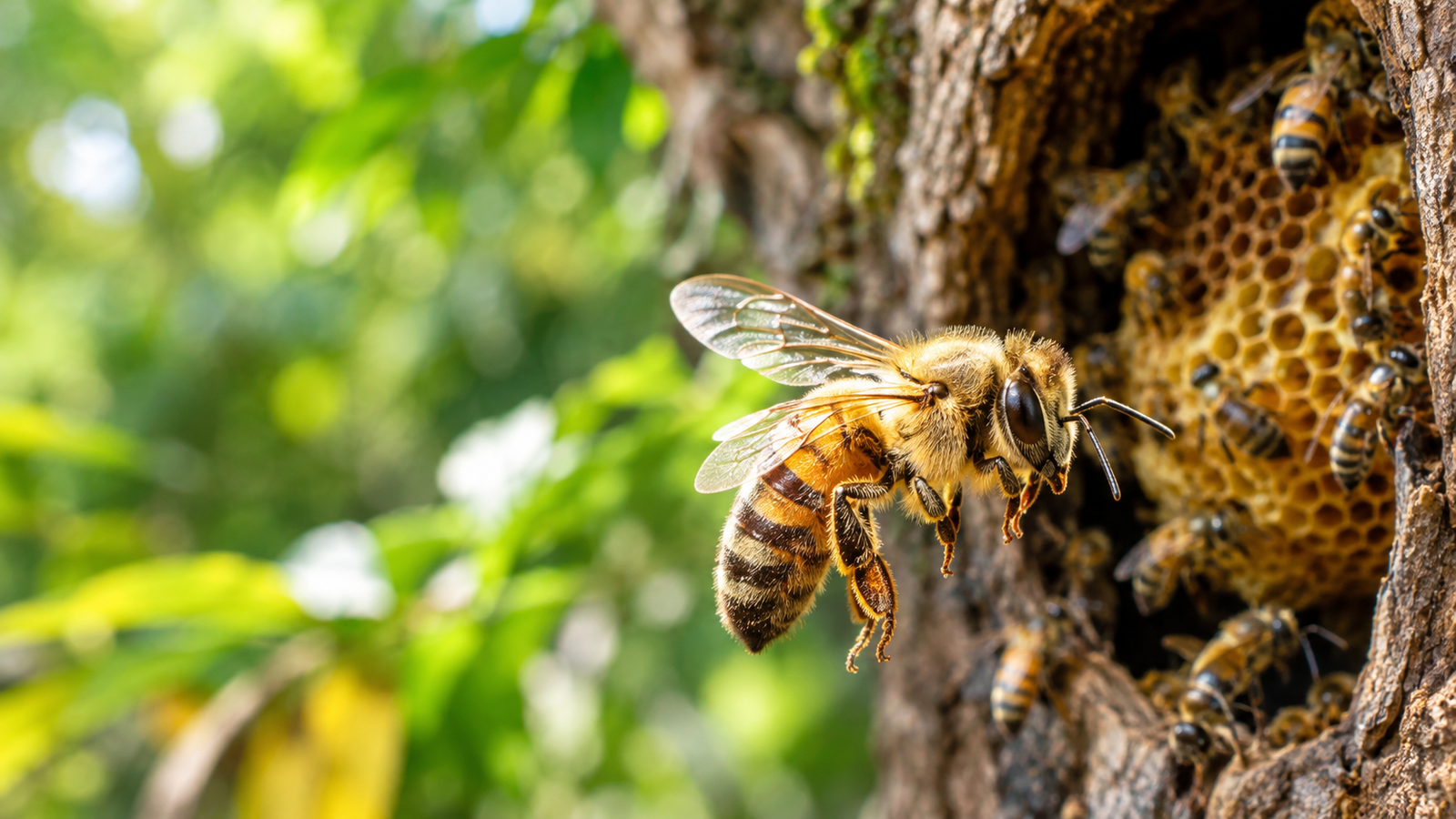
Which bee is the most dangerous? The Africanized honey bee, commonly known as the killer bee, is widely regarded as one of the most dangerous bees to humans because of its unusually strong colony-defence behaviour. When its nest is disturbed, hundreds or potentially thousands of worker bees may respond together, increasing the risk of multiple stings. However, its venom is not necessarily more toxic per sting than that of other honey bees. Its greatest danger comes from the number of bees that may participate in an attack.
The Africanized honey bee is not the only bee capable of causing serious injuries. The giant honey bee (Apis dorsata) is also exceptionally defensive when its exposed nest is threatened. Western honey bees can inflict numerous stings, while bumblebees and carpenter bees can sting when threatened.
Even a single sting from a bee can cause a life-threatening allergic reaction in a susceptible person.
In this guide, you will discover which bee is the most dangerous, why certain bees defend their nests so intensely, how five different bees compare, and what to do if you encounter a defensive colony.
Which Bee Is the Most Dangerous in the World?
The Africanized honey bee (Apis mellifera populations with African-derived ancestry) is commonly considered one of the most dangerous bees to humans because of its powerful colony-defence response.
These bees developed in the Americas after African honey bees were introduced to Brazil in 1957. Some of the introduced bees escaped controlled breeding programmes and interbred with European-derived honey bee populations. Their descendants spread through parts of South and Central America and eventually reached the southern United States.
Africanized honey bees are commonly called killer bees because they can mobilize large numbers of workers when they perceive a threat near their colony.
According to the University of Florida’s Institute of Food and Agricultural Sciences (UF/IFAS), an African honey bee colony may send hundreds or even thousands of defenders in response to disturbances considerably farther from the nest than those that typically trigger a response from many European honey bee colonies.
The bees may also pursue perceived threats for considerable distances.
Their danger comes primarily from their defensive behaviour, not from unusually powerful venom. A person who disturbs a colony may receive numerous stings, and a large amount of injected venom can cause severe systemic illness.
However, Africanized honey bees do not constantly search for people to attack. They are particularly dangerous when they perceive that their colony is threatened.
Important distinction: The Africanized honey bee is especially notorious for mass-stinging incidents, but the giant honey bee (Apis dorsata) has also been described in scientific literature as one of the most defensive honey bee species. There is no universally accepted scientific ranking that establishes one bee as the most dangerous under every circumstance.
Why Are Africanized Honey Bees So Dangerous?
Several characteristics make Africanized honey bees particularly concerning around their colonies.
1. Strong colony defence
Africanized honey bees respond strongly to disturbances around their nests. Activities such as cutting trees, operating noisy machinery, mowing grass or attempting to remove a colony can trigger a defensive response.
2. Large numbers of defending workers
Instead of only a few guard bees responding, numerous workers may participate in protecting the colony.
This increases the possibility of receiving many stings within a short period.
3. Persistent defensive behaviour
Africanized honey bees may pursue a perceived threat farther from their nest than many European honey bee colonies.
Escaping quickly and reaching enclosed shelter is therefore particularly important during an attack.
4. Chemical alarm signals
When a worker honey bee stings, it releases alarm pheromones that can alert other workers to a perceived threat.
These chemical signals help coordinate colony defence and can attract additional defending bees to the area.
5. Serious consequences of multiple stings
A large number of stings can introduce enough venom into the body to cause systemic toxicity, even in someone who has never experienced a bee allergy.
A person with a severe venom allergy may experience anaphylaxis after just one sting.
These characteristics explain why Africanized honey bees deserve particular caution around their nests.
Which Bees Are the Most Dangerous? 5 Bees You Should Know
Different bee species present different risks. Some are especially defensive when protecting large colonies, while others are generally peaceful but can still deliver painful or medically serious stings.
Here are five bees worth understanding.
1. Africanized Honey Bee — The Notorious Killer Bee
Scientific name: Africanized populations of Apis mellifera
Main danger: Large-scale defensive attacks and multiple stings.
Where they live: Parts of South America, Central America, Mexico and the southern United States.
Africanized honey bees are among the most widely recognized dangerous bees because of their strong colony-defence behaviour.
They are descendants of African honey bees introduced into Brazil in the 1950s. Their populations subsequently spread through the Americas and developed through interbreeding with European-derived honey bees.
Unlike many managed European honey bee colonies, Africanized colonies can respond strongly to disturbances farther from their nests.
For example, imagine a farmer operating a grass-cutting machine near a tree containing an established bee colony. The vibration may disturb the colony, causing numerous workers to emerge and defend their nest.
If the farmer remains close to the colony, the situation can quickly become dangerous.
An important biological detail is that Africanized honey bees are not necessarily more venomous than European honey bees. Their reputation comes mainly from their defensive behaviour and the number of stings they can inflict.
They are also difficult to identify through ordinary visual inspection. A bee’s colour or size alone cannot reliably establish whether it belongs to an Africanized population.
How to stay safe: Never approach or attempt to remove a suspected defensive colony. Move away immediately if bees begin responding to you and seek enclosed shelter.
2. Giant Honey Bee — One of the Most Defensive Honey Bees
Scientific name: Apis dorsata
Main danger: Powerful colony defence and multiple stings.
Where they live: South and Southeast Asia.
The giant honey bee is one of the largest honey bee species. Unlike many familiar honey bees that nest inside enclosed cavities, Apis dorsata builds large exposed combs on tree branches, cliffs and buildings.
Its nesting arrangement makes colony defence particularly important.
The exposed comb is covered by layers of worker bees that protect the developing brood and stored food. When a threat approaches, guard bees can produce coordinated defensive displays and recruit other colony members.
Research and educational publications from the University of Florida describe Apis dorsata as exceptionally defensive, even more so than African honey bees in some comparisons.
This is an important distinction: the Africanized honey bee is particularly notorious for dangerous encounters with humans in the Americas, while the giant honey bee demonstrates that other species can also possess extremely strong defensive behaviour.
For example, disturbing an exposed giant honey bee nest during tree work or honey harvesting can provoke a large defensive response.
Although many bees may participate in the response, not every bee necessarily delivers a sting. The colony also uses coordinated behaviour to deter predators.
How to stay safe: Stay well away from exposed giant honey bee nests. Never climb toward, shake or strike a branch containing a colony.
3. Western Honey Bee — A Familiar Bee That Can Cause Serious Injuries
Scientific name: Apis mellifera
Main danger: Multiple stings and potentially severe allergic reactions.
Where they live: Naturally associated with Africa, Europe and western Asia, and introduced to many other parts of the world.
The western honey bee is among the most important pollinating insects in agriculture. It produces honey and helps pollinate numerous crops and wild plants.
Many managed colonies have been selected by beekeepers for relatively gentle behaviour. Nevertheless, these bees can become defensive when their nests are threatened.
A normally manageable colony can respond strongly when someone strikes its hive, attempts to remove its comb or accidentally disturbs its nesting site.
One important feature of western honey bees is their barbed worker-bee stinger.
When a worker stings human skin, the barbed stinger commonly becomes lodged in the skin. As the bee flies away, the sting apparatus may tear away from its abdomen, causing the worker to die shortly afterward.
This means a worker honey bee generally cannot sting a person repeatedly.
However, multiple workers can each deliver a sting, which is why disturbing an entire colony can be dangerous.
Another important exception is that an individual with a severe bee-venom allergy may develop anaphylaxis after a single sting.
How to stay safe: Avoid disturbing colonies, use appropriate protective equipment when handling managed hives, and seek professional assistance when a wild colony is located near people.
4. Bumblebee — Usually Peaceful but Capable of Repeated Stings
Scientific name: Bombus species
Main danger: Painful stings and allergic reactions.
Where they live: Many temperate regions and some tropical and subtropical areas.
Bumblebees are recognizable by their relatively large bodies and dense, fuzzy hair.
They are valuable pollinators that visit flowers to collect nectar and pollen. Most bumblebees spend their time foraging and generally avoid unnecessary contact with people.
However, female bumblebees, including queens and workers, possess stingers and can sting when threatened.
Unlike worker honey bees, bumblebees have smooth stingers that generally allow them to sting repeatedly without losing their stinging apparatus.
Male bumblebees cannot sting because they do not possess a functional stinger.
Bumblebees usually become defensive when someone handles them, steps on them or disturbs their nests.
For example, a bumblebee nest located beneath grass or inside an abandoned rodent burrow may be disturbed accidentally during gardening.
A nearby worker may respond defensively to protect the colony.
How to stay safe: Avoid stepping on or disturbing nests. Allow bumblebees to forage naturally, and do not attempt to handle them.
5. Carpenter Bee — Large but Generally Less Dangerous
Scientific name: Xylocopa species
Main danger: A female may sting when handled or seriously threatened.
Where they live: Many tropical, subtropical and temperate regions, depending on the species.
Carpenter bees are large bees that excavate nesting tunnels in wood.
They commonly use wooden fences, tree branches, decks, garden furniture and other suitable wooden structures.
Their size and loud buzzing can make them appear threatening, particularly when they hover close to people.
However, carpenter bees are generally solitary and do not defend large colonies like honey bees.
One particularly interesting difference concerns their sexes.
Male carpenter bees often hover around nesting areas and may fly toward people entering their territory. Despite this intimidating behaviour, males cannot sting because they lack a stinger.
Female carpenter bees possess stingers but generally sting only when handled, trapped or seriously threatened.
For example, a male carpenter bee hovering around someone repairing a wooden fence may appear to be preparing to attack. In reality, it may simply be displaying territorial behaviour.
How to stay safe: Avoid handling carpenter bees or blocking their nesting entrances. Their presence around wooden structures does not automatically mean they pose a serious stinging threat.
Comparison: Which of These Five Bees Is Most Dangerous?
The following table compares their main risks rather than assigning an unsupported numerical danger ranking.
| Bee | Main source of danger | Can it sting repeatedly? | General risk |
|---|---|---|---|
| Africanized honey bee | Large-scale colony defence | No, an individual worker generally stings once | High near a disturbed colony |
| Giant honey bee | Strong defensive colony response | No, individual workers generally die after stinging | High near a disturbed nest |
| Western honey bee | Multiple stings and allergic reactions | No, individual workers generally sting once | Depends on colony behaviour |
| Bumblebee | Defensive individual stings | Yes, females can sting repeatedly | Usually low |
| Carpenter bee | Female stinging when threatened | Females can sting more than once | Usually low |
These comparisons describe general biological tendencies. Individual encounters can differ depending on the species, colony, location and circumstances.
The key takeaway: Africanized honey bees are particularly notorious for dangerous mass attacks, but giant honey bees are also exceptionally defensive. Bumblebees and carpenter bees are generally less likely to cause mass-stinging incidents.
What Makes Africanized Honey Bees Different From European Honey Bees?
Africanized and European honey bees belong to the same species, Apis mellifera. Their differences are associated with their ancestry, genetics, colony characteristics and behaviour.
| Characteristic | Africanized honey bees | Many European honey bee colonies |
|---|---|---|
| Defensive behaviour | Generally more defensive | Often more manageable |
| Response to disturbance | May recruit many defenders | Often recruit fewer defenders |
| Pursuit of threats | Can pursue farther | Generally defend a smaller area |
| Venom per sting | Not necessarily more potent | Similar general venom danger |
| Nesting behaviour | Often use smaller cavities and varied locations | Often prefer larger enclosed cavities |
| Visual identification | Difficult to distinguish reliably | Difficult to distinguish reliably |
These are general tendencies rather than absolute rules. European honey bee colonies can also become highly defensive, particularly when stressed or threatened.
Can You Identify an Africanized Honey Bee by Its Appearance?
No, not reliably.
Africanized honey bees may be slightly smaller on average than some European honey bee populations, but the differences are too subtle for dependable identification by an ordinary observer.
Their colour is also not a reliable identification feature because ordinary honey bees can have similar golden, brown and dark banding.
Specialists use laboratory methods, including morphological measurements and genetic analysis, when accurate identification is necessary.
This is important because a person should never approach an unfamiliar colony to determine whether its workers are Africanized.
Practical advice: Pay attention to the presence of a colony and its behaviour rather than trying to identify individual bees by sight.
Which Bee Has the Most Poisonous Sting?
There is no universally established scientific winner for the most poisonous bee sting.
The Africanized honey bee is particularly dangerous because a defensive colony can inflict numerous stings. However, its individual sting is not generally considered more venomous than that of a European honey bee.
It is important to distinguish between venom potency, the amount of venom delivered and the body’s reaction to the venom.
Three factors are especially important:
1. Number of stings
Numerous stings can introduce a large quantity of venom into the body, potentially causing serious systemic toxicity.
2. Individual allergic sensitivity
Someone with a severe bee-venom allergy may experience anaphylaxis after a single sting.
3. Location of the sting
A sting inside the mouth or throat can cause swelling that interferes with breathing, even without a generalized allergic reaction.
Therefore, a bee does not need to possess unusually powerful venom to cause a life-threatening injury.
How Many Bee Stings Are Dangerous to Humans?
There is no single number of bee stings that is safe for every person.
The consequences depend on the person’s body weight, health, venom sensitivity and total amount of venom received.
A person with a severe bee allergy may experience a life-threatening reaction after one sting. Someone without an allergy may still become seriously ill after receiving numerous stings.
Possible warning signs following multiple stings include:
- Severe or increasing pain and swelling.
- Nausea, vomiting or diarrhoea.
- Headache, dizziness or unusual weakness.
- Muscle pain or dark-coloured urine.
- Reduced urine output or other signs of organ injury.
A large number of stings should be treated as a medical emergency. Do not wait for severe symptoms to develop before seeking medical attention.
What Should You Do If Killer Bees Attack You?
If a group of bees begins attacking, your priority should be to escape the area and reach enclosed shelter.
Follow these steps:
- Run away immediately. Move away from the suspected nest as quickly as possible.
- Protect your face and eyes. Use your clothing or arms to protect your head and face while escaping.
- Find enclosed shelter. Enter a building or enclosed vehicle and close the doors and windows.
- Avoid swatting at the bees. Concentrate on escaping rather than fighting the insects.
- Do not stop to photograph the attack. Every second spent near the colony increases your exposure.
- Do not jump into water as an escape strategy. Seek proper enclosed shelter instead.
- Get medical assistance. Anyone who receives numerous stings or develops concerning symptoms needs prompt medical evaluation.
If a honey bee stinger remains embedded in the skin, remove it as quickly as possible. Scraping or pulling it out promptly is preferable to delaying removal while trying to use a particular technique.
What If You Experience an Allergic Reaction?
A severe allergic reaction to a bee sting is called anaphylaxis.
It can become life-threatening very quickly.
Warning signs include:
- Difficulty breathing or wheezing.
- Swelling of the tongue or throat.
- Difficulty swallowing.
- Severe dizziness or fainting.
- Widespread hives accompanied by breathing problems or other systemic symptoms.
- Collapse or signs of circulatory shock.
If anaphylaxis is suspected, use prescribed epinephrine immediately if available and call emergency medical services.
Antihistamines are not a substitute for epinephrine in treating anaphylaxis.
A sting inside the mouth or throat also requires urgent medical attention because swelling can obstruct breathing.
Are the Most Dangerous Bees Found in Africa?
Africa is home to several populations and subspecies of honey bees, including the African honey bee (Apis mellifera scutellata).
However, African honey bees and Africanized honey bees are not interchangeable terms.
African honey bees are native to Africa. Africanized honey bees developed in the Americas following the introduction of African honey bees into Brazil in 1957 and their interbreeding with European-derived honey bee populations.
This distinction is important because not every African honey bee is an Africanized honey bee.
Wild honey bee colonies in Africa can still pose serious risks when disturbed, particularly when they are established close to homes, farms, schools or busy outdoor work areas.
What Should People in Ghana Know About Dangerous Bees?
People in Ghana and other African countries should exercise caution around wild bee colonies, especially during farming, construction, tree cutting and vegetation clearing.
For example, a colony established inside a tree cavity may remain unnoticed until someone begins cutting or trimming the tree.
Similarly, a colony inside a wall, roof space or other enclosed structure may become defensive if its nesting area is disturbed.
The safest approach is to avoid the colony and seek assistance from an experienced beekeeper or qualified pest-control professional.
Do not assume that a defensive wild honey bee colony in Ghana is an Africanized honey bee. Accurate identification requires appropriate specialist assessment.
Bees are also essential pollinators, so their presence alone is not a reason to destroy them.
How Can You Avoid Dangerous Bee Encounters?
Understanding bee behaviour can significantly reduce the risk of being stung.
Follow these practical precautions:
- Keep your distance from active bee colonies and large clusters of bees.
- Never throw stones, strike or shake a bee nest.
- Check trees, walls and other structures before carrying out work that could disturb a colony.
- Be particularly cautious when operating lawnmowers, chainsaws and other noisy equipment near suspected nests.
- Avoid attempting to remove a large or defensive colony yourself.
- Teach children not to poke nests or disturb bees.
- Contact a qualified beekeeper or professional when a colony is located close to people or animals.
- If bees become defensive, leave the area and seek enclosed shelter.
It is also important to distinguish ordinary foraging activity from colony defence.
A few bees visiting flowers, collecting nectar or drinking water are not necessarily dangerous. They are usually occupied with gathering resources rather than defending a nest.
A honey bee swarm is also not automatically an attacking colony. Swarming is a natural reproductive process in which a queen and a group of workers leave an established colony to establish a new one.
Although swarms are often less defensive than established colonies because they have no developed nest to protect, unfamiliar swarms should still be left undisturbed.
Frequently Asked Questions
1. Which bee is the most dangerous in the world?
The Africanized honey bee is widely regarded as one of the most dangerous bees to humans because of its strong colony-defence behaviour and ability to inflict numerous stings during an attack. The giant honey bee is also exceptionally defensive.
2. Are killer bees more poisonous than regular honey bees?
No. An individual Africanized honey bee sting is not generally more venomous than an individual European honey bee sting. Their main danger comes from the large number of bees that may participate in defending a disturbed colony.
3. Can one bee sting kill a human?
Yes. A single sting can cause fatal anaphylaxis in someone with a severe bee-venom allergy. A sting inside the mouth or throat can also become dangerous because swelling may interfere with breathing.
4. Which bee is the most aggressive?
Africanized honey bees are particularly well known for their strong defensive behaviour. However, the giant honey bee (Apis dorsata) is also described as exceptionally defensive. Behaviour varies between colonies and circumstances.
5. Are giant honey bees dangerous?
Yes. Giant honey bees can be dangerous when their exposed nests are disturbed. Their coordinated colony-defence behaviour can expose intruders to numerous stings.
6. Do killer bees chase people?
Africanized honey bees can pursue perceived threats farther from their colonies than many European honey bee populations. If bees begin attacking, move toward enclosed shelter immediately.
7. Are all bees dangerous to humans?
No. Most bees spend their time gathering nectar and pollen and generally avoid unnecessary contact with people. Many species sting only when handled, trapped or threatened.
8. Can male bees sting?
No. Male bees do not possess functional stingers because the stinger is a modified egg-laying structure found in females. This includes male carpenter bees and male bumblebees.
9. Which bee can sting more than once?
Female bumblebees can sting repeatedly because their stingers are generally smooth. Female carpenter bees can also sting more than once. Worker honey bees, in contrast, generally die after their barbed stingers become lodged in human skin.
10. Are African honey bees the same as Africanized honey bees?
No. African honey bees are native to Africa. Africanized honey bees developed in the Americas after African honey bees were introduced to Brazil and interbred with European-derived honey bee populations.
11. What should I do if I find a wild bee colony near my house?
Do not approach, strike or attempt to remove the colony yourself. Keep children and animals away and contact an experienced beekeeper or qualified removal professional.
Final Thoughts: Which Bee Is the Most Dangerous?
The Africanized honey bee is one of the most dangerous bees to humans, particularly because of its strong colony-defence behaviour and ability to produce large-scale defensive attacks.
However, it is important to understand that danger is not determined by venom potency alone. The giant honey bee is also exceptionally defensive, while ordinary honey bee colonies can cause serious injuries through multiple stings.
Even bumblebees and carpenter bees, which are generally less likely to cause mass-stinging incidents, can still sting when threatened. For someone with a severe bee-venom allergy, even one sting can become a medical emergency.
The safest approach is to respect all bee colonies, avoid disturbing their nests and seek professional help when a colony is located near people.
Understanding the differences between these bees helps you recognize potential dangers without developing unnecessary fear of insects that play an essential role in pollination and the environment.
References and Further Reading
The following scientific and educational sources support the information in this article:
- Ellis, J. D., and Bammer, M. C. (2018, revised 2024). Living with the African Honey Bee. University of Florida, IFAS Extension.
- University of Florida, IFAS Extension. Differences Between European and African Honey Bees.
- University of Florida, IFAS Extension. African Honey Bee, Africanized Honey Bee, Killer Bee.
- University of Florida, IFAS Extension. Giant Honey Bee Apis dorsata.
- Florida Department of Agriculture and Consumer Services. Africanized Honey Bees.
- Cornell University Integrated Pest Management. Carpenter Bees.
- Cornell University Integrated Pest Management. Bumble Bees.
- Mayo Clinic. Bee Sting: Symptoms and Causes.
- Kastberger, G., Ebner, M., and Hötzl, T. (2024). Giant honeybees (Apis dorsata) trade off defensiveness against periodic mass flight activity. PLOS ONE.
