
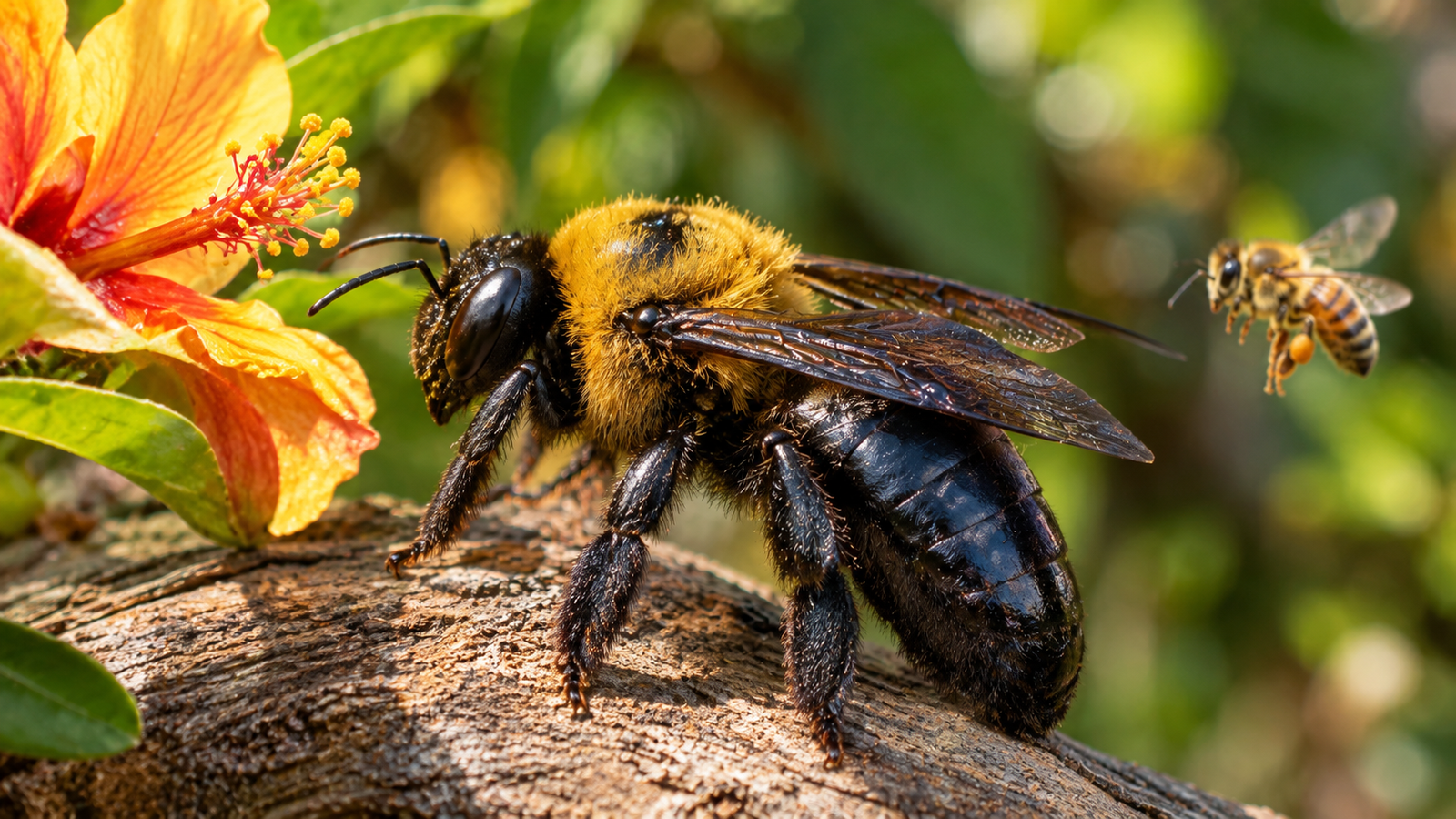
Which bee sting hurts the most? According to the 2019 research by entomologist Justin Schmidt, the giant Bornean carpenter bee (Xylocopa sp.) has one of the highest recorded sting pain ratings among bees, scoring 2.5 on the Schmidt Sting Pain Index. This is higher than the rating of the Western honey bee, which scores 2.
However, the giant Bornean carpenter bee does not have the most painful sting of all insects. Some wasps and ants receive much higher ratings on the same scale. The Schmidt Index also measures the pain of a sting, not how dangerous its venom is.
Bee sting pain varies depending on the species, the amount of venom injected, the location of the sting, and the person’s sensitivity. A bee sting on the lip or nose, for example, may hurt considerably more than a sting on the forearm.
In this guide, you will learn which bee sting hurts the most, how scientists compare sting pain, which bee species have more painful stings, and what to do if you are stung.
Which Bee Sting Hurts the Most?
The giant Bornean carpenter bee is the bee with the highest recorded sting pain rating in the species listed in Justin Schmidt’s 2019 study, Pain and Lethality Induced by Insect Stings: An Exploratory and Correlational Study.
The bee is recorded as Xylocopa sp. (giant Bornean bee), with a pain score of 2.5 on the Schmidt Sting Pain Index.
The Western honey bee (Apis mellifera) and several bumblebee species received ratings of 2. This places their recorded sting pain below that of the giant Bornean bee in the study.
It is important to understand that this ranking is based on a limited set of species and observations. It does not prove that every giant Bornean carpenter bee sting will hurt more than every honey bee sting.
The direct answer is therefore:
The giant Bornean carpenter bee has the highest recorded sting pain rating among the bee species listed in Schmidt’s 2019 study, but individual sting pain can vary.
What Is the Giant Bornean Carpenter Bee?
The giant Bornean carpenter bee is a large solitary bee associated with Southeast Asia. It belongs to the carpenter bee genus Xylocopa.
Carpenter bees are known for their ability to excavate nesting tunnels in wood. Unlike honey bees, which live in organized colonies, most carpenter bees live solitary lives, although several individuals may nest near one another.
The giant Bornean bee is sometimes identified in secondary educational sources as Xylocopa latipes. However, Schmidt’s 2019 table lists the specimen more cautiously as Xylocopa sp. (giant Bornean bee). For scientific accuracy, this article uses the designation reported in the original study rather than assuming that the identification is definitive.
Can the giant Bornean carpenter bee sting?
Yes. Female carpenter bees possess a stinger and can sting when threatened, trapped, or handled.
Male carpenter bees cannot sting because they lack a functional stinger. They may appear aggressive when hovering around people near their nesting areas, but this behavior is usually territorial or investigative rather than an attempt to sting.
Female carpenter bees are generally reluctant to sting unless they feel directly threatened.
A practical example is a person attempting to grab a carpenter bee from a wooden fence. The bee may sting if it is trapped or handled roughly. Simply seeing a large carpenter bee hovering nearby does not mean that a sting is imminent.
How Is Bee Sting Pain Measured?
Scientists and entomologists use different methods to investigate sting pain. One of the best-known systems is the Schmidt Sting Pain Index, developed by entomologist Justin Schmidt.
The index was designed to compare the painfulness of stings from insects in the order Hymenoptera, which includes bees, wasps, ants, and related insects.
The scale generally ranges from 1 to 4, with higher numbers representing more intense pain.
Understanding the Schmidt Sting Pain Index
| Pain rating | General description |
|---|---|
| 1 | Relatively mild sting pain |
| 2 | Moderate, noticeable sting pain |
| 3 | Intense and significantly painful sting |
| 4 | Extremely painful sting |
The Western honey bee is assigned a rating of 2 and serves as a reference point for comparing other insect stings.
The scale is based primarily on Schmidt’s own experiences. It is not a standardized clinical pain test conducted across large groups of people.
This distinction matters because a rating of 2.5 does not mean that a sting is exactly 25% more painful than a sting rated 2. Human pain perception is subjective, and the scale should not be interpreted as a precise mathematical measurement.
Which Bee Stings Are the Most Painful? Comparison Table
The following comparison uses the bee species and pain ratings listed in Schmidt’s 2019 scientific study.
| Bee species | Scientific name | Schmidt pain rating |
|---|---|---|
| Giant Bornean bee | Xylocopa sp. | 2.5 |
| Western honey bee | Apis mellifera | 2 |
| Giant honey bee | Apis dorsata | 2 |
| Eastern honey bee | Apis cerana | 2 |
| Common eastern bumblebee | Bombus impatiens | 2 |
| Sonoran bumblebee | Bombus sonorus | 2 |
| Nocturnal carpenter bee | Xylocopa rufa | 2 |
| California carpenter bee | Xylocopa californica | 2 |
| Dwarf honey bee | Apis florea | 1.5 |
| Orchid bee | Euglossa dilemma | 1.5 |
| White-faced bee | Habropoda pallida | 1 |
| Squash bee | Xenoglossa angustior | 1 |
| Giant sweat bee | Dieunomia heteropoda | 0.5 |
Important: These ratings are not a complete ranking of all bee species in the world. The study evaluated a selected set of species, and some bee species have not been assessed using the same method.
The scores also do not indicate how dangerous a bee is, how much venom it injects, or how likely it is to attack.
Why Do Some Bee Stings Hurt More Than Others?
Bee sting pain is influenced by several factors. The size of a bee alone cannot determine how painful its sting will be.
1. Venom composition
Bee venom contains biologically active compounds that interact with tissues and sensory nerves.
In Western honey bee venom, melittin is a major pain-causing component. It can activate sensory neurons and contribute to the burning pain experienced after a sting.
Research on the Australian great carpenter bee (Xylocopa aruana) has also identified venom peptides with pain-producing effects. This shows that different bee species may have similar venom mechanisms while differing in the potency of individual compounds.
However, venom composition alone does not provide a simple way to rank every bee sting.
2. Amount of venom injected
The quantity of venom delivered during a sting can influence the intensity of the reaction.
A sting that delivers more venom may cause more pain, inflammation, or swelling. The amount injected can vary depending on the insect and the circumstances of the sting.
This is one reason why two stings from the same bee species may feel different.
3. Location of the sting
The body location where a bee stings a person can have a major effect on pain.
Research published in PeerJ by Michael L. Smith examined honey bee sting pain across 25 body locations in a single participant. The study found significant differences in pain depending on the location.
The nostril and upper lip were among the most painful locations, while the skull and upper arm were among the least painful locations in that study.
For example, a honey bee sting on the upper lip may produce much more intense pain than a sting on the upper arm, even though the bee species and venom are the same.
The study involved one participant, so its results should not be treated as universal measurements for every person.
4. Individual sensitivity
People do not experience pain in exactly the same way.
Factors such as previous sting experiences, age, pain sensitivity, and the body’s reaction to venom may influence how a sting feels.
A beekeeper who has experienced many ordinary honey bee stings may describe the pain differently from someone who has never been stung.
This does not mean that the beekeeper is immune to venom or allergic reactions.
5. Local inflammation
Bee venom can trigger inflammation around the sting site.
The resulting redness, swelling, warmth, and tenderness can make the sting feel worse over time, even after the initial sharp pain has passed.
A sting may therefore produce immediate pain followed by several hours or days of discomfort.
Is the Most Painful Bee Sting the Most Dangerous?
No. The most painful bee sting is not necessarily the most dangerous.
Pain and venom toxicity are different biological effects.
A bee may cause intense localized pain without delivering enough venom to produce serious systemic toxicity in a healthy adult. Another bee may produce a less painful sting but still cause a severe allergic reaction in a susceptible person.
There are two important risks to understand.
Venom toxicity
Venom toxicity occurs when the amount of venom delivered causes harmful effects throughout the body.
Multiple stings can increase the total venom exposure. A mass attack by defensive honey bees may be especially dangerous because a person can receive many stings in a short period.
The risk depends on factors such as the number of stings, the victim’s body size, and the amount of venom delivered.
Anaphylaxis
Anaphylaxis is a severe, potentially life-threatening allergic reaction.
It can occur after a single bee sting in a person who is allergic to the venom.
Warning signs include:
- Difficulty breathing or wheezing.
- Swelling of the tongue or throat.
- Swelling of the lips or face.
- Widespread hives.
- Dizziness or fainting.
- Vomiting or severe abdominal symptoms.
A bee sting that causes breathing difficulty, throat swelling, fainting, or other signs of anaphylaxis requires emergency medical help immediately.
If the person has a prescribed epinephrine auto-injector, it should be used according to their emergency instructions. Do not wait to see whether the reaction gets worse.
Which Insect Sting Hurts More Than a Bee Sting?
Although the giant Bornean carpenter bee has a high recorded pain rating among bees in the Schmidt study, several non-bee insects have ratings above it.
The bullet ant (Paraponera clavata) and tarantula hawk wasps (Pepsis species) are famous for their extremely painful stings.
| Insect | Scientific name | Schmidt pain rating |
|---|---|---|
| Giant Bornean bee | Xylocopa sp. | 2.5 |
| Bullet ant | Paraponera clavata | 4 |
| Tarantula hawk wasp | Pepsis species | 4 |
| Warrior wasp | Synoeca septentrionalis | 4 |
| Western honey bee | Apis mellifera | 2 |
The bullet ant, tarantula hawk wasp, and warrior wasp are not bees.
This comparison is useful because it prevents a common misunderstanding: the bee with the highest recorded pain score is not necessarily the insect with the most painful sting overall.
How Long Does Bee Sting Pain Last?
Most ordinary bee stings cause immediate sharp or burning pain.
The pain often becomes less intense over the next several hours. Redness, itching, tenderness, and swelling may remain for a day or longer.
The duration depends on the individual and the severity of the local reaction.
| Symptom | Typical pattern |
|---|---|
| Immediate sharp pain | Begins at the moment of the sting |
| Burning or throbbing | Often lasts for several hours |
| Local redness | May persist for a few days |
| Mild swelling | Often improves over one or two days |
| Larger local swelling | May last several days or longer |
These are general patterns, not guaranteed timelines.
A sting that becomes increasingly painful, shows signs of infection, or causes unusual symptoms should be assessed by a healthcare professional.
What Should You Do After a Painful Bee Sting?
If a bee stings you and you are not experiencing signs of a severe allergic reaction, basic first aid can help relieve discomfort.
Step 1: Move away from the bees
Calmly leave the area to avoid additional stings.
Do not swat at bees or attempt to disturb a hive or nest.
Step 2: Remove the stinger if it remains in the skin
Honey bee stingers may remain embedded in the skin after a sting.
Remove the stinger as soon as possible. You can scrape it out or pull it out using an appropriate method that is readily available.
The important point is not to delay removal.
Step 3: Wash the area
Clean the sting site with soap and water.
This helps remove surface dirt and reduces the risk of infection.
Step 4: Apply a cold compress
Place a cold pack wrapped in a cloth on the affected area.
Cold can help reduce local pain and swelling. Avoid placing ice directly on the skin.
Step 5: Monitor for allergic symptoms
Watch for breathing difficulty, swelling of the tongue or throat, widespread hives, dizziness, or fainting.
Seek emergency medical help immediately if these symptoms occur.
Do not assume that a sting is harmless simply because the bee species is considered less painful.
How to Identify Bees That Can Sting
Understanding the differences between common bee groups can help people avoid unnecessary fear and handle bees more responsibly.
Honey bees
<IMAGE_PLACEHOLDER>
Honey bees (Apis species) are social insects that live in colonies.
Female worker honey bees can sting when defending the colony or when threatened. Their barbed stingers often remain in human skin after a sting.
Bumblebees
<IMAGE_PLACEHOLDER>
Bumblebees (Bombus species) are usually robust, hairy bees.
Female bumblebees can sting, but they are generally not aggressive when left undisturbed. Their stingers are not typically left embedded in the skin, so they may sting more than once.
Carpenter bees
<IMAGE_PLACEHOLDER>
Carpenter bees (Xylocopa species) are often large and may hover around wooden structures.
Female carpenter bees can sting, but males cannot. Males sometimes hover close to people, which may appear threatening but does not mean they can sting.
Small solitary bees
<IMAGE_PLACEHOLDER>
Many solitary bee species are small and generally avoid human interaction.
Some females can sting, but their stings may be relatively mild compared with those of larger or more defensive species.
Avoid handling any bee unnecessarily, even if it appears harmless.
Frequently Asked Questions
Which bee sting hurts the most?
The giant Bornean bee (Xylocopa sp.) has the highest recorded sting pain rating among the bee species listed in Justin Schmidt’s 2019 study, scoring 2.5 on the Schmidt Sting Pain Index.
Is the giant Bornean carpenter bee sting worse than a honey bee sting?
Its recorded rating is higher than the Western honey bee’s rating of 2. However, the index is based on subjective pain observations, so it does not guarantee that every sting from the giant Bornean bee will hurt more.
What is the Schmidt Sting Pain Index?
The Schmidt Sting Pain Index is a system developed by entomologist Justin Schmidt to compare the pain caused by stings from different insects in the Hymenoptera order. It generally ranges from 1 to 4.
Are carpenter bee stings painful?
Yes. Female carpenter bees can sting, and their stings can be painful. The intensity varies depending on the species, amount of venom delivered, sting location, and individual sensitivity.
Can male carpenter bees sting?
No. Male carpenter bees lack a functional stinger. Females possess stingers and can sting when threatened.
Are honey bee stings more painful than bumblebee stings?
In Schmidt’s 2019 study, the Western honey bee and the listed bumblebee species both received a pain rating of 2. This does not establish that their stings feel exactly the same to every person.
Does a more painful bee sting mean the bee is more dangerous?
No. Pain intensity and venom toxicity are different. Allergic reactions can also make even a single sting life-threatening.
Which bee has the least painful sting?
Some bee species listed in Schmidt’s 2019 study received ratings as low as 0.5, including the giant sweat bee (Dieunomia heteropoda) and a cuckoo bee (Triepeolus sp.).
These ratings are limited to the species assessed in the study and should not be generalized to every bee species.
Can a bee sting kill a person?
Yes, but fatal outcomes are uncommon. A sting can cause fatal anaphylaxis in a person with a severe venom allergy. Multiple stings can also cause dangerous venom toxicity.
Emergency medical attention is essential if serious symptoms develop.
Conclusion: Which Bee Sting Hurts the Most?
The giant Bornean carpenter bee (Xylocopa sp.) has the highest recorded sting pain rating among the bee species listed in Justin Schmidt’s 2019 scientific study, with a score of 2.5 on the Schmidt Sting Pain Index.
The Western honey bee and several bumblebee species score 2, while other bee species receive lower ratings.
However, the most painful sting is not necessarily the most dangerous. Sting pain depends on venom, sting location, and individual sensitivity, while serious risks include allergic reactions and the effects of multiple stings.
The most important lesson is to respect bees without unnecessarily fearing them. Most bees are focused on foraging, pollination, and nesting. Avoid handling or disturbing them, and seek emergency medical help if a sting causes symptoms of a severe allergic reaction.
References
- Schmidt, J. O. (2019). Pain and Lethality Induced by Insect Stings: An Exploratory and Correlational Study. Toxins, 11(7), 427. https://doi.org/10.3390/toxins11070427
- Smith, M. L. (2014). Honey bee sting pain index by body location. PeerJ, 2, e338. https://doi.org/10.7717/peerj.338
- Pucca, M. B., et al. (2019). Bee Updated: Current Knowledge on Bee Venom and Bee Envenoming Therapy. Frontiers in Immunology, 10, 2090. https://doi.org/10.3389/fimmu.2019.02090
- The Schmidt Sting Pain Index. Natural History Museum. https://www.nhm.ac.uk/discover/schmidt-pain-index-insect-stings.html
- American Heart Association and American Red Cross. (2024). 2024 Guidelines for First Aid. https://cpr.heart.org/en/resuscitation-science/2024-first-aid-guidelines
- Cornell University, Integrated Pest Management. Carpenter Bees. https://cals.cornell.edu/integrated-pest-management/outreach-education/whats-bugging-you/bees-and-wasps/identifying-bees-and-wasps/carpenter-bees
