

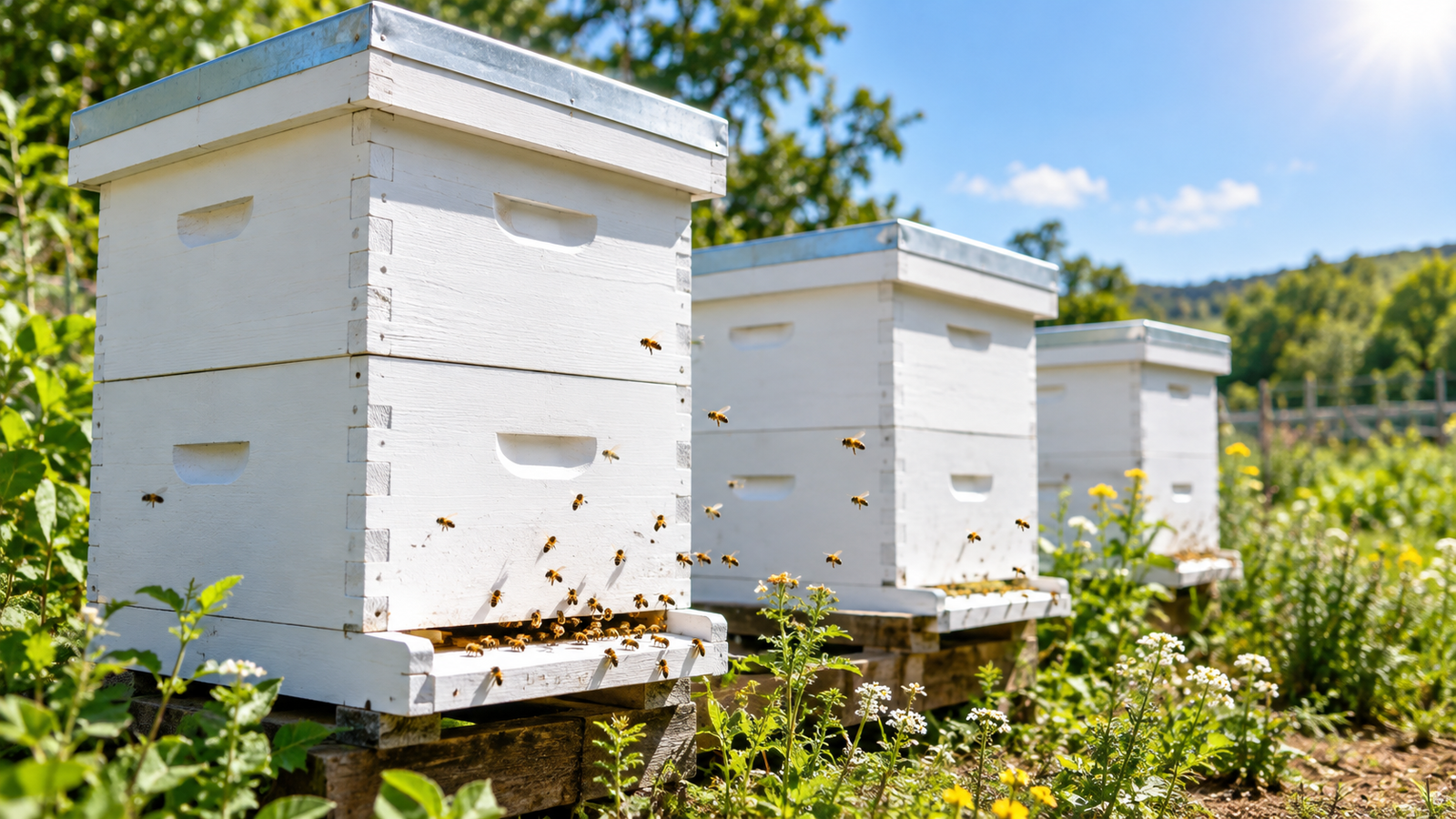
Bee boxes, commonly called beehives, are often painted white because white surfaces reflect more sunlight than dark surfaces. This helps reduce the amount of solar heat absorbed by the hive, which is particularly useful in hot climates where wooden beehives are exposed to intense sunlight.
However, temperature control is not the only reason beekeepers choose white. Painting a beehive also protects its wooden exterior from rain and weather damage, while different colours can help honey bees distinguish neighbouring colonies.
The practice is especially common among beekeepers who use wooden Langstroth hives. Although white is a traditional choice, other light colours, including pale blue, yellow, and green, can also be suitable.
Understanding why bee boxes are white requires looking at how sunlight affects hive temperature, how honey bees regulate their colonies, and how beekeepers choose suitable colours for different environments.
1. White Bee Boxes Reflect Sunlight and Reduce Heat Absorption
The main reason bee boxes are white is their ability to reflect sunlight.
When sunlight reaches a beehive, some of its energy is reflected while the rest is absorbed by the hive’s exterior. The absorbed energy warms the wooden walls and roof, and some of this heat can move into the hive.
White paint generally reflects more visible sunlight than black, dark brown, and other dark colours. Consequently, a white hive exposed to the same sunlight will generally absorb less solar energy than an otherwise similar dark-coloured hive.
Consider two wooden Langstroth hives standing in an open apiary:
- White hive: Reflects more incoming sunlight and generally develops a lower exterior surface temperature.
- Black hive: Absorbs more incoming sunlight and generally develops a higher exterior surface temperature.
The difference becomes particularly relevant during hot afternoons when sunlight is strong.
However, the colour of the exterior does not determine the exact temperature inside the hive. Insulation, wall thickness, ventilation, roof construction, colony strength, and surrounding weather also influence internal conditions.
A white box is therefore a way of reducing external heat gain, not a substitute for proper hive design.
2. White Beehives Help Honey Bees Maintain Their Brood Temperature
Honey bees are social insects that work together to regulate their colony’s internal environment.
One of their most important responsibilities is maintaining a stable temperature around developing brood. Eggs, larvae, and pupae are sensitive to temperature changes, so worker bees must prevent the brood area from becoming excessively hot or cold.
The brood nest of a honey bee colony is generally maintained around 34–35°C (93–95°F), although the exact temperature varies with conditions and the brood’s developmental stage.
When the weather becomes hot, worker bees use several cooling mechanisms.
How honey bees cool an overheated hive
Fanning: Worker bees beat their wings to move air through the hive. Some position themselves near the entrance, while others fan inside the colony.
Water evaporation: Water collectors bring water into the hive. Other workers distribute droplets around the nest and fan their wings, increasing evaporation and helping remove heat.
Bearding: During hot weather, bees may gather outside the entrance or on the hive’s exterior. This can reduce crowding inside the colony.
Colony ventilation: Worker bees coordinate airflow to help regulate the temperature and humidity inside their nest.
A white hive can make this task easier by reducing the amount of solar heat absorbed by its exterior.
This is particularly useful for colonies in exposed apiaries where direct sunlight reaches the hive throughout much of the day.
Scientific research published in the Journal of Economic Entomology explains that honey bee colonies maintain brood temperatures within a narrow range of approximately 34.5–35.5°C through coordinated behavioural responses.
Therefore, the benefit of white paint is not that it controls brood temperature directly. Instead, it can reduce one of the external heat sources that the colony must manage.
3. White Paint Can Reduce Heat Stress in Hot Climates
The advantages of white beehives are especially relevant in warm environments.
In tropical and subtropical regions, wooden hives may experience prolonged exposure to high temperatures and strong sunlight. Dark-coloured surfaces absorb more solar radiation, potentially increasing the heat transferred through the hive walls and roof.
This makes light-coloured hives a practical choice for beekeepers operating in hot environments.
For example, consider a beekeeper managing ten wooden hives in Ghana.
If all ten boxes are positioned in an exposed field, their surfaces may receive several hours of direct sunlight. Choosing white or another light-coloured exterior finish can help reduce solar heat absorption.
However, painting the boxes white should not be the only heat-management measure.
The beekeeper should also:
- Position hives where they receive suitable afternoon shade when necessary.
- Maintain adequate ventilation without exposing colonies to excessive drafts.
- Provide a reliable water source.
- Avoid unnecessary disturbance during extremely hot periods.
- Monitor colony strength and signs of overheating.
A useful distinction is that a strong colony may regulate its brood temperature successfully even when the outside temperature is high. A weaker colony may have fewer workers available for ventilation and cooling.
For this reason, hive colour should be considered alongside colony strength and apiary management.
4. White Beehives Are Common Because They Protect Wooden Hive Equipment
Another important reason beekeepers paint their boxes white is to protect the wood.
Traditional Langstroth beehives are commonly made from timber such as pine and other suitable woods. Although wood is relatively easy to work with and provides a practical nesting structure, it can deteriorate when continuously exposed to rain, sunlight, and moisture.
Unprotected wooden hive components may experience:
- Water penetration.
- Rot and fungal deterioration.
- Cracking and splitting.
- Surface damage.
- Reduced equipment lifespan.
Exterior paint provides a protective coating that helps shield the wood from weather exposure.
White is a convenient choice because it combines this protective function with relatively low solar heat absorption.
However, the protective benefit comes from using appropriate exterior paint, not from white pigment alone.
The University of Florida IFAS Extension recommends protecting exterior hive components with suitable outdoor paint. It also advises against very dark colours because they absorb more heat.
Beekeepers should avoid painting the interior walls and frames because the inside of a hive has different moisture and biological conditions from its exterior.
5. Different Beehive Colours Can Help Honey Bees Recognise Their Colonies
White is not the only colour used in beekeeping. Some beekeepers paint neighbouring hives different colours to provide visual landmarks.
Honey bees use their vision to navigate between their colonies and foraging locations.
They can learn visual features around their hive entrances, helping them identify where to return after collecting nectar, pollen, and water.
When several colonies are arranged close together, returning worker bees may occasionally enter the wrong hive. This is called bee drifting.
Drifting can be influenced by several factors, including hive arrangement, entrance orientation, colony condition, and visual landmarks.
One way beekeepers can reduce confusion is by giving neighbouring hives distinctive appearances.
For example, an apiary might have:
- One white hive.
- One pale blue hive.
- One yellow hive.
- One light green hive.
Distinctive entrance markings, patterns, and positioning can also help.
A 2009 study published by Cambridge University Press, titled Further Experiments on the Drifting of Honey-Bees, found that worker bees learned visual features associated with hive entrances, including the colour near the entrance.
This supports the practical use of visual differences in apiary arrangements.
Importantly, the goal is not to make every hive a different colour. It is to provide recognisable landmarks that help bees return to the correct colony.
6. Are All Beehives Supposed to Be White?
No. White is traditional, but there is no universal requirement that every beehive must be painted white.
Beekeepers select colours according to their climate, hive materials, apiary layout, and management preferences.
Here is a comparison of commonly used beehive colours.
| Hive colour | Main advantage | Possible limitation |
|---|---|---|
| White | Reflects substantial sunlight and helps reduce heat absorption | Dirt and stains may be more noticeable |
| Pale blue | Provides a light exterior and visual distinction | Still requires weather protection |
| Yellow | Creates a distinctive visual landmark | Brightness alone does not guarantee cooler temperatures |
| Light green | Offers another light-coloured option | Performance depends on the actual shade and finish |
| Dark green | Can blend into a green landscape | Absorbs more solar energy than pale colours |
| Black | Can be useful in some cooler or shaded settings | Generally absorbs more solar heat in direct sunlight |
For hot environments, white and other light shades are generally sensible choices.
However, there are exceptions. A hive in a shaded woodland location may not experience the same solar heating as a hive standing in an exposed field.
Likewise, hive construction and ventilation may have a greater influence on internal temperature than a small difference between two light paint colours.
7. Why Are Some Beehives Painted Blue, Yellow, or Green Instead of White?
Different hive colours serve both practical and environmental purposes.
Some beekeepers prefer multiple colours because they help distinguish colonies. Others select colours that complement the surrounding environment or are readily available from local suppliers.
Honey bees also have a different visual system from humans.
Research into honey bee colour vision shows that honey bees have photoreceptors sensitive to ultraviolet, blue, and green wavelengths. This means they do not perceive every colour in exactly the same way humans do.
A colour that looks particularly bright to a person may not look identical to a honey bee.
This is one reason it is useful to distinguish between human colour preferences and the visual information bees actually use.
A beekeeper can use different light colours, contrasting entrance patterns, or simple geometric markings to make neighbouring hive entrances easier to distinguish.
Nevertheless, colour alone cannot prevent all drifting.
Hive spacing, entrance orientation, surrounding landmarks, and colony management remain important.
8. What Colour Should You Paint a Beehive in a Hot Country Like Ghana?
For beekeepers in Ghana and other warm regions, white or another light-coloured exterior finish is generally a practical choice.
The country experiences substantial sunshine, and some apiaries are located in open areas where hive surfaces receive direct sunlight.
A suitable hive-colour strategy should consider the following:
White: A good general option for exposed wooden hives because it reflects sunlight effectively.
Pale blue: A useful alternative when a beekeeper wants to distinguish neighbouring colonies without choosing a very dark colour.
Light yellow: Another option for creating visual differences between neighbouring hives.
Light green: Suitable where a beekeeper prefers a natural-looking appearance while avoiding very dark finishes.
In Ghana, hive placement is equally important.
A beekeeper should consider afternoon shade, airflow, drainage, water availability, and the direction of the hive entrance.
For example, two white Langstroth hives positioned under suitable partial shade may experience less solar heating than two white hives standing in an exposed field.
This demonstrates why paint colour should never be treated as the only factor controlling hive temperature.
9. What Type of Paint Should You Use on White Bee Boxes?
The correct paint protects the hive without introducing unnecessary chemicals into the colony.
For wooden beehives, choose suitable exterior paint intended for outdoor wooden surfaces.
Low-VOC exterior latex paint is one option recommended in beekeeping extension guidance.
Follow these precautions:
- Paint the exterior surfaces of the hive.
- Avoid painting the interior walls, frames, and other surfaces occupied by bees.
- Do not use unsuitable chemical wood preservatives on interior hive surfaces.
- Allow the paint to dry and cure completely before introducing bees.
- Follow the manufacturer’s instructions for preparation and curing.
- Inspect the hive regularly for peeling paint and weather damage.
Oklahoma State University Extension recommends painting exterior hive components with low-VOC outdoor paint and completing the work at least two to three weeks before introducing bees.
The University of Florida IFAS Extension also recommends maintaining exterior paint protection while leaving interior hive surfaces unpainted.
The inside of a hive is naturally coated by bees with propolis, a resinous material collected from plants. Leaving the interior untreated avoids unnecessary coatings and allows bees to maintain their own internal surfaces.
10. Does Painting a Beehive White Increase Honey Production?
Painting a beehive white does not automatically increase honey production.
Its potential benefit is indirect: reducing excessive solar heat absorption may help the colony manage its internal environment.
When honey bees experience hot conditions, workers may spend more time ventilating the hive, collecting water, and cooling the brood area.
However, honey production depends on many other factors, including:
- Colony population and health.
- Queen quality and egg-laying performance.
- Availability of flowering plants.
- Nectar production and seasonal weather.
- Pests and diseases.
- Available honey-storage space.
- Beekeeping management.
A study published in Acta Biológica Colombiana in 2024 investigated different hive colour combinations and recorded differences in internal hive temperatures. The completely white group had the lowest reported average temperature among the three experimental groups.
The study supports the idea that hive colour can influence internal thermal conditions. However, its temperature measurements should not be confused with brood-nest temperature, and the findings do not establish that white paint alone increases honey production in every apiary.
The practical conclusion is that white paint may support heat management, but it is not a guaranteed honey-production improvement.
11. Why Are Some Beehives Left Unpainted?
Not every beekeeper paints their wooden hives.
Some use naturally durable timber, while others choose alternative protective treatments or hive materials.
Unpainted wooden hives can function perfectly well, but their durability depends on the type of wood, moisture exposure, construction, and maintenance.
In wet or humid environments, unprotected wood may deteriorate more quickly.
Other beekeepers use plastic hive components or wax-based protective treatments instead of conventional exterior paint.
The important consideration is protecting the hive from weather while ensuring that materials used around the bees are appropriate.
A beekeeper should never assume that an unpainted hive is automatically healthier for bees or that a painted hive is automatically harmful. The material and treatment used matter more than the simple presence of paint.
Frequently Asked Questions About White Bee Boxes
Why are most bee boxes painted white?
Most bee boxes are painted white because white reflects more sunlight than dark colours, helping reduce solar heat absorption. White exterior paint also protects wooden hive components when an appropriate outdoor coating is used.
Do white beehives keep bees cooler?
White beehives can reduce the amount of solar heat absorbed by the hive exterior. However, internal temperatures also depend on ventilation, insulation, colony strength, water availability, and weather conditions.
Can I paint my beehive black?
Yes, but black is generally less suitable for beehives exposed to intense sunlight in hot climates because it absorbs more solar energy than white. If using dark paint, consider the hive’s location and exposure to sunlight.
Can I paint my beehive blue or yellow?
Yes. Blue and yellow are suitable exterior colour options. Light shades are generally preferable in hot environments, and different colours can help distinguish neighbouring colonies.
Do honey bees prefer white beehives?
No. Honey bees do not specifically prefer white boxes. They select nesting sites based on suitable cavity conditions and other environmental factors. White is primarily a practical choice for beekeepers.
Do bees recognise the colour of their hive?
Honey bees can learn visual features around their hive entrances. Different colours and patterns can provide landmarks that help them return to their colonies.
Should I paint the inside of a beehive?
No. The interior of a wooden beehive should generally remain unpainted. Bees naturally coat internal surfaces with propolis, and leaving these surfaces untreated avoids introducing unnecessary paint or chemical residues.
How often should I repaint my beehive?
It depends on the paint, wood type, and weather exposure. The University of Florida IFAS Extension suggests inspecting and maintaining exterior paint, with repainting approximately every three to five years when necessary.
Are white beehives better in tropical countries?
White or other light-coloured beehives are generally sensible in tropical environments because they reflect more sunlight than dark colours. Proper hive placement, shade, ventilation, and water availability are also important.
Can an unpainted beehive survive outside?
Yes, but unprotected wood may deteriorate faster when exposed to rain and moisture. Suitable exterior protection can extend the useful life of wooden hive equipment.
Conclusion: Why Are Bee Boxes White?
Bee boxes are white mainly because white paint reflects sunlight and reduces the amount of solar heat absorbed by the hive. This is particularly useful in hot environments where wooden beehives are exposed to strong sunlight.
White paint also protects wooden hive components from weather damage and gives apiaries a clean, uniform appearance. Different light colours can also help honey bees distinguish neighbouring colonies.
However, white is not compulsory. Beekeepers can use other suitable light colours depending on their local climate, hive construction, and apiary arrangement.
For anyone establishing an apiary in a warm country such as Ghana, white is a sensible starting choice for exposed wooden hives. Combine it with appropriate shade, ventilation, water availability, and regular hive maintenance.
Ultimately, bee boxes are white because it is a practical way to reduce solar heat absorption while protecting the hive’s wooden structure. The colour supports good beekeeping, but the health of the colony still depends on proper management.
References
- University of Florida IFAS Extension. Preserving Woodenware in Beekeeping Operations.
- Oklahoma State University Extension. Beginning Honey Beekeeping Equipment and Associated Costs.
- University of Delaware, Mid-Atlantic Apiculture Research and Extension Consortium. Beekeeping Equipment.
- Honey Bee Research Centre, University of Guelph. Painting Hive Equipment.
- Thermal Impacts of Apicultural Practice and Products on the Honey Bee Colony. Journal of Economic Entomology, 2021.
- How Honeybees Respond to Heat Stress from the Individual to Colony Level. Scientific review, 2023.
- Erkan, C. and Öztürk, Y. (2024). Potential Effect of Hive Color on Honey Bee Colony Performance. Acta Biológica Colombiana.
- Free, J. B. and Spencer-Booth, Y. (2009). Further Experiments on the Drifting of Honey-Bees. The Journal of Agricultural Science.
- Hempel de Ibarra, N., Vorobyev, M. and Menzel, R. (2014). Mechanisms, Functions and Ecology of Colour Vision in the Honeybee. Journal of Comparative Physiology A.
